Chan Tien Pagoda was built during the Tran Dynasty (13th century). The pagoda has been renovated and restored three times, most recently in 2005. Currently, the pagoda has two shrines: one dedicated to the Buddha and the other to the Holy Mother.
The Buddhist temple covers an area of 50.2 square meters and is built in the four-pillar style, consisting of three bays with yin-yang tiled roofs, four built pillars, and walls surrounding it on three sides.
The temple dedicated to the Holy Mother, also known as the "Holy Mother's Hall," consists of the Upper Hall, the Middle Hall (Dragon Pavilion), and the Prayer Hall, with a total area of 56 square meters. Above the Upper Hall are four Chinese characters: "Thiên hạ mẫu nghi" (The Virtuous Mother of the World) and an image of a phoenix soaring with outstretched wings. A crescent moon is depicted at the apex of the roof. The four corners of the roof are adorned with dragons and floral motifs. Inside the Hall, on the rear roof, are three Chinese characters: "Thượng Thánh cung" (The Palace of the Holy Emperor). The Middle Hall is where offerings are placed and incense is burned by visitors. Eight dragon figures adorn the four eaves of the hall's roof. Inside the hall are eight cranes. On either side of the corridor are two tiger-shaped statues dedicated to the Holy Mother's attendants. In front of the Prayer Hall are three Chinese characters: "Tạ Phúc đường" (House of Blessings), and the four pillars each bear couplets praising the Holy Mother's virtues. The Chan Tien Pagoda currently houses 14 Buddha statues made of jackfruit wood, an altar, an incense burner, an incense table, drums, wooden clappers, etc.
The origins of this temple are associated with mystical legends. Legend says that long ago, a group of celestial fairies, after seeking permission from the Nine Heavens Mother to visit the mortal world, chose Tien An Peak as their resting place. Tien An, nestled against the mountain and facing the sea, was blessed with the gentle rustling of pine trees day and night, and boasted a crystal-clear stream of jade flowing year-round – a truly unparalleled beauty. Some fairies, after admiring the mountains, rivers, and caves, went down to the lake in front of the mountain to bathe, then sat on a rock beside the lake to play chess. Others, captivated by the fragrant flowers, exotic plants, and clear stream, refused to leave. One fairy, engrossed in chasing a six-winged golden butterfly, accidentally stepped on a porcupine quill, injuring her foot. Unable to walk, she had to use her horse to return to heaven. Before she left, the other fairies washed her feet with the water from the jade stream, and her delicate heel left its mark on the rock alongside the hoofprints of the divine horse. The local people then built a temple and named it Chan Tien Temple to commemorate this story.
According to legend, in ancient times, a fairy, forced by her father to marry, left her fairyland. She took a plum tree as a staff. She walked and walked until she reached Tien An Mountain, where she stopped and buried the plum tree in the ground. It then grew into a lush, green plum grove. This grove remains green year-round, regardless of the hot summer or the cold winter. Another story, passed down through generations, tells of a giant named Ong Dung (a giant with extraordinary strength and the ability to move mountains). One day, he moved all the mountains in the Lam and La river deltas to form the Hong Linh mountain range. The mountains were named after the shapes of animals, such as Ngu Ma (five horses), Su Tu (lion), Ham Rong (dragon's jaw)... Once, while carrying two mountains, Ong Dung's carrying pole broke, causing him to fall. The two mountains that fell were named Tien An Mountain and Ru Bong (also known as Bang Son in Thach Bang commune, Loc Ha district today). The carrying pole that Ông Đùng used to carry those two mountains formed a strip of golden sand that connected and served as the boundary between Lộc Hà and Can Lộc districts. Legend says that King An Dương Vương, during the time of his kingdom, once set foot in this place. Not only is it said to be the place where "fairies descended to earth," but many other fascinating folk tales also surround this mountain.



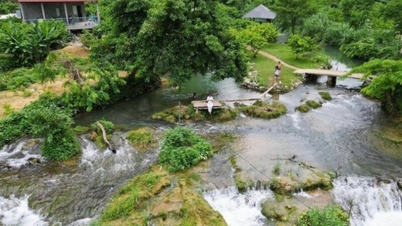
Surrounding the pagoda is a vast, lush natural pine forest that remains green all year round. Tien An Mountain also boasts many beautiful caves, such as Truc Cave, Mai Cave, Thach That Cave, Da Nguoi Cave… and many ancient rock formations such as Ban Co Cave, Gia Gao Rock, Coi Xay Rock, Muoi Hai Cua Rock… and especially the towering Husband and Wife Rocks standing side-by-side for millennia at the foot of the mountain, facing the East Sea. At the foot of the mountain in front of the pagoda are Bau Tien and Ban Co Tien, along with historical relics such as: the footprints of Ông Bành Tổ, the footprints of the Fairy Maiden, horse hooves, Ngoc Stream, Tien Well, and Kim Quy Rock…
The historical and cultural site of Chan Tien Pagoda is also a key location for the revolutionary movement, serving as a contact point for Party organizations during the 1930-1931 period. At this location, on April 25, 1930, the Yen Diem Party Branch, the predecessor of the Thinh Loc Commune Party Committee today, was established.
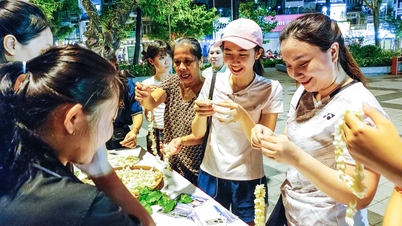
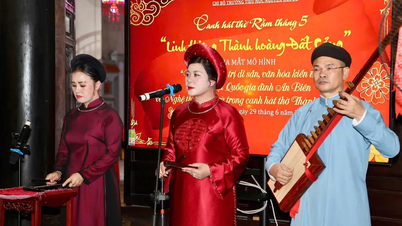
The Chan Tien Pagoda Festival is held annually on the 3rd day of the 3rd lunar month. The festival lasts two days, following the incense offering ceremony, followed by festivities including cultural performances, boat races on Bau Tien Lake, traditional wrestling, beach volleyball, tug-of-war, card games, kite flying, camping, and more.
Besides visiting the temple, tourists can also participate in cultural and artistic activities, admire the picturesque landscape from the mountaintop, explore historical sites associated with fascinating stories, swim at Thinh Loc beach, and enjoy the unique dishes of the local people.
Instructions:
* From Ha Tinh city, follow provincial road 9 for about 25km to reach Chan Tien Pagoda.



* Nearby attractions : The ancestral temple of King Mai Thúc Loan is 10km southeast of Chân Tiên Pagoda, and Lộc Hà beach is 1km east of it.
Article author: Tran Duc Cuong. Photo: Archival material.
Source: https://dulichhatinh.com.vn/tai-nguyen-du-lich/di-tich-danh-thang/chua-chan-tien-9/




![[Photo] Strengthening character and expertise: Intense training for artillery soldiers.](https://vphoto.vietnam.vn/thumb/1200x675/vietnam/resource/IMAGE/2026/06/30/1782815602541_lu-368-1875-4571-jpg.webp)