

Consequently, the VN-Index recorded its third consecutive week of decline, officially losing the psychological threshold of 1,800 points.
Increased uncertainty

Continuing the correction trend from the end of January, the VN-Index opened the trading week of February 2-6 with a sharp decline of over 22 points. Although there was a slight recovery in the following session, the market quickly reversed direction and experienced strong fluctuations for three consecutive sessions, causing the index to "evaporate" a total of 58 points in just the latter half of the week.
At the end of the trading week (February 2-6), the VN-Index fell 73.55 points, equivalent to 4.02% compared to the previous week, closing at 1,755.49 points. This marks the third consecutive week of sharp declines, establishing a clear correction trend after surpassing the 1,900-point mark on January 22. Market liquidity increased slightly, reaching nearly 160,000 billion VND, up 8.8% compared to the previous week; the average trading volume was approximately 900 million shares per session, up 7.6%.
The downward pressure last week was mainly concentrated on blue-chip stocks. Vingroup stocks, including VIC, VHM, and VPL, were among the stocks with the most negative impact, dragging the VN-Index down by nearly 23 points. In between were two large bank stocks, VCB and BID, which deducted 9.1 and 3.5 points from the index, respectively.
Foreign investor activity continues to be a major negative factor for the market. Over the past week, foreign investors sold net in all five trading sessions, totaling over VND 6,300 billion across both exchanges. Specifically, HoSE saw net selling of over VND 6,400 billion, while HNX saw net buying of VND 116 billion. Since the beginning of the year, foreign investors have sold net nearly VND 13,000 billion.
According to Vietnam Construction Securities Joint Stock Company (CSI), selling pressure is engulfing the market amidst increasing caution in trading sessions leading up to Tet (Lunar New Year). Last weekend, the VN-Index recorded its third consecutive day of decline with increased liquidity, indicating that selling pressure shows no sign of stopping. On the weekly chart, the index experienced its third consecutive week of significant decline (4.02%), breaking deeply through the psychological 1,800-point mark, reflecting the negative sentiment among investors.
CSI believes that the VN-Index is highly likely to soon test the 1,740-point support level, and may even break through it and head towards lower levels. In this context, buying positions are riskier than offering opportunities; investors should prioritize risk management, avoid bottom-fishing or averaging down, and consider selling to reduce their holdings when the market rebounds.
From a cautious perspective, Saigon - Hanoi Securities Joint Stock Company (SHS) assesses that the VN-Index is under pressure to correct towards the 1,700 - 1,730 point range, corresponding to the average price range of 100 - 120 sessions, which is also an important support zone connecting the lows of November and December 2025. In the context of increasing uncertainties such as the risk of asset bubbles (cryptocurrency, precious metals, AI), declining credit growth, rising deposit and lending interest rates, volatile interbank interest rates, and instability in the global financial market, SHS believes that the top priority remains short-term risk management, portfolio reassessment, and reducing speculative weighting.
However, after three weeks of sharp correction, some experts expect a technical rebound to soon appear in the market, as the index is entering oversold territory. Valuation factors are also gradually becoming more attractive. According to VNDirect Securities Joint Stock Company (VNDirect), the P/E ratio (price-to-earnings ratio) of the VN-Index has fallen to 14.69 times, the lowest level in nearly two months.
Meanwhile, according to data from FiinGroup, the total after-tax profit of listed companies in Q4/2025 increased by 31.3%, and for the whole year 2025 increased by 29.7%, indicating that the profit base remains positive and may open up opportunities for medium- to long-term investment as short-term risks are gradually absorbed.
Amidst pressure for correction in the domestic market, developments in international financial markets have also become a factor closely monitored by investors.
Wall Street surged, while Asian stocks weakened at the end of the week.

US stocks surged on February 6th as technology stocks recovered after days of sell-offs, helping the Dow Jones index surpass the 50,000-point mark for the first time.
At the close of trading, the Dow Jones rose 1,206.95 points to 50,115.67; the S&P 500 gained 1.97% to 6,932.30; and the Nasdaq Composite rose 2.18% to 23,031.21. This move brought the S&P 500 back into bullish territory for 2026. However, for the week as a whole, the S&P 500 was down 0.1% and the Nasdaq down 1.8%, while the Dow Jones gained 2.5%, reflecting a shift in capital towards cyclical stocks.
Several technology stocks saw notable recoveries, with Nvidia rising nearly 8%, Broadcom up 7%, and Oracle and Palantir Technologies both gaining around 4% as investors took advantage of lower prices. At the same time, Bitcoin surged about 10%, at one point touching $71,458/BTC after having previously fallen below $61,000/BTC.
In Asia, stock markets were generally in the red on the afternoon of February 6th, influenced by the global market downturn and cautious sentiment regarding the profit outlook for the artificial intelligence sector.
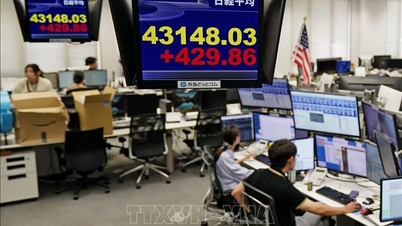
At the close of trading, the Hang Seng (Hong Kong, China) fell 1.2% to 26,559.95 points; the Shanghai Composite (Shanghai, China) dropped 0.3% to 4,065.58 points. Markets in Seoul, Sydney, and Singapore all declined, while Jakarta fell sharply after Moody's downgraded Indonesia's credit outlook to negative. The Nikkei 225 (Japan), however, rose 0.8% to 54,253.68 points.
Concerns are growing as major tech corporations like Amazon and Alphabet announce plans to spend around $385 billion on AI, while the prospect of recouping that investment remains unclear. According to Charu Chanana of Saxo Markets, the rapid development of AI models could force the market to reassess the long-term valuation prospects of the software industry, particularly in the services sector.
Source: https://baotintuc.vn/thi-truong-tien-te/chung-khoan-lao-doctuan-dau-thang-2-20260207155842997.htm


![[Image] National Assembly discusses the implementation of the socio-economic development plan.](https://vphoto.vietnam.vn/thumb/1200x675/vietnam/resource/IMAGE/2026/04/20/1776696707422_ndo_br_img-20260420-185419-jpg.webp)

![[Photo] General Secretary and President To Lam meets with National Assembly delegates from ethnic minorities.](https://vphoto.vietnam.vn/thumb/1200x675/vietnam/resource/IMAGE/2026/04/20/1776696701056_a1-bnd-8331-3342-jpg.webp)





























































































Comment (0)