

TP - Lieutenant Colonel Ngo Thi Ngoc Diep, now 88 years old, looks graceful thanks to the performing arts spirit flowing in her veins. After much persuasion from the reporter, her hands still moved softly as she performed a segment of the traditional Dien Bien Phu dance from the Dien Bien Phu campaign. Both she and her husband were performing artists at the Dien Bien Phu campaign, and they have walked hand in hand through decades of marriage "without ever arguing."
The Fire-Lighting Xoe Dance: Although she is 88 years old, Lieutenant Colonel Ngo Thi Ngoc Diep (born in 1936, an actress in the performing arts troupe of the 308th Division of the Vanguard Army during the Dien Bien Phu campaign) is still full of energy and youthful for her age. Lieutenant Colonel Diep recounts that she joined the army at the age of 15 and participated in two major campaigns: Hoa Binh and Tran Dinh (part of the Dien Bien Phu campaign). In December 1953, at the age of 17, she followed the soldiers to participate in the campaign. In the morning, the entire unit received their assignments, and by the afternoon, the whole group was ready with their equipment for the march.
She recounted that the campaigns at that time were highly secretive; even if your name was on the list, you couldn't know where you were going or what the campaign was called. "When we heard about the campaign, we just knew we had to go. I was young then, and all I knew was I was ready to go with the youthful enthusiasm of a 17-year-old," Lieutenant Colonel Diep confided. Even now, she's surprised at how she overcame those difficulties. Her shoulders were heavily laden with military equipment, and the weather was harsh. At 17, the performing arts troupe member only carried simple personal belongings: a backpack, a bag of rice weighing about 3-4 kg, a shovel/hoe, and a bamboo water pipe. It sounds simple and light, but for a girl born and raised in the capital, carrying all that on a march was no joke. “During marches, no matter how tired we were, we couldn't complain, because it easily dampened the team's spirits. My spirits were unusually high at that time, perhaps because deep down I was always thinking about the moment of victory and hoping that wherever our troops went, they would win,” Ms. Diep recalled. The long journey through the treacherous mountains and forests meant that the members of the group couldn't avoid getting fevers; she herself suffered from quite severe malaria. Short breaks were for the performing arts troupe to perform. At that time, they could only perform on small, dimly lit areas. Before setting off, Diep and many other female performers learned to dance, including the Xoe Hoa dance of the Thai people, and were eager to perform it. However, to perform successfully, they needed hand bells. “At that time, props were very scarce, so we came up with the idea of using lighter lids as bells. After the performance, the soldiers would tease us, saying we were dancing the Xoe Hoa dance with lighters instead of the Xoe Hoa dance,” Lieutenant Colonel Ngo Thi Ngoc Diep laughed.
The most memorable experience was the theatrical performance about a village oppressed by the French and the unwavering fighting spirit of the soldiers. In the play, Ms. Diep played the daughter-in-law in a family where the mother encouraged her son to join the army, hoping to avenge his family and village. “In the play, there was a song: ‘Go, brother, kill all the enemy and avenge us, go, kill the enemy and avenge us…’ Many soldiers, after hearing my song, stood up and shouted, ‘Brothers and sisters, our compatriots are suffering so much, let us kill all the enemy so that our compatriots can be happy!’” Ms. Diep recounted. When asked about the heroic deeds during the time of “digging tunnels in the mountains, sleeping in bunkers, enduring torrential rain, and eating dried rice rations,” she only smiled gently. The cultural performance was just a small part compared to the other great and magnificent aspects of the campaign. That being said, her eyes always shone with pride. Those months of campaigning, the songs and dances that encouraged and inspired the soldiers to fight, were the most beautiful and precious years. The Love Story of the Dien Bien Phu Performing Arts Troupe : As the general counter-offensive approached, along with the 316th and 312th Divisions, Ms. Diep's 308th Performing Arts Troupe was mobilized to build roads for tanks advancing into Dien Bien Phu. Ms. Diep vividly remembers the moment she received news of the victory. “It was so joyful, overwhelming. At that moment, we threw our carrying poles into the stream. Without a word, everyone in the troupe ran forward. It turned out that the vehicle was carrying General De Castries, who had been captured alive from his command bunker,” Ms. Diep excitedly recalled. Peace was restored, and Lieutenant Colonel Diep returned to the capital. This was also when she and her husband, Mr. Nguyen Khac Tue, got married. “I met my lover, who is now my husband, after the Dien Bien Phu campaign. I was in the 308th Division, and he was in the 312th Division. At that time, he was in the dance troupe and a newly promoted combat soldier. Later, he joined the General Political Department and was in the same troupe as me. We danced the bamboo pole dance together… and talked to each other, and we fell in love without even realizing it,” Mrs. Diep recounted.
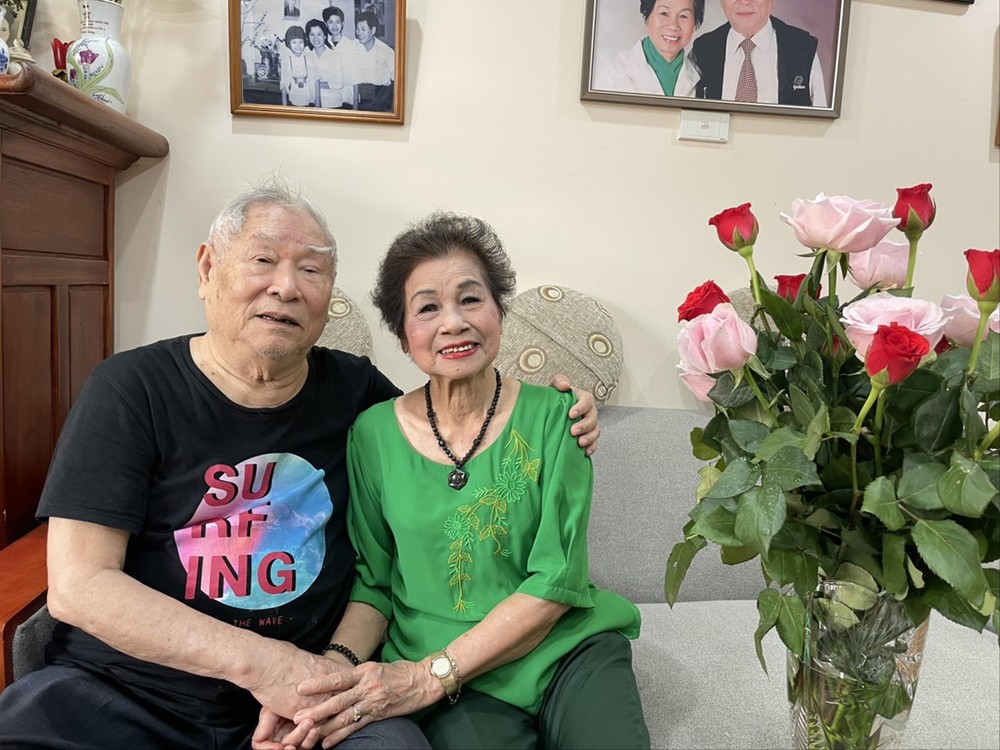 |
| Despite being nearly 90 years old, Mrs. Ngo Thi Ngoc Diep and her husband do not hesitate to show each other love and affection. |
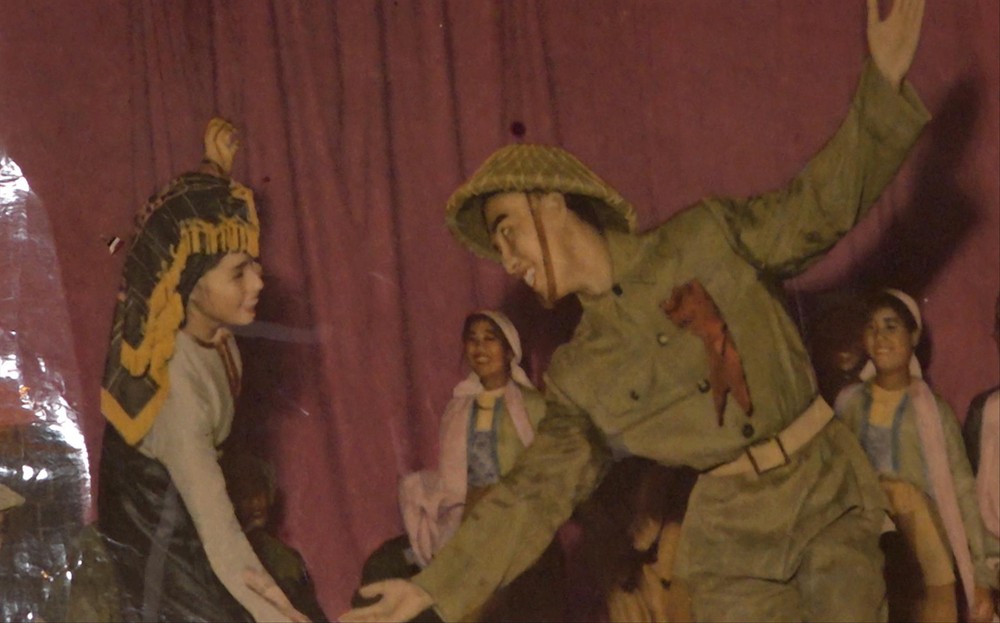 |
| Ms. Ngo Thi Ngoc Diep on stage during her younger years. |
Mr. Nguyen Khac Tue, originally from Kien An (Hai Phong), initially felt inferior because his wife's family had many revolutionary achievements and were intellectuals in Hanoi, while he was just a farmer. Since his parents were no longer alive, Mr. Tue considered his wife's family as his own, and his father-in-law taught him like a son. His wife's tolerance, patience, and perseverance impressed him, and his love for her grew stronger. After many years together, Mr. Tue affirms that they never argued.
The love story of the performing arts troupe also has many interesting details. Ms. Diep revealed that, at that time, performing arts troupes had regulations regarding the age of dating and marriage. Since they were underage, they often had to keep it a secret, not daring to talk directly much, only writing letters to each other. “We had to hide behind a mosquito net to read the letters to avoid being discovered. We were in love from the end of 1954 to 1958, keeping it a secret. When we returned to Hanoi , on Sundays we went out together as a group, but then we would separate and go our separate ways. There were many other couples in the troupe who were in secret like us,” Lieutenant Colonel Diep confided. It wasn't until much later, when their superior discovered and approved, that they publicly cared for each other. Shortly after their marriage, Mr. Tue was continuously assigned to overseas duties for nearly four years. The burden of caring for and raising the children fell entirely on Ms. Diep's shoulders. She single-handedly became both father and mother to the two children. “When my husband became a Youth Union leader, there were many girls around him, but he remained steadfastly loyal, deeply loving his wife and children. He valued me because, despite being away from home for so many years, I single-handedly raised our children to adulthood,” Mrs. Diep confided. Young people admire the fulfilling life of Mr. Tue and Mrs. Diep in their 80s. When they are healthy, they often go swimming and dancing together…to make up for the years they had to live apart. During the march, while embroidering the "Determined to Fight, Determined to Win" flag, Mrs. Diep and Meritorious Artist Phung De were unexpectedly assigned the task of embroidering the flag, given only a piece of red cloth. This task was assigned to many units along the march, as there were no flags readily available from the rear to the front lines. To create the star, they had to dye their bandages yellow using antimalarial drugs. “We ground the drugs and dyed them on the march. The bandages were dried on our backpacks. The star and letters were cut out letter by letter and sewn onto the red cloth. The tassels of the flag were made from the inner cord of the French army's parachute cord. After finishing, we sent it to the assault team – the force that would enter the enemy outpost first. If victorious, the soldiers would plant this flag to signal the news. When the soldiers received the flag, they were very happy and gave us a notebook and asked us to copy the song so they could sing it together when they had free time,” Mrs. Diep said.
Tienphong.vn
Source: https://tienphong.vn/chuyen-cua-cap-doi-van-cong-dien-bien-post1631462.tpo
![[Photo] Enchanted by the deciduous forest during the leaf-changing season.](/_next/image?url=https%3A%2F%2Fvphoto.vietnam.vn%2Fthumb%2F1200x675%2Fvietnam%2Fresource%2FIMAGE%2F2026%2F02%2F04%2F1770196861704_2066642_8ffd5f25c3c9433be0e644abe71613ae.jpeg&w=3840&q=75)


![[Photo] General Secretary To Lam attends the inauguration ceremony of Si Pa Phin multi-level boarding school.](/_next/image?url=https%3A%2F%2Fvphoto.vietnam.vn%2Fthumb%2F402x226%2Fvietnam%2Fresource%2FIMAGE%2F2026%2F01%2F31%2F1769840655651_ndo_br_z7486540481209-f37c7e00a962aec2a061c64b7db569ef-jpg.webp&w=3840&q=75)


![[Photo] Heartwarming "Journey Home for Tet" in the Year of the Horse at the People's Police Academy](/_next/image?url=https%3A%2F%2Fvphoto.vietnam.vn%2Fthumb%2F1200x675%2Fvietnam%2Fresource%2FIMAGE%2F2026%2F02%2F04%2F1770198043990_hv-cong-an-13-1206-jpg.webp&w=3840&q=75)


![[Photo] Prime Minister Pham Minh Chinh presides over the regular Government meeting in January 2026.](/_next/image?url=https%3A%2F%2Fvphoto.vietnam.vn%2Fthumb%2F402x226%2Fvietnam%2Fresource%2FIMAGE%2F2026%2F02%2F04%2F1770209446450_hopcp-jpg.webp&w=3840&q=75)



Comment (0)