

At Hong Cum, Regiment 57 reinforced the siege, attacked and destroyed many enemy forces. At dawn on May 2, 1954, the enemy had to withdraw from area C. At 4:00 a.m. on May 2, 1954, Regiment 209 (Division 312) captured strongholds 505 and 505A (Dominique 3) on the east bank of the Nam Rom River.
On the night of May 2, 1954, the 36th Regiment completely destroyed the 311B stronghold (Huguette 4). During the day, our units eliminated 2 enemy battalions from combat, shot down 1 Morane-type observation aircraft and 1 Corsair aircraft.
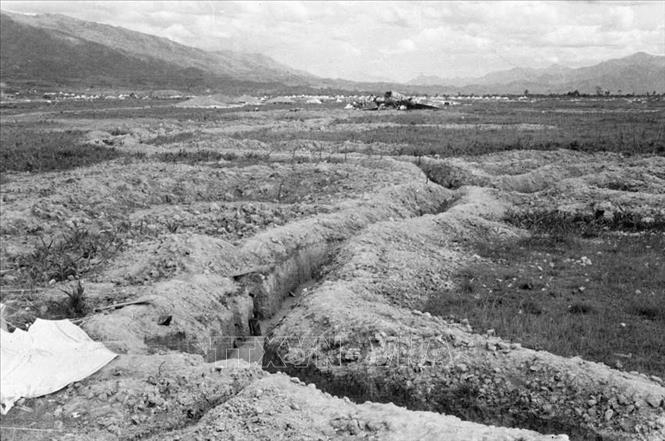
After our victories, the Eliane Resistance Center, which was blocking the east of the stronghold, had only two positions left: A1 (Eliane 2) and C2 (Eliane 4). On the west side of Muong Thanh field, troops opened trenches straight towards De Castries' Command Post, in some places only 300m from the stronghold's Command Post.
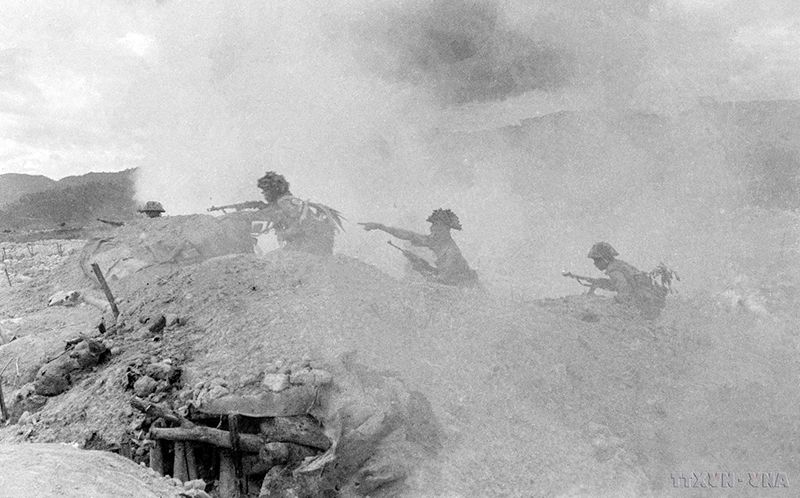
Our assault units are attacking the enemy on hill A1. (Photo: VNA)
On the enemy side: While French units were besieged in the Dien Bien Phu basin, on May 2, 1954, the US government was forced to accept the Soviet government's firm stance that the Democratic Republic of Vietnam was a party to the Geneva Conference. With the active support of the Soviet Union, Vietnam participated in a major international conference for the first time, although it had not yet been diplomatically recognized by Britain, France, and the United States .
Facing the imminent threat of annihilation at Dien Bien Phu, on May 2, 1954, Navarre hastily flew from Saigon to Hanoi to convene a meeting to discuss how to salvage the situation. Attending the meeting were General Connaught, Colonel Krevco – Commander of the Laotian forces, and officers from the North Vietnamese army. Everyone unanimously agreed that "Dien Bien Phu cannot be held any longer." General Navarre also reported this to the French and received the reply: "Under no circumstances should we surrender ! "
Faced with this situation, Navarre advocated: Continuing the fight to prolong the existence of Dien Bien Phu. If there was a shortage of troops, reinforcements would be sent. If there was a shortage of weapons, ammunition, and food, supplies would be provided. When the conditions for fighting were no longer viable, they would withdraw to Laos; he decided to form "paratrooper volunteer" teams, meaning that even those who didn't know how to parachute would climb onto planes, put on their parachutes, and jump down. According to French records, in the final stages of the Battle of Dien Bien Phu, 1,800 "paratrooper volunteers," including soldiers who were inexperienced, had not graduated, or had not even learned parachute jumping, were dropped into the Dien Bien Phu valley.
Under Navarre's direct supervision, on the day and night of May 2, 1954, 120 tons of supplies were dropped on Dien Bien Phu, of which 50% were lost, contributing to increasing food reserves from three to five days, along with five bases of 105mm artillery shells, three bases of 155mm artillery shells, and three bases of 102mm mortar shells.
Logistics were reorganized flexibly to ensure the success of the third offensive and to effectively utilize resources. In the book " Logistics for the Dien Bien Phu Campaign, " published by the General Department of Logistics in 1979, it is written: After the second offensive, the General Department and the units learned from experience and clearly saw the important role of the proximity of the rear area to the front lines, which greatly affected all aspects of logistical support. Therefore, adjustments were made . Moving the unit's logistics lines closer to the front lines was also a very difficult ideological struggle. Afterward, the units' rear areas moved closer to the front lines. At that time, we had tightly encircled them, preventing the enemy from penetrating, so we adopted the strategy of "maximizing the effectiveness of mechanized transport at the front lines," taking advantage of the use of trucks to reduce the need for human transport on the battlefield. To avoid congestion in the trenches, reduce casualties and reduce traffic obstruction, we proposed the motto "reduce the number of people, increase productivity", leaving only healthy and productive people on the battlefield.
Author: Major, Master Tran Quoc Dung , Institute of Military History , Ngoc Toan Thu Photo: VNA Presented by: VU ANH TUAN
Nhandan.vn
Source: https://special.nhandan.vn/ngay251954quantakhepchatvongvay/index.html?_gl=1*1dvr14p*_ ga*MTk3MTc4ODk3My4xNzAzMzM4NjUx*_ga_2KXX3JWTKT*MTcxNDYwNDIxOS42NS4wLjE3MTQ2MDQyMTkuNjAuMC4w


![[Photo] Explore the US Navy's USS Robert Smalls warship](/_next/image?url=https%3A%2F%2Fvphoto.vietnam.vn%2Fthumb%2F1200x675%2Fvietnam%2Fresource%2FIMAGE%2F2025%2F12%2F10%2F1765341533272_11212121-8303-jpg.webp&w=3840&q=75)












![[Photo] Explore the US Navy's USS Robert Smalls warship](https://vphoto.vietnam.vn/thumb/402x226/vietnam/resource/IMAGE/2025/12/10/1765341533272_11212121-8303-jpg.webp)





















































Comment (0)