

VHO - In the current period, digital transformation for the preservation of historical sites and heritage is extremely necessary. This is the bridge that brings historical sites and heritage closer to the community, contributing positively to the process of preserving and promoting cultural values, turning cultural heritage into a tourism product, developing socio -economic aspects, and contributing to promoting the image of Vietnam to the world.
Thanh Hoa is renowned as the "cradle of heritage" of the country, home to the Ho Dynasty Citadel, a World Cultural Heritage site with many outstanding global values in history, culture, and architecture. To bring the image of Thanh Hoa's land and people closer to domestic and international tourists, the "digitization of historical sites" in the province has been increasingly effectively implemented in recent years.
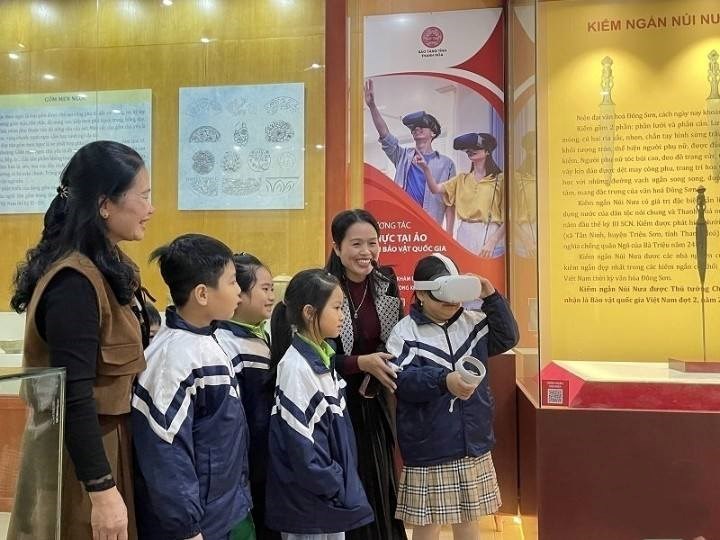
Thanh Hoa is also one of the localities that implemented digital transformation early in the country, promoting the application of digitalization in the development of smart tourism .
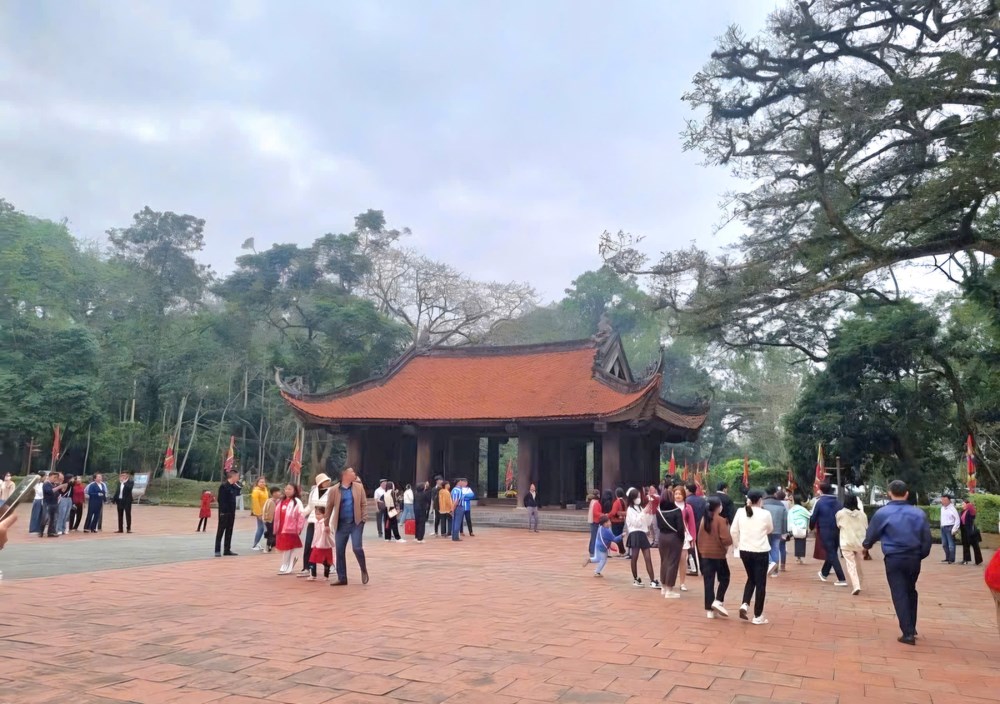
In particular, at the Provincial Museum and several historical sites in Thanh Hoa province such as: Lam Kinh Historical Site (Tho Xuan), Ho Dynasty Citadel Cultural Heritage Site (Vinh Loc), Nua Temple - Am Tien Historical Site (Trieu Son), Ngoc Trao Guerrilla War Zone (Thach Thanh), Le Huu Lap Memorial Area (Hau Loc)... locals and tourists only need a smartphone with internet access to visit and learn about these destinations.
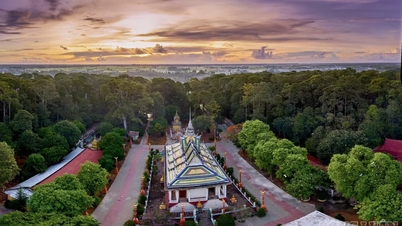
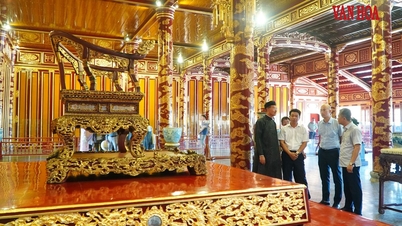
Visiting the Lam Kinh Historical Site (Tho Xuan), tourists not only get direct introductions from tour guides and access to a system of 28 automated audio guides, but also many other interesting experiences. With just a mobile phone connected to the internet, useful and important information, including audio and video files about the site, is quickly transmitted to visitors via QR code scanning. This is one of the useful applications that helps tourists easily learn about and fully appreciate the values of the destination.
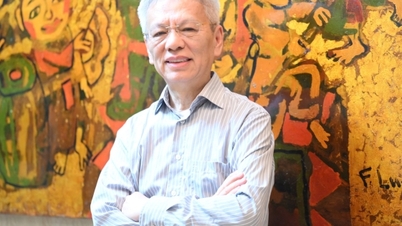
According to Nguyen Xuan Toan, Head of the Lam Kinh Historical Relic Management Board, the unit is currently preserving and storing more than 22,000 artifacts, including many valuable items such as bowls and plates decorated with embossed and painted dragons from the Le Dynasty; architectural decorative materials; and some artifacts from the foundations of architectural structures that have been excavated and unearthed from the ground at the Lam Kinh Relic and Thang Long Imperial Citadel. These artifacts are vivid evidence of the Lam Son Uprising and the Le Dynasty, contributing to a clearer understanding of the cultural and historical values associated with the Lam Kinh historical relic.
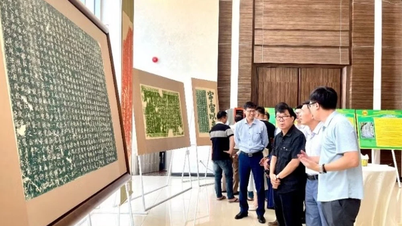
The five national treasures include the Vinh Lang stele (stele of King Le Thai To), the Khon Nguyen Chi Duc stele (stele of Empress Ngo Thi Ngoc Dao), the Chieu Lang stele (stele of King Le Thanh Tong), the Du Lang stele (stele of King Le Hien Tong), and the Kinh Lang stele (stele of King Le Du Tong). Each of these treasures is not only a valuable work of art; it can also be likened to a "slice" of history reflected through the life and career of the person inscribed on the stele.
“In implementing the heritage digitization program, the Management Board has recently coordinated with relevant units to apply information technology in the preservation and promotion of historical sites. This has helped to make the preservation of artifacts more scientific and systematic, while also making it easier for tourists to access, visualize, and understand the unique values of the heritage. It spreads the image of the Lam Kinh historical site with its distinctive cultural and historical values closer to tourists, and contributes to raising awareness and responsibility of the community in jointly protecting the site,” Mr. Toán added.
The Thanh Hoa Provincial Museum currently displays over 30,000 artifacts chronologically. With innovative display methods and the application of digital transformation, the museum has become a unique cultural space in recent years, attracting a large number of people and tourists, contributing to revitalizing this "special" destination.
Currently, a notable application of digital technology at the Thanh Hoa Provincial Museum is the use of 3D virtual tours on its website and QR code scanning, allowing visitors to conveniently and comprehensively explore documents and artifacts.
Notably, in 2022, the Thanh Hoa Provincial Museum completed the digitization of three national treasures: the Nua Mountain short sword, the Cam Giang I bronze drum, and the Cam Thuy bronze cauldron, allowing visitors to access these treasures in a multi-dimensional space and experience surreal sensations.
Director of Thanh Hoa Provincial Museum, Trinh Dinh Duong, shared: “The application of digital technology not only helps bring artifacts and documents closer to the public, but also makes management and preservation more professional and accurate. In particular, the application of virtual reality technology has helped visitors access national treasures in a vivid way, allowing them to see every detail and pattern on the artifacts instead of just looking at them and listening to explanations as before.”
According to the "Project for Innovation in the Operation of Thanh Hoa Provincial Museums until 2030," in the period 2023-2025, the Provincial Museum will digitize 10-15% of its existing artifacts and documents. In the following five years, the digitization of artifacts and documents will reach 20-30% of the total number of artifacts...
Simultaneously, Industry 4.0 technology is applied to the four permanent exhibition rooms, following a historical timeline, utilizing an intelligent automated audio guide system.
The aim is to introduce and promote the value of typical and unique artifact collections about the land, history, culture, and people of Thanh Hoa province to a wider audience, making the Provincial Museum an attractive destination.
It can be affirmed that digital transformation is truly a "boost" that contributes to changing people's approach to historical and cultural heritage in a more positive, modern, vibrant, proactive, and personalized way.
However, to achieve the "sweet fruits" of digital transformation in heritage management, the Department of Culture, Sports and Tourism of Thanh Hoa province has had to overcome many difficulties. Despite the attention and support from leaders at all levels, the journey of digitizing heritage is far from simple.
Accordingly, to gradually remove these barriers, the Department of Culture, Sports and Tourism of Thanh Hoa province is continuing to focus on implementing a strong digital transformation, aiming towards digital museums, digital libraries, digital tour guides, and digital transformation in cultural heritage management. Each official in the department acts as an "ambassador," an active communicator spreading advanced values, striving to bring cultural heritage closer to the people and, conversely, bringing the people closer to heritage.
Source: https://baovanhoa.vn/van-hoa/chuyen-doi-so-de-bao-ton-va-phat-huy-gia-tri-di-san-111479.html
![[Image] Shipbuilders exposed to steel and record-breaking heat.](https://vphoto.vietnam.vn/thumb/1200x675/vietnam/resource/IMAGE/2026/06/04/1780545781745_ndo_br_img-5402-4683-jpg.webp)



































![[Video] Sunset at Lap An Lagoon – Where the sun sets over the fishing nets](https://vphoto.vietnam.vn/thumb/1200x675/vietnam/resource/IMAGE/2026/05/31/1780192137701_beach-landscape-sea-water-nature-grass-745871-pxhere-com.jpeg)

















![[INFOGRAPHICS] Sustainable Business Support Program (2026 – 2030)](https://vphoto.vietnam.vn/thumb/402x226/vietnam/resource/IMAGE/2026/06/04/1780552996067_1780552915.webp)












Comment (0)