


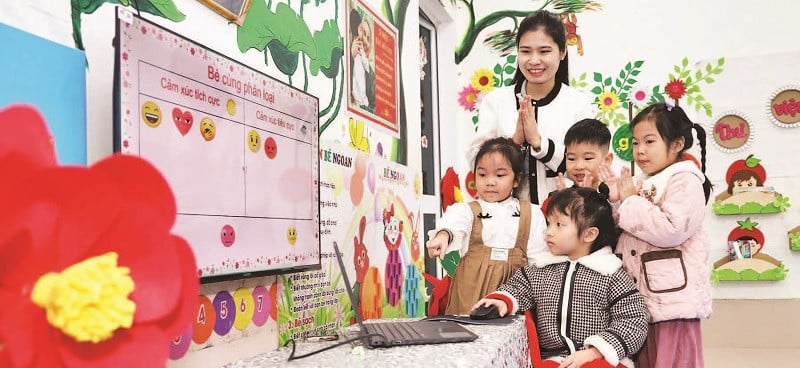
In addition, the sector is focusing on reviewing, reducing, and simplifying administrative procedures and promoting the application of digital platforms in management, teaching, and learning.
Innovating teaching methods through technology.
Le Van Tam Primary School in Minh Xuan Ward currently has over 900 students across all grades, with 28 spacious classrooms fully equipped with teaching and learning materials; the school has a computer room with 25 computers; 100% of televisions and projector screens are connected to the internet.
The school has intensified training for staff and teachers to improve their ability to apply information technology in teaching, management, and administration. Digital transformation in management has helped minimize some administrative tasks, facilitate inspection work, and synchronize data on teachers and students.
Principal Nguyen Viet Hai stated: “100% of the school's teachers actively implement digital transformation, applying information technology in lesson planning and developing electronic lesson plans. Thanks to the use of audio, visuals, and games instead of traditional teaching methods, the quality of student learning has improved, creating a lively learning atmosphere.”
In management, the school effectively utilizes software such as VNEDU, industry databases, MISA , and IOFFICE to store and process information scientifically. Simultaneously, the Board of Directors also uses electronic handbooks, online timetables, and Zalo groups to connect with parents.
Digital transformation has contributed to improving the quality of lectures and increasing the number of teachers and students winning awards in competitions. Furthermore, the school aims to build a comprehensive digital education environment, collaborating with the province in promoting digital transformation and educational modernization.”
Implementing the digital transformation plan, Hoa Phuong Kindergarten in An Tuong ward has innovated its teaching methods. Teachers regularly use software to design, edit, and create illustrative videos , making lessons more lively and effective.
Currently, 100% of the kindergarten classrooms and the school's 7 computers have been installed with Kidsmart software to support the intellectual development of preschool children. Thanks to this, children learn math, letters, English, drawing, develop their musical listening skills, learn storytelling through various cute characters, and directly interact with computers, gaining access to technology.
Activity time with Kidsmart is always exciting and encourages children to participate actively. According to Ms. Nguyen Thi Kieu Thuy, the school principal, promoting digital transformation has improved the quality of teaching, management, and interaction between the school and parents and students, contributing to building a "Connected School".
In addition to Kidsmart software, teachers also design their own games using Canva to make lessons more engaging. The school has also built a digital learning resource library for each age group and uses AI to create videos and e-lessons, supporting teachers in updating data more easily.
In the future, the school will continue to strengthen the application of technology and train teachers to use the Babylala software to teach English, meeting the requirements of innovation and maintaining national standards.
Promoting school modernization
Recently, Le Quy Don Secondary School in Minh Xuan Ward was equipped with an internationally standardized STEM education practice room. This is the first STEM room installed in the province, equipped with modern technology such as AI, IoT, and Robotics to serve hands-on activities and scientific and technological research according to international standards.
The core objective is to build a STEM ecosystem, promote career guidance and entrepreneurship oriented towards Industry 4.0, and strengthen international connections. Vice Principal Dang Thi Bich Ngoc stated: In the STEM lab, students have access to modern technologies, and can design, assemble, and control robots using software.
The students also used artificial intelligence to develop ideas on computers, then created products using 3D printers and laser cutters, such as hearts, school logos, and animal models.
3D products help students visualize things more easily than two-dimensional images, thereby developing creative thinking and practical skills. In Tuyen Quang province, over 95% of primary schools and 100% of secondary and high schools are equipped with computer rooms; 222 out of 695 general education schools have online learning rooms; and 100% of educational institutions use school management software that is synchronously connected to the database of the Ministry of Education and Training.
The database of schools, teachers, and students has been 100% digitized; the issuance of digital signatures for primary school teachers to implement digital report cards has reached over 90%, and the issuance of digital signatures for secondary and high school teachers has reached over 70%. The provincial education sector has implemented online registration for admission to grade 10 of high school, high school graduation exams, and college and university admissions through the public service portal and in person at schools. 100% of administrative procedures are provided online through the National Public Service Portal; over 90% of procedures are processed online.
The majority of teachers are proficient in using platforms such as Zoom, Google Meet, Microsoft Teams, and other digital platforms in teaching. According to the Director of the Department of Education and Training, Vu Dinh Hung, the Department will continue to restructure the system, improve governance efficiency, and maintain its central role in developing high-quality human resources. In the coming period, they will review and propose the abolition of administrative procedures, strengthen mechanisms for data lookup and verification to eliminate the requirement for submitting paper copies; complete and apply electronic student records (digital report cards); promote comprehensive digital transformation, applying digital technology and artificial intelligence in management and teaching; and promote STEM education and scientific research activities in educational institutions.
In addition, the education sector will improve the quality of foreign language teaching, implement a roadmap to make English a second language; standardize the sector's database, prepare the infrastructure for online classroom observation and professional development; establish professional clusters to strengthen support among schools; and improve the effectiveness of the Provincial Professional Advisory Board.
The Department also hopes that all levels and sectors will continue to create favorable conditions for investing in subject-specific classrooms, online learning, computer labs, and a number of software and digital teaching platforms to meet the requirements of educational reform.
Source: https://nhandan.vn/chuyen-doi-so-dong-luc-doi-moi-giao-duc-post928339.html











































































Comment (0)