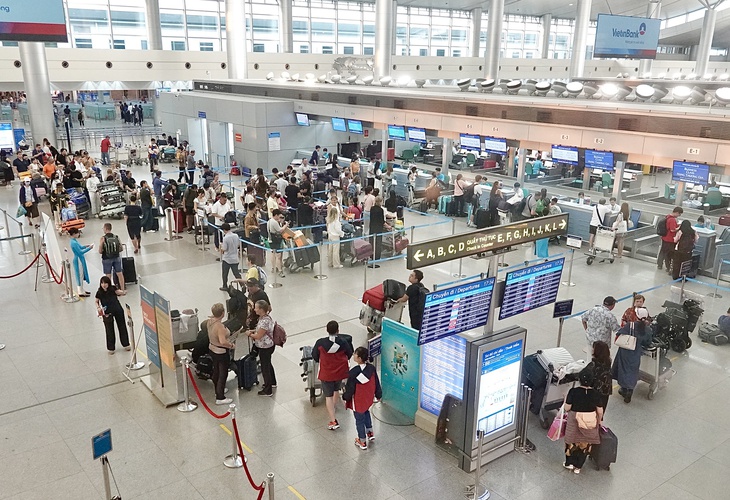
Passengers go through immigration procedures at Terminal 2, Tan Son Nhat Airport on the afternoon of March 3 - Photo: TTD
Mr. and Mrs. Tran Khang, currently living in Canada, returned to Ho Chi Minh City with their two young children in mid-February to visit family after the Lunar New Year. According to their schedule, the whole family will return to Canada in about a week, transiting through Dubai.
However, to date, his family has not received any clear notification from Emirates regarding the flight status. "There's still about a week until the scheduled flight, but we're still anxious. Our two children are young, so we just hope the airline will confirm soon so the family can make plans accordingly," Mr. Khang shared.
One announcement at a time, then we waited and worried.
This worry is not unique. Behind the dry updates from airlines or regulatory agencies are countless disrupted family, work, study abroad, medical, and business travel plans. Some people are stranded mid-journey, some are afraid to go to the airport, and others have to consider changing tickets, rescheduling flights, or finding alternative routes at significantly increased costs.
For many Vietnamese passengers, Doha, Dubai, and Abu Dhabi have long been familiar transit hubs on their journeys to Europe, North America, or Africa. One passenger on the Hanoi -Doha-Paris route said he left Hanoi more than two days ago, but as of the morning of March 3rd, he still hadn't arrived in France as planned for his work trip.
When the plane was just over an hour's flight from Doha, the crew unexpectedly announced they had to divert and land in Muscat (Oman) due to flight restrictions in Doha. "All the passengers waited on the plane for over seven hours. It was then that everyone took the opportunity to go online to read the news and learned that the airspace in the area was being tightened due to escalating conflict," the person recounted.
The Middle East - a bottleneck for global aviation.
According to updates from the Vietnam Civil Aviation Authority as of the morning of March 3rd, many airspaces in the Middle East remain completely closed or subject to strict restrictions. In the aviation industry, even a single bottleneck in the Middle East can create a widespread ripple effect.
Dubai, Doha, and Abu Dhabi are not only major regional airports but also leading global transit hubs, connecting Southeast Asia and South Asia with Europe, North America, and Africa. When these three links are disrupted simultaneously, numerous airlines are forced to cancel flights, delay departures, reroute routes, or reduce frequencies, leading to significant increases in fuel, crew, and ground service costs.
In Vietnam, according to data from the Vietnam Civil Aviation Authority, from February 28 to March 2, Qatar Airways canceled numerous flights between Vietnam and Doha, affecting approximately 2,557 passengers. Emirates suspended flights to and from Dubai until 6 PM on March 2, affecting approximately 1,881 passengers, including 1,117 in Ho Chi Minh City, 725 in Hanoi, and 39 in Da Nang . Etihad Airways also temporarily suspended flights to and from Abu Dhabi until 5 AM on March 2.
When transit routes through the Middle East become congested, pressure immediately shifts to alternative options such as direct flights by Vietnam Airlines to Frankfurt, Munich, and Paris; connecting flights via Istanbul; or diversions via Taipei, Seoul, Hong Kong, or even major cities in China.
As a result, seats quickly became scarce, ticket prices tended to rise, and flight schedules became increasingly unpredictable. On March 3, Vietnam Airlines announced that all flights between Vietnam and Europe were being rerouted to avoid conflict zones, extending travel time by 60-90 minutes.
In response to the disruptions, many airlines have opened support counters at airports and implemented policies offering free ticket changes, refunds, or rescheduling. However, given the unstable aviation security situation, all these support measures are only temporary solutions. The decisive factor remains the unfolding conflict and the ability of regional authorities to reopen the airspace.
CONG TRUNG
Source: https://tuoitre.vn/nhieu-khach-viet-thap-thom-cho-bay-20260304080846155.htm













































































Comment (0)