Digital transformation in the capital city is not only concentrated in agencies and units, but is gradually spreading from the grassroots level, where the government, organizations, and citizens all participate in the process of forming new ways of working and living.
Customer satisfaction is the benchmark.
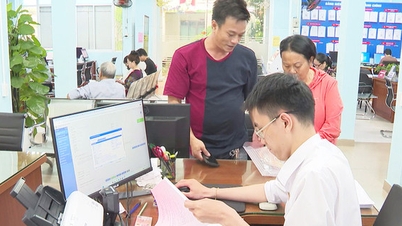
Early in the morning at the Thanh Tri Commune Public Service Support Point, the atmosphere was bustling but orderly. Citizens coming to handle administrative procedures were guided step-by-step by officials, from obtaining a queue number and filling out online forms to making cashless payments. Gone are the days of long waits and multiple trips; technology is gradually becoming an "extended arm" helping the government serve the people more quickly and conveniently.
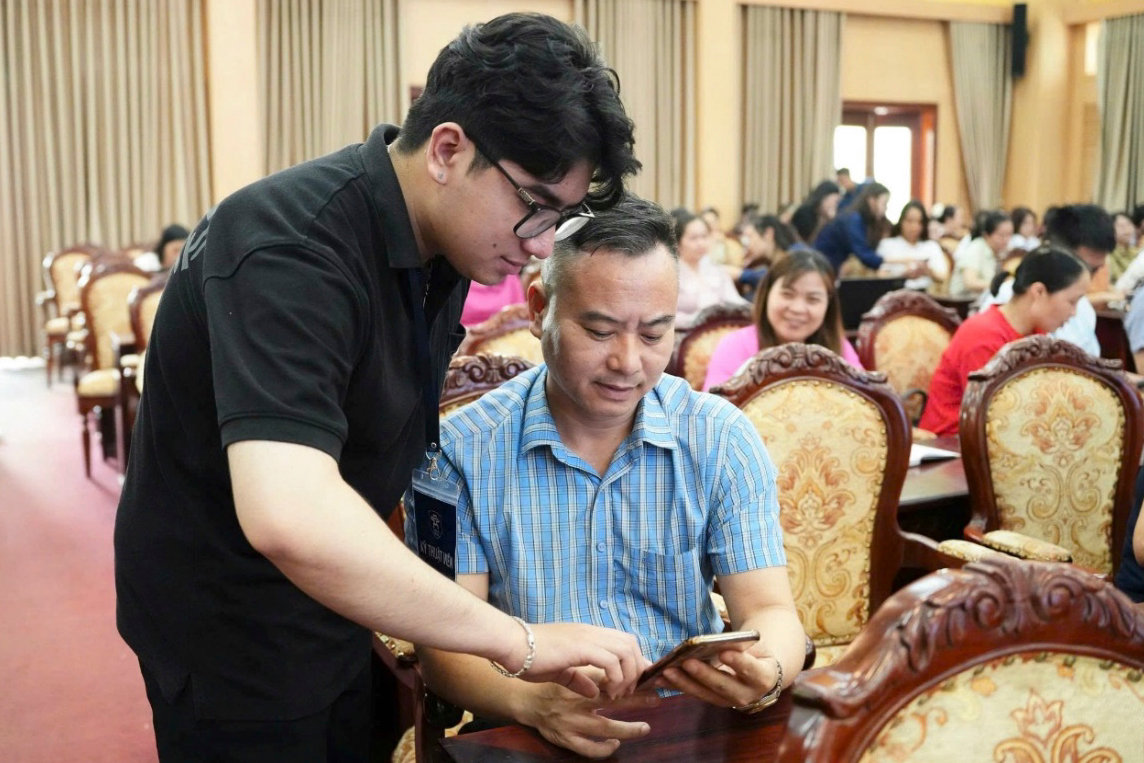
Ms. Nguyen Thi Hoa (Co Dien A village, Thanh Tri commune) shared that what she noticed most during the current administrative procedures is the convenience and sense of responsibility of the staff. Previously, some procedures required citizens to spend a lot of time traveling and submitting documents multiple times, but now they receive clear guidance from the start, their applications are processed quickly, and they are resolved on time. Submitting applications online and paying via QR code also significantly saves people time and effort.
In Tung Thien ward, the implementation of Resolution No. 57-NQ/TW of the Politburo is closely linked to the task of socio-economic development, aiming to build a modern, transparent, and efficient administrative system.
For example, within the Party apparatus, 100% of Party branches maintain online collection and payment of Party membership fees; all electronic documents are issued entirely online; and the rate of using the electronic Party member handbook reaches 99.53%. These figures show that digital transformation is not only taking place in the administrative apparatus but is becoming a new way of working throughout the entire political system.
In the administrative sector, Tung Thien ward focuses on standardizing and effectively utilizing data to serve management and support the people. The locality has completed data standardization for 1,336 social welfare beneficiaries, 405 meritorious individuals, and 24 beneficiaries of policies under Resolution No. 13/2023/NQ-HĐND, achieving a 100% rate. In the field of education , digital transformation continues to create significant changes, with 100% of teachers proficiently using digital learning materials and electronic lectures; all electronic student records are fully updated…
The transformations, from individual public service support points and agencies to every organization and association, are revealing a new face of local government in the digital age: closer to the people, more transparent, and more effective in serving them.



Scaling up effectiveness
For digital transformation to be truly effective, the decisive factor lies not only in infrastructure or technology, but first and foremost in the capacity of the implementing team. Recognizing this, many localities have proactively equipped their officials and civil servants with digital knowledge and skills, gradually forming new working methods based on technology.

In Binh Minh commune, enhancing the digital capacity of its officials has been identified as one of its key priorities. The locality has organized training courses on the application of artificial intelligence (AI) in public service, helping officials access new tools to support their daily work.
According to Nguyen Dang Viet, Chairman of the People's Committee of Binh Minh commune, in the context of implementing the two-tiered local government model, the workload is increasing, and the demands for progress and quality in task resolution are becoming higher. Equipping officials and civil servants with AI application skills is therefore essential. Technology will not replace the role of officials, but it is becoming a powerful tool to help improve the efficiency of management and administration.
From seemingly simple but time-consuming tasks like drafting administrative documents, developing report outlines, proofreading, and standardizing content, to more complex tasks such as analyzing socio-economic data and synthesizing information for leadership and management, AI tools are opening up more flexible and scientific ways of working. In addition, the application of AI in designing promotional content and creating illustrative images also contributes to making information more vivid and accessible to the public.
In Hoai Duc commune, digital transformation is not only serving administrative purposes but is also becoming a driving force for the local economy. OCOP products, agricultural products, and distinctive goods from Hoai Duc are gradually appearing on e-commerce platforms, expanding their consumer market instead of relying solely on traditional sales channels. Many small businesses have begun using social media to promote their products, reach customers, and apply electronic contracts in transactions.
According to Ms. Dong Thi Nga, Vice Chairman of the People's Committee of Hoai Duc commune, in implementing Resolution No. 57-NQ/TW of the Politburo and the city's directives on the development of science, technology, innovation, and digital transformation, the locality has identified this as a continuous task requiring the participation of the entire political system and the people. The application of information technology and digital transformation is spreading across various fields, from state management to production, business, and social life.
Digital transformation is not limited to government agencies; it is gradually expanding to various aspects of social life, creating more development opportunities for citizens, businesses, and community groups.



In the field of supporting women's entrepreneurship, digital platforms are considered a crucial "facilitator," helping to bridge the gap between business ideas and the market. Hanoi aims to achieve, by 2035, 90-95% of women's association members and citizens receiving information and raising awareness about economic development and entrepreneurship; and 90-100% of full-time Women's Union officials at all levels receiving training and skill enhancement to effectively organize activities supporting women's business development, cooperatives, and collaborative groups.
A new approach today is that startup models are no longer developing in isolation but are connected in a digital environment. Through online platforms, women entrepreneurs can access experts, investors, consultants, learn about the market, update on consumer trends and green production standards, and improve their modern management skills. Technology thus becomes a bridge connecting small-scale business ideas to larger opportunities.
From Binh Minh to Hoai Duc, from civil servants to business owners, women's association members and individual citizens, digital transformation is demonstrating its strong ripple effect as it is implemented based on real-world needs. It's not just about bringing technology into the workplace, but about changing ways of thinking and doing things, creating a digital society that is close to the people, serves the people, and develops alongside the people.
Source: https://hanoimoi.vn/chuyen-doi-so-tu-nhung-viec-gan-dan-nhat-1210424.html