

Breakthroughs stemming from a new mindset.
Ms. Nguyen Thi Le, a small business owner at Vinh Hoa Market in Vinh Xuong commune, happily shared that since implementing digital transformation, buying and selling pork has become much more convenient. Both vendors and customers now pay cashless, eliminating worries about torn or counterfeit bills, and saving time on counting money. “Thanks to digital transformation, business is easier and faster. This is a huge change in my daily management and life that I am very pleased with.”

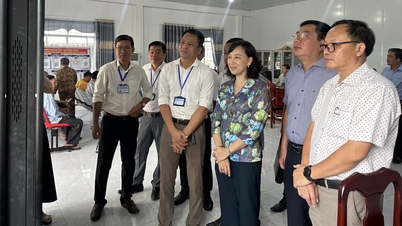
Police officers from Vinh Xuong commune inspect the security camera system in Vinh Thanh A hamlet. Photo: MINH HIEN
Ms. Ly Thi Hue, a long-time small business owner in Vinh Xuong, said: "This payment method helps attract customers, especially young people, contributing to making traditional markets more civilized and modern."
In Tan An commune, the percentage of households using online public services has reached over 80%, the cashless payment rate exceeds 80%, and many administrative procedures are processed entirely in the digital environment. Behind these figures is a whole process of bringing technology closer to the people, through community digital technology groups and the "digital literacy" model, helping people gradually become familiar with and proactively use technology.

According to Mr. La Hong Phong, Secretary of the Party Committee of Tan An commune, since the implementation of Resolution No. 57-NQ/TW of the Politburo on breakthroughs in the development of science, technology, innovation, and national digital transformation, we have identified this as an important foundation and an opportunity to make breakthroughs in local development and improve the lives of the people in the new era. Recognizing that the implementation of Resolution 57 is a profound and comprehensive transformation, the Party Committee of Tan An commune has begun to change its mindset and approach throughout the entire political system. From there, the locality has chosen a focused approach, closely adhering to practical realities for implementation.
Three major directions were established from the outset: digital transformation as the driving force, institutions playing a leading role; a people- and business-centric approach; and accountability of leaders for performance results. These directions went beyond mere policy principles and were concretized through programs and action plans, coupled with clear monitoring and evaluation mechanisms. Performance results became the measure of the leadership capacity of each official and each unit.
Spreading to the grassroots level
Digital transformation is not only spreading in the commercial sector but also strongly impacting agricultural production. Mr. Nguyen Van Hung, a member of the Tan Phu A1 Agricultural Cooperative in Tan An commune, stated: “Since Resolution 57 was issued, farmers in this area have boldly changed their mindset and practices, shifting from small-scale production to collaboration and finding markets for their products, thus making production more convenient.”
This change is not happening in isolation, but is linked to the leading role of cooperatives, which connect farmers with the market, with technology, and with new practices. Mr. Trinh Van Dut - Chairman of the Board of Directors and Director of Tan Phu A1 Agricultural Cooperative shared: “We have shifted from a mindset of agricultural production to an agricultural economy, promoting the application of digital technology in management and traceability, and will soon bring our products to e-commerce platforms, gradually participating more deeply in the value chain.”
The experience of Tan An commune shows that digital transformation is only effective when it is based on a synchronized foundation of institutions, people, and technology. If any of these three elements are missing, the implementation process will struggle to achieve the expected results. First and foremost is the role of the leader in concretizing policies into specific actions, with clear monitoring, evaluation, and accountability. Secondly, a people-centered approach is crucial, ensuring policies directly address real-world needs. Furthermore, leveraging local forces such as community digital technology groups, cooperatives, and digital learning models creates a widespread implementation network, ensuring uninterrupted digital transformation.

However, this process also presents numerous challenges, ranging from uneven levels of technological access to infrastructure and human resources. These are issues that need to be addressed to ensure sustainable development.
MINH HIEN
Source: https://baoangiang.com.vn/chuyen-doi-so-ve-vung-dau-nguon-a482512.html




























































![[Video] Sunset at Lap An Lagoon – Where the sun sets over the fishing nets](https://vphoto.vietnam.vn/thumb/1200x675/vietnam/resource/IMAGE/2026/05/31/1780192137701_beach-landscape-sea-water-nature-grass-745871-pxhere-com.jpeg)

































Comment (0)