

 |
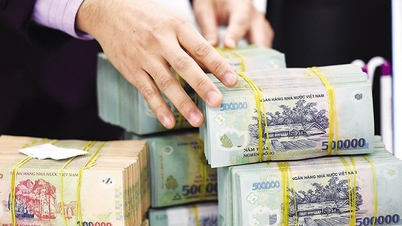
| People enthusiastically participated in purchasing National Government Bonds. Photo: Archival material. |
Issuing war bonds and promissory notes for the resistance war.
According to Decree No. 122/SL, dated July 16, 1946, issued by the President of the Democratic Republic of Vietnam, Southern Vietnam was the first region permitted to issue government bonds to mobilize the people's resources for the resistance war. In July 1946, a batch of government bonds worth 5 million dong was issued in Southern Vietnam, divided into 5 installments, with a maximum interest rate of 5% per year. This is considered an important first step in mobilizing financial resources through government bonds, serving both production and combat, and laying the foundation for the later issuance of resistance bonds.
In early 1948, building on the victory in the Viet Bac Autumn-Winter campaign of 1947, the Government continued to issue "resistance bonds" according to Decree No. 160/SL, dated April 3, 1948, with a total projected value of 500 million dong, an interest rate of 3% per year, and a repayment period of 5 years. These bonds consisted of four types: A (200 dong, bearer), B (1,000 dong, registered), C (5,000 dong, registered), and D (10,000 dong, registered).
The purpose of the resistance bonds was to mobilize idle money among the people to serve the war effort and production, and to serve as a reserve so that local administrative resistance committees could issue coercive orders when necessary. This allowed the bonds to circulate like banknotes and could be used for buying, selling, and settling debts on a voluntary basis and out of patriotism.
By the end of 1949, only about 40% of the total issued resistance bonds had been sold, due to several reasons, such as distribution not being tailored to regional realities, a lack of a plan to promote issuance, low interest rates (only 3% per year) while interest rates on bank deposits and loans among the people were higher, and the rapid devaluation of the currency, which made people hesitant to invest in them.
In 1950, learning from the experience with government bonds, the government issued government bonds denominated in rice worth 100,000 tons, with an interest rate of 3% per year and a term of 5 years. Stronger publicity and a more meticulous issuance plan helped the national bonds sell faster, but the results only reached about 30% of the projected target. Reasons such as socio -economic difficulties, limited financial literacy, the novelty of government bonds for the majority of the population, and the shorter issuance period limited the effectiveness of capital mobilization through government bonds.
 Vietnamese financial banknotes and promissory notes issued in the South Central and Southern regions truly became effective tools and means for successfully carrying out the struggle on the economic and financial front, protecting national independence, freedom, and sovereignty , and serving the resistance war against France.
By mid-1947, transportation between the regions was severely disrupted by the enemy, making travel difficult. This hampered the transport of financial banknotes printed in the North to the Central region for distribution, hindering budget spending and the smooth flow of goods. Furthermore, the enemy employed various schemes and tactics to sabotage the financial currency, aiming to weaken the economic and monetary system in the Central region.
In response to this situation, on July 18, 1947, President Ho Chi Minh issued Decree No. 231/SL authorizing the issuance of promissory notes in South Central Vietnam, with a total value not exceeding 100 million dong, divided into seven denominations: 1 dong, 5 dong, 10 dong, 20 dong, 50 dong, 100 dong, and 500 dong. The promissory note printing factory in Central Vietnam was initially located in Son Ha district (Quang Ngai province), and later moved to Nghia Lam (Tu Nghia district, Quang Ngai province).
The issuance of promissory notes in South Central Vietnam increased the financial resources of the Provincial Resistance Administrative Committees in the region to cover the needs of the resistance against French colonialism, while also helping to develop production, business, and the circulation of goods, and build a self-sufficient economy. Furthermore, the issuance of promissory notes also served to counter enemy sabotage of Vietnamese financial notes.
In Southern Vietnam, on November 1, 1947, the President of the Government of the Democratic Republic of Vietnam also issued Decree No. 102/SL authorizing the issuance of promissory notes of 1 dong, 5 dong, 10 dong, 20 dong, 50 dong, 100 dong, and 500 dong, with the same value as Vietnamese Financial Banknotes, with a total issuance value of 20 million dong.
Thus, Vietnamese financial notes and promissory notes issued in the South Central and Southern regions truly became effective tools and means to successfully carry out the struggle on the economic and financial front, protect national independence, freedom, and sovereignty, and serve effectively the resistance war against France.
 |
Establishment of the National Bank of Vietnam
To meet the demands of the economy serving the resistance war, the Government established three monetary zones and authorized the issuance of regional currencies. On February 3, 1947, the Production Credit Department (the first credit institution in our country) was established with the task of providing capital support to the people for production development, limiting usurious lending in rural areas, and supporting the policy of interest rate reduction and collective business.
Entering 1950, the Vietnamese people's resistance war against the French was progressing strongly, with resounding victories on all battlefields, and liberated areas were constantly expanding. The changing revolutionary landscape demanded that economic and financial work be strengthened and developed to meet new requirements.
Therefore, the Second National Party Congress (February 1951) put forward new policies and guidelines on economics and finance, which clearly stated: "Financial policy must be closely combined with economic policy; establish a National Bank, issue new currency to stabilize the currency, and improve the credit system."
In line with that policy, on May 6, 1951, at Bong Cave in Tan Trao commune (Son Duong district, Tuyen Quang province), President Ho Chi Minh signed Decree No. 25/SL establishing the National Bank of Vietnam to replace the National Treasury and the Production Credit Department, under the Ministry of Finance.
On the same day, the Government issued Decree No. 16/SL appointing Mr. Nguyen Luong Bang and Mr. Le Viet Luong as Director General and Deputy Director General of the National Bank of Vietnam. This was a historic turning point in the development of Vietnam's monetary and banking system. The organizational structure of the National Bank of Vietnam included the Central Bank, inter-regional banks, and provincial and city banks. The first headquarters of the National Bank was located in Dam Hong commune (Chiem Hoa district, Tuyen Quang province).
Accordingly, the State Bank of Vietnam is tasked with issuing banknotes and regulating monetary circulation; managing the national treasury, and also responsible for issuing government bonds; lending capital, contributing capital, and mobilizing capital from the people for production development; managing foreign currency and settling transactions with foreign countries; and managing precious metals, including gold, silver, precious stones, and bank notes used for asset valuation according to administrative regulations.
The State Bank of Vietnam operates in a dual role, serving as both a central bank and a commercial bank. During this period, the State Bank's activities played a crucial role in consolidating the country's independent and self-reliant monetary system, developing production and goods circulation, strengthening the state-owned economic sector, and supporting the resistance war against France.
On May 12, 1951, the Bank began issuing banknotes to replace the Financial notes, with an exchange rate of 1 bank note to 10 financial notes. The issuance of banknotes served to strengthen the monetary and financial system, aligning with the people's aspirations and the socio-economic situation at the time. Simultaneously, the Bank promoted the implementation of monetary circulation management and reformed credit operations.
The issuance of money was carried out in a planned and measured manner, primarily to serve production and circulation of goods, gradually limiting the issuance of money for financial expenditures. By the end of 1953, the proportion of money issued for state budget expenditures was only 10.8% of the total issued; conversely, the proportion issued for credit increased from 0.6% in 1951 to 30.6% in 1952 and reached 89.2% by the end of 1953.
Clearly, this is one of the positive measures to strengthen the value of the currency, stabilize prices, and balance the state budget.
Source: https://baodautu.vn/chuyen-huy-dong-von-thuo-so-khai-d347527.html


![[Photo] General Secretary and President To Lam meets with National Assembly delegates from ethnic minorities.](https://vphoto.vietnam.vn/thumb/1200x675/vietnam/resource/IMAGE/2026/04/20/1776696701056_a1-bnd-8331-3342-jpg.webp)

![[Image] National Assembly discusses the implementation of the socio-economic development plan.](https://vphoto.vietnam.vn/thumb/1200x675/vietnam/resource/IMAGE/2026/04/20/1776696707422_ndo_br_img-20260420-185419-jpg.webp)






























































































Comment (0)