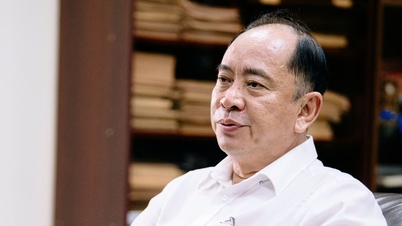
In Kim Bong village ( Hoi An ward, Da Nang city), People's Artisan Huynh Suong has dedicated more than half his life to preserving the ancestral craft. From lifeless pieces of wood, he has created many works bearing the imprint of the land and people of Quang Nam province, bringing the traditional carpentry craft from a village along the Thu Bon River to international friends.

Traditional craft villages are being revived.
As the 13th-generation descendant of a renowned woodworking family in Hoi An, People's Artisan Huynh Suong (born in 1969) developed a passion for the craft early on under the tutelage of his father, People's Artisan Huynh Ri. But what he inherited from his father went beyond mere carving and sculpting techniques. "The most important thing is grasping the essence of the patterns. Each stroke carries the soul and spirit of the countryside," he shared.
Following his father's lead in restoring ancient houses in Hoi An, and then temples and pagodas throughout Central Vietnam, the young craftsman gradually understood that carpentry was not simply about creating aesthetically pleasing products. What gave a piece its value was its ability to preserve the spirit of the craftsman and the land where the craft originated. It was from these experiences that he gradually developed his own style, combining the standards of his ancestral craft with creative inspiration in each piece.
When Kim Bong went through a difficult period, and many people left the craft, he chose to return to his hometown to dedicate himself to his family's carpentry workshop. In his memory, that was a time when many believed the ancestral craft would disappear. Keeping the workshop going at that time was no longer just about making a living, but about preserving a part of the memory of a long-standing craft village.
The turning point came in 1996, when the Kim Bong carpentry craft received support from UNESCO and the People's Committee of Hoi An (formerly) in its restoration and development. From then on, he and his family made an important decision: to expand the transmission of the craft instead of preserving it only within their family.
According to him, a craft can survive for several generations if it's only passed down within the family, but for a craft village to develop sustainably, it needs successors and the collective effort of the entire community. With that in mind, the doors of the carpentry workshops were opened to young people with a passion for the craft. Gradually, more and more workers returned to the traditional trade, and many carpentry workshops in the village reopened.
To date, his workshop serves as both a production facility and a training ground for the next generation. The facility employs around 10 permanent workers and also participates in the construction and restoration of numerous projects, creating additional seasonal employment for dozens of local workers. For artisan Huynh Suong, this is both a continuation of a family craft and a way for the Kim Bong craft tradition to continue flowing through generations.



Sea voyage
Preserving a craft is difficult enough, but taking it further afield is an even more challenging journey. For artisan Huynh Suong, the years spent at the Kim Bong carpentry workshop have not only been dedicated to preserving traditional techniques but also to finding ways to bring his products to a wider market.
The first orders came naturally, following the tourists who visited the village. Every day, the workshop remains open to welcome visitors who can experience the handcrafted process. Many, after witnessing firsthand how a lifeless block of wood gradually transforms into a finished work of art, decided to place orders and recommend the products to friends abroad.
From small initial orders, Kim Bong furniture has gradually established a foothold in markets such as the UK, France, the US, and Canada. Today, many products are custom-made, with prices ranging from a few million to hundreds of millions of Vietnamese dong. For handcrafted furniture lines, customers are willing to spend between $2,000 and $10,000 (approximately 50 to 250 million dong), depending on the materials and level of craftsmanship.
According to artisan Huynh Suong, what makes Kim Bong wooden furniture different is that each product is made from a single block of wood with its own unique characteristics. "No two blocks are alike, because each grain has its own direction; you have to understand it to create the shape," he said.
Therefore, almost no two products are exactly alike. Some pieces are completed in a few hours, but there are also blocks of wood that sit in the workshop for months while the craftsman waits for a suitable idea. According to him, working quickly may complete a product, but it doesn't necessarily guarantee the creation of a masterpiece.
The artwork "Origins" is a prime example. Winning third prize at the 7th Vietnam Handicrafts Competition in 2010, the piece is inspired by the Vietnamese legend of the gourd. On a single, unjoined block of wood, the craftsman carved over 1,000 dragons from the Ly Dynasty along with many cultural symbols such as Hoan Kiem Lake, the Temple of Literature, and the One Pillar Pagoda... “Someone offered 3 billion dong for this gourd-shaped incense burner, but I didn’t sell it. I want to keep it as a milestone in my craft, because this is a work that cannot be replicated a second time,” Mr. Suong shared.
Besides high-value works of art, the workshop also produces wooden statues, carved paintings, and souvenirs for tourists. Although the products change according to market demand, he believes that the core of the craft cannot be compromised. "Machines can work faster, but they can't replace human hands. If we lose that, it's no longer Kim Bong woodworking."
Therefore, he persevered with the traditional handcrafted method, seeing it as the clearest way to preserve the identity of the craft village. His efforts, along with those of other artisans, contributed to the recognition of Kim Bong carpentry as a National Intangible Cultural Heritage in 2016.



Currently, the craft village employs around 200 workers in more than 20 production facilities, and the sounds of chiseling and carving still regularly echo every day along the Thu Bon River.
In 2013, Huynh Suong was awarded the title of Outstanding Artisan. In May 2025, he was further awarded the title of People's Artisan by the President of Vietnam . For a craftsman who has dedicated his life to woodworking, this is a recognition of his individual achievement, and also a shared joy for those who are still preserving the Kim Bong carpentry craft every day.
As evening falls by the Thu Bon River, in his carpentry workshop, blocks of wood still lie waiting for the craftsman's hands. The sounds of chiseling and carving continue to resonate as they have for generations in Kim Bong. Amidst the changes of modern life, that rhythm is preserved, as a way for the craft village to continue telling its story through each piece of wood.
Source: https://baovanhoa.vn/van-hoa/chuyen-nghe-moc-ben-song-thu-bon-239061.html






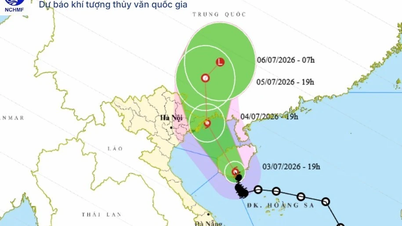

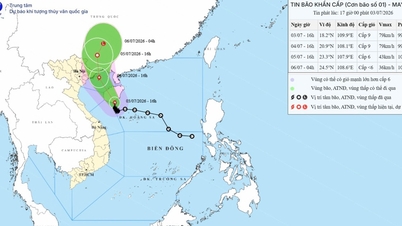






![[Video] Experts predict: Typhoon No. 1 is likely to enter the Gulf of Tonkin, causing very heavy rain in the Northeast region.](https://vphoto.vietnam.vn/thumb/402x226/vietnam/resource/IMAGE/2026/07/03/1783084195895_z8004474966557-2e5d8dd84c53d976b830d2de88ab7766-3999-jpg.webp)






![[Video] Weather forecast for tonight and tomorrow, July 4, 2026: The remnants of Typhoon No. 1 will cause widespread and prolonged heavy rain in Northern Vietnam.](https://vphoto.vietnam.vn/thumb/402x226/vietnam/resource/IMAGE/2026/07/03/1783083905760_thum-dem-png.webp)