Changing the mindset regarding production is the way to remove acidity from the soil.
Standing amidst the lush green rice fields in Long Thuan hamlet, Thanh My Tay commune, An Giang province, Mr. Nguyen Huu Thao couldn't hide his joy as he looked at the rice plants growing uniformly, with strong stems, upright leaves, and healthy white roots deeply embedded in the soil. Few people know that just a few years ago, these very fields were a major source of worry for his family due to the soil being contaminated with alum.
Long Thuan is a region with heavily acidic soil. The characteristic acidity and low pH, combined with continuous rice cultivation of three crops per year, have led to soil depletion. At the beginning of each planting season, a layer of yellowish acidity rises to the surface of the fields, causing newly sown rice plants to suffer root constriction, iron and sulfur poisoning, slow growth, and increased susceptibility to pests and diseases. Rice farmers have to apply more fertilizer, but the results are not as desired.

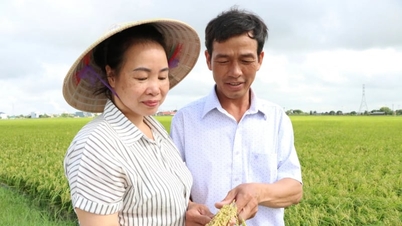
Mr. Nguyen Huu Thao boldly changed farming practices, applying production processes under the "Green Journey - Healthy Soil, Healthy Crops" program, gradually improving rice production efficiency on acidic soil. Photo: Ngoc Van.
Having spent many years cultivating rice on his 5 hectares, Mr. Thao also followed traditional farming methods like many other farmers. Whenever the rice grew poorly, he would often think about increasing the amount of fertilizer or pesticides. Investment costs increased steadily, but profits did not increase proportionally.
"Our people have been growing rice for many years, so they're used to the old ways. When the soil is weak, they think they need to add more fertilizer. But the more they do it, the more they realize the soil doesn't get healthier, the rice plants aren't really healthy, and on the other hand, the costs increase," Thao recalled.
The turning point came when he participated in the "Green Journey - Healthy Soil, Healthy Crops" program organized by Binh Dien Fertilizer Joint Stock Company. There, experts analyzed that to have healthy rice plants, it's essential to restore soil health and improve the farming environment right from the start of the season, instead of just focusing on supplementing nutrients for the plants.

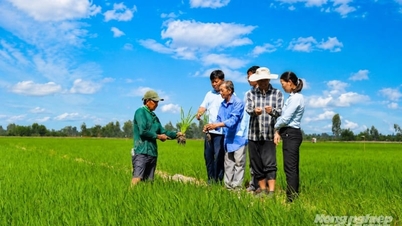
Technical staff from Binh Dien Fertilizer Joint Stock Company, agricultural extension workers, and Mr. Nguyen Huu Thao inspect the growth of rice fields after applying solutions to improve soil, reduce acidity, and care for plants at each stage of development. Photo: Ngoc Van.
That message completely changed the thinking of farmers who had spent many years working in the fields.
"I realized that I've been taking good care of the plants for a long time but neglecting the soil. For sustainable production, the soil must be healthy first, then the plants will be healthy," he shared.
Boldly making a change, in the very next planting season, he applied the comprehensive solution introduced in the program. Before sowing, he applied Đầu Trâu Bio Canxi as a base fertilizer at a rate of 150-200 kg/ha to improve soil, reduce acidity, and raise pH. He then continued using Đầu Trâu Bio Rice 1 during the tillering stage and planned to apply Đầu Trâu Bio Rice 2 when the rice entered the heading stage.


Healthy soil provides the foundation for sustainable crops.
The results exceeded the farmers' expectations. In a short time, the layer of acid sulfate soil on the field surface significantly decreased, and the soil became more porous. The soil pH increased from 4.2-4.3 to approximately 5.0-5.2, creating favorable conditions for root development.
What pleased Mr. Thao the most was the rice root system. The white, thick roots, with many root hairs and no longer clinging to acidic soil, helped the plant absorb nutrients more effectively. As a result, the rice grew balanced, tillered vigorously with about 2-3 effective tillers per plant, had strong stems, upright leaves, and significantly reduced pests and diseases right from the beginning of the season.

Thanks to soil improvement right from the start of the season, the root system developed healthily, and the rice plants in Mr. Nguyen Huu Thao's field grew uniformly, producing many effective tillers, strong stems, upright leaves, and reduced pest and disease problems. Photo: Ngoc Van.
Mr. Thao happily shared further: "In my experience, for rice plants to be healthy, the soil must be healthy first. My rice is over 30 days old, and when I go to the field, I see that the soil is much less acidic than before, the plants are healthier, and pests and diseases have significantly decreased. Visiting the fields makes me very happy."
Not only did he make changes on his own farm, but he was also willing to share his experience with neighboring farmers. Whenever someone came to visit his model farm, he would introduce the process he was applying, from soil preparation at the beginning of the season to each stage of rice plant care.
According to him, the cost of using the complete solution is not much different from conventional fertilizers, but the results are very noticeable. At the beginning of the season, the soil is better neutralized, the seedlings are healthier, the tillering stage has many effective shoots, and the plants maintain their green color until heading, promising high yields.
Mr. Thao believes that when rice plants are healthy, it reduces the need for care, minimizes pests and diseases, and lessens the pressure to use pesticides. More importantly, it improves farmers' profits.
Starting with a single successful farming household, the model is now spreading throughout the region. Many farmers who have visited have begun paying more attention to soil improvement and root care, instead of just focusing on fertilizing their plants as before.

The shift in mindset from "plant care" to "soil care" is helping many farmers in the acidic soil area of Thanh My Tay improve production efficiency, contributing to the implementation of the 1 million hectare high-quality, low-emission rice project in An Giang . Photo: Ngoc Van.
The story of Mr. Nguyen Huu Thao also reflects the shift in mindset taking place in many fields of An Giang. In the context of the agricultural sector implementing the Project to develop 1 million hectares of high-quality, low-emission rice cultivation linked to green growth, changing farming practices from experience-based production to science- and technology-based production has become a decisive factor.
It's not just about increasing productivity or profits for individual farmers, but also about contributing to restoring soil fertility, using fertilizers more efficiently, reducing greenhouse gas emissions, and building a sustainable rice production system.



GREEN JOURNEY – HEALTHY SOIL, HEALTHY PLANTS
Starting from the summer-autumn crop season of 2025.
Implementation in the Mekong Delta and Tay Ninh.
Focus on restoring soil health through soil analysis, pH improvement, reduction of organic toxicity, and enhanced nutrient utilization efficiency with the Bio product line.
In partnership with Binh Dien Fertilizer Joint Stock Company, along with the advice of Prof. Dr. Nguyen Bao Ve and other agricultural experts.
Source: https://nongnghiepmoitruong.vn/chuyen-nguoi-nong-dan-danh-thuc-vung-dat-phen-d819694.html


![[Image] Overview of the construction site for the underground station of metro line 5 at the Hanoi Ring Road 1 intersection.](https://vphoto.vietnam.vn/thumb/1200x675/vietnam/resource/IMAGE/2026/07/03/1783065595682_ndo_br_z7974930852369-100ca093c306e72675f1d3700966a86b-jpg.webp)