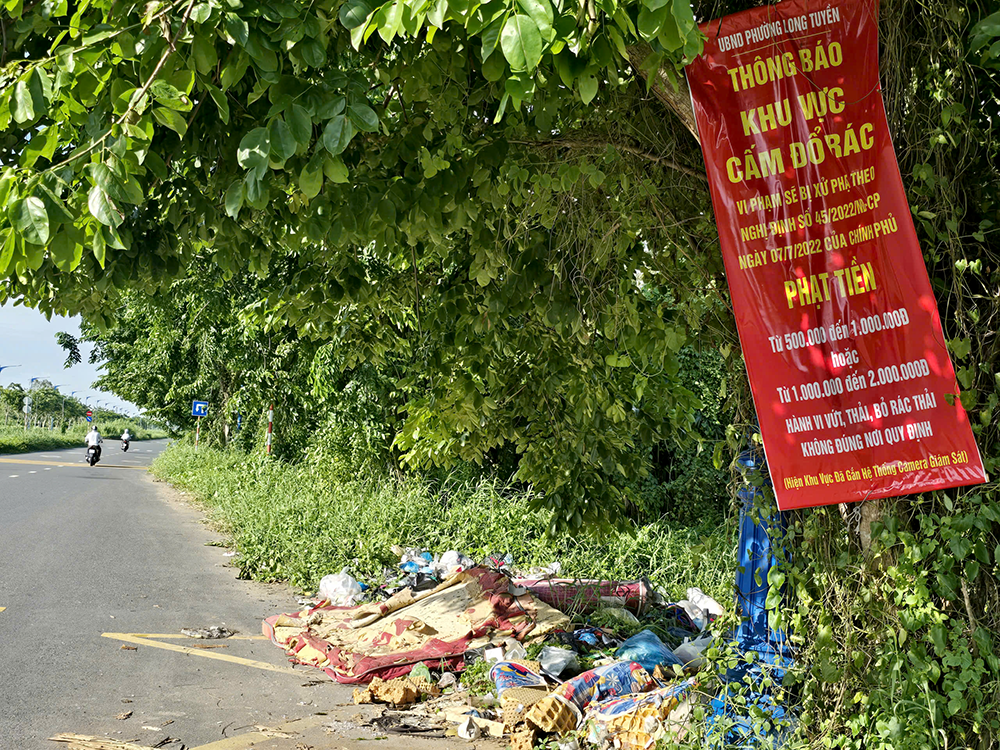
Long Tuyen Ward has put up signs reminding and warning about the illegal dumping of garbage.
Le Phuoc Tho Street (Long Tuyen Ward, Can Tho City) has only recently been put into use but has become a "hot spot" for illegal dumping. Many vacant plots of land, even right on the road surface, have become dumping grounds for household waste and construction debris, detracting from urban aesthetics and environmental hygiene. Recently, the Long Tuyen Ward People's Committee installed a surveillance camera system along the road, and within just a few days of activation, the cameras recorded a violation. Specifically, late in the afternoon of June 21st, a person driving a truck secretly dumped household waste along the roadside. Based on the extracted footage, authorities verified and processed the case. In addition to a 3.5 million VND fine, the individual was also required to collect all the waste and restore the area to its original state.
This is not an isolated case. Previously, in My Xuyen ward, a man who dumped nearly 800kg of garbage in an empty plot of land was fined the same amount and forced to clean up all the waste. Even earlier, in January 2026, Tan An ward also handled 8 environmental violations thanks to the surveillance camera system at "hot spots".
Clearly, surveillance cameras have proven very effective. Clear images of people, vehicles, and actions have become solid evidence for handling traffic violations.


For many years, illegal littering has been one of the most challenging problems in urban environmental protection. Numerous streets, vacant lots, alleyways, and riverside areas have become makeshift dumpsites, and even when cleaned up, the problem often recurs. Many people know it's wrong but still do it, taking advantage of the darkness, deserted areas, or thinking "no one will see" to secretly dump garbage. Therefore, "on-the-spot fines" based on camera footage are considered an effective solution that should be widely implemented. Just a few cases being strictly punished will have a much stronger deterrent effect than mere reminders or public awareness campaigns.
However, there are small alleys, vacant lots, suburban areas, or sparsely populated places that can be considered "blind spots" for cameras to capture. This is because there aren't enough resources to install a comprehensive network of cameras to monitor people's behavior. In other words, cameras can detect violations, but they cannot replace people's conscience.
A civilized city cannot be maintained solely by cameras or traffic violation tickets. Most importantly, each citizen needs to be self-aware of the importance of keeping the environment clean and beautiful, considering it a shared asset of the community. It shouldn't be about waiting for a camera to record you before behaving properly!
Therefore, in addition to the "all-seeing eye" of technology, the "eye of the people" is also crucial. When each citizen is willing to remind, report, or provide information to the authorities about illegal littering, the monitoring network will be expanded. Currently, many localities have channels for receiving reports through applications, social media, or hotlines. If effectively implemented, almost everywhere will have someone monitoring. Moreover, pressure from the community can sometimes have a greater deterrent effect than administrative penalties, because no one wants to be seen as someone lacking awareness.
Protecting the environment is not just the responsibility of government agencies, nor is it the responsibility of any one individual. Don't wait until you're caught on camera and receive a fine from authorities to realize your actions. Maintain a constant awareness, stay alert, and be responsible for your living environment. It doesn't have to be a big deal; simply disposing of trash properly and in the designated place contributes to building a bright, green, clean, and beautiful city – a city worth living in for all of us.



Text and photos: DANG HUYNH
Source: https://baocantho.com.vn/chuyen-phat-nguoi-and-y-thuc-nong--a208544.html



![[Image] National conference summarizing one year of operation of the overall organizational model of the political system, the three-tiered government model.](https://vphoto.vietnam.vn/thumb/1200x675/vietnam/resource/IMAGE/2026/07/01/1782882811691_ndo_br_1-jpg.webp)