

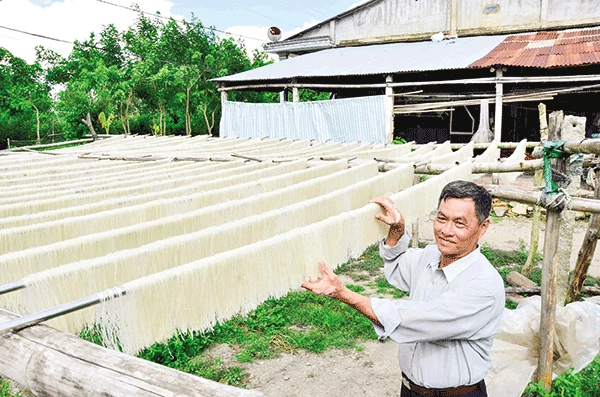
Mr. Nguyen Quoc Chuyen personally dries the rice noodles in the midday sun.
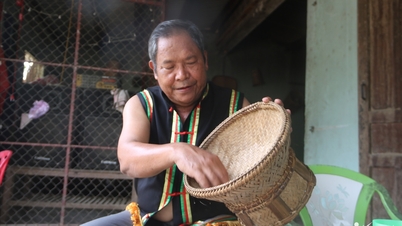
The man's name is Nguyen Quoc Chuyen, 70 years old, the owner of a rice noodle making facility – a name that's both familiar and unusual in this nameless craft village. "It was fate," Mr. Chuyen said with a smile, gently untangling some noodles that were stuck together. "I didn't know anything about this trade back then!" He recounted that about fifteen years ago, during a trip to the North, he happened to visit a rice noodle making facility. Captivated by the aroma of cooked rice flour and the translucent white noodles drying in the sun, he boldly asked to learn the trade. The owner refused to teach him, but didn't chase him away either, allowing him to observe from the sidelines. "Seeing them work, I memorized each step, watching them mix the flour, press the noodles, and dry them. I learned the trade first, then I went home and did it myself," he recalled, his voice nonchalant.
Back in his hometown, he gathered all his savings, exactly 20 million dong, to buy machinery and begin experimenting. But "life isn't like the movies." The dough was mushy, the noodles broke, and the vermicelli wouldn't form properly. Seeing his failures, his whole family was discouraged. But he, he persevered. "I wasted so much rice, it wasn't a joke. But I'm passionate about it, I can't give up," he said, his smile a mixture of sadness and pride. After six months of self-learning and experimentation, he succeeded. The first batch of vermicelli came out white, soft, fragrant, and chewy, surprising his whole family.
“When making rice noodles, the most important thing is knowing how to choose the rice. If the rice isn't good, the noodles won't be chewy or translucent; you can tell immediately,” Mr. Chuyen explained. He specializes in choosing rice that is neither too new nor too old, ensuring a natural consistency when ground. All the flour is carefully filtered, and no additives are used. Thanks to this, his rice noodles are always inspected and certified safe by the authorities. “People can eat without worrying about chemicals; that's the virtue of a food maker,” Mr. Chuyen said. Unlike many places that still use manual methods, his facility has mechanized the flour grinding and noodle pressing process. However, the most important step – drying the noodles – remains traditional: drying them in the sun for two days. He once tried a drying machine to be more proactive during the rainy season, but it failed. "If you dry them in a machine, the rice noodles become hard and dry, they don't absorb the broth when cooked, and they don't have the flavor," he shook his head, emphasizing, "Sun-drying is the soul of rice noodles." Therefore, during the rainy season, he accepts stopping production for a few days, preferring to run out of stock rather than compromise on quality.
Currently, his small noodle workshop is the livelihood of his entire family of five. His son, Nguyen Kieu Hung, operates the machinery, while his wife cuts the noodles and arranges them for stir-frying. After sun-drying, the noodles are bundled into 200g portions for delivery to regular customers. Each day, the facility produces about 100kg of noodles, selling them at 17,000 VND/kg, a price that has remained unchanged for several years. "People have been buying from us for years; we can't raise prices just because there's a shortage. We depend on our customers for our livelihood, so we have to think about them," Mr. Chuyen said firmly.
After deducting expenses for rice, electricity, and water, the family earns about 1 million dong a day. They're not rich, but he says, "Having food to eat and providing work near home for my children is happiness enough." Without a sign or social media advertising, Mr. Chuyen's rice noodle business is still trusted by many eateries. His regular customers are mainly noodle and vermicelli soup shops, and beef noodle shops in Tan Hiep, Giong Rieng, and even some from Rach Gia City. Many people have suggested he print packaging and register a brand to sell further afield. He laughs, "I'm old now; I'll think about it when someone else takes over. For now, whatever I make, my regular customers eat it all." On the drying racks, the noodles gradually turn whiter, glistening like silk. Amidst the scorching sun of the countryside, Mr. Chuyen diligently turns each tray of noodles. His hands are calloused, but his passion for the craft has never waned.
Text and photos: DANG LINH
Source: https://baocantho.com.vn/chuyen-soi-hu-tieu-o-tan-ha-b--a187536.html

























































Comment (0)