

Farmland, considered the "space for survival" of farmers, is being abandoned in many places. The main reasons remain poor economic efficiency due to the difficulty in finding markets for traditional crops and livestock, and the fragmented, small-scale farming methods that are no longer suitable. The challenge is to consolidate land for the development of larger-scale, more modern production, or to transform to an agricultural model that is more in line with the evolving realities...
From one commune...
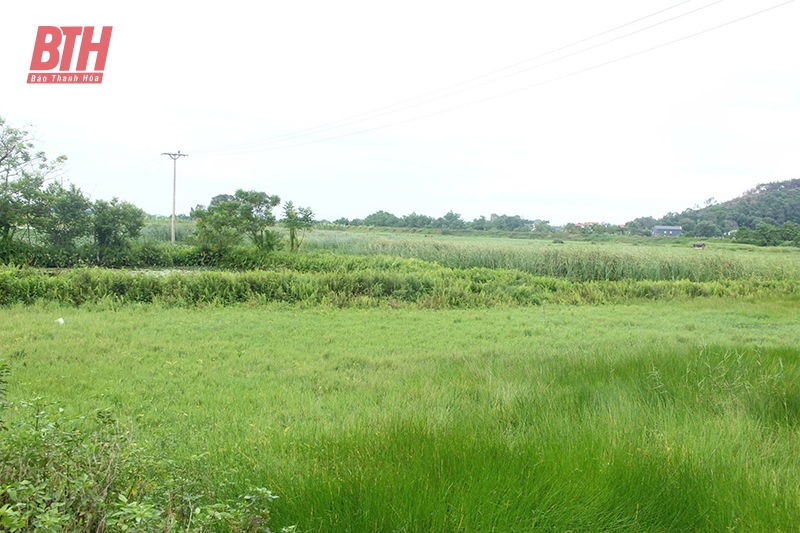
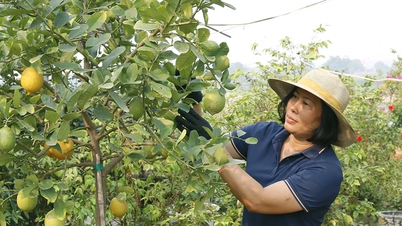
For many years now, the vast Thều rice fields along National Highway 47 in Triệu Sơn district have been covered in a green carpet of weeds. This is a large rice field belonging to two communes, Dân Lý and Dân Quyền, but farmers mainly only cultivate the spring crop. Like dozens of other households in the village, Mrs. Lê Thị Cử, from Hamlet 6, Dân Quyền commune, also leaves her more than 3 sao (approximately 0.3 hectares) of rice land in this inter-communal field uncultivated. According to this 65-year-old farmer, her family has four laborers: herself, her husband, and two children. However, in recent years, one child has worked as a factory worker in the district, and another has opened a hair salon. The income from the service industry and factory work is many times higher than the arduous 4-5 months of rice cultivation. Meanwhile, the yield of the autumn rice crop is usually not high, and in many years, storms have caused flooding and crop failures, so local people are not enthusiastic about farming it.
In the same village (Hamlet 6) as Mrs. Cu, there are about 50 households with rice fields in the Theu area, all of which are left fallow. Some households cultivate the spring crop, but most do not farm the autumn crop, covering a total area of over 20 acres. Due to being left fallow for many years, the area has also become a grazing ground for buffalo herds belonging to some local households. Because of its convenient location along the national highway, the Trieu Son District People's Committee has recently proposed to the province that this rice field be converted into an industrial cluster to utilize the land and create more jobs for the people.
In Dan Quyen commune, the abandonment of farmland is widespread throughout the villages. The fields are uneven, with some showing signs of cultivation, others overgrown with weeds, and still others covered in bushes. Along the road to village 4 in the same commune, the Doc Khang and Dong Dam fields are also covered in lush green weeds. In the Cao Buoc field, right next to the residential area of village 4, the fields are overgrown with grass as tall as an adult's waist. According to local residents, this area has been abandoned for 6-7 years... Mr. Pham Hong Bac, one of the households with many abandoned fields in these areas, has 10 sao (approximately 1000 square meters) of rice land that has not been cultivated for many seasons.
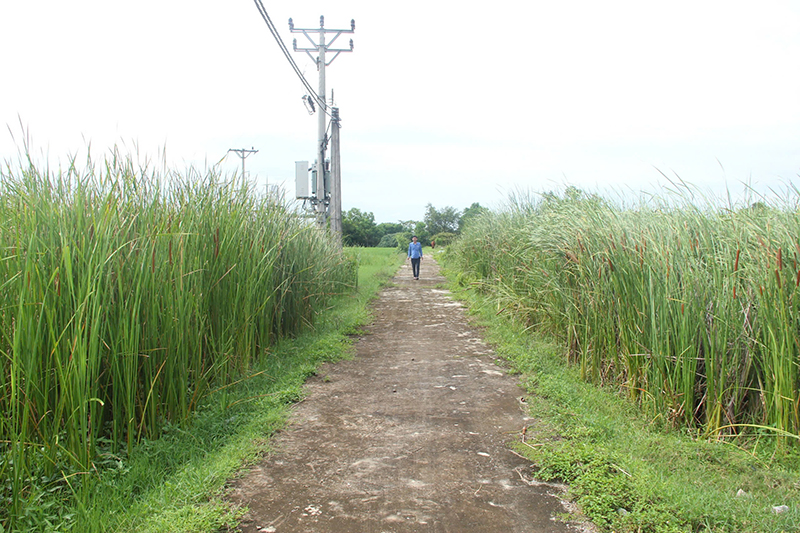
Regarding this situation, Mr. Le Gia Quang, Vice Chairman of the People's Committee of Dan Quyen commune, said: "The commune has a large area of single-crop rice land, and farmers only plant the spring crop to provide enough food for the whole year, so they often leave the autumn crop fallow. Furthermore, in many rice-growing areas, the autumn crop coincides with the rainy season, making irrigation difficult and sometimes crop failures due to flooding, so people are not enthusiastic about farming. Many households lack labor and have to hire 100% of their workers for land preparation, pesticide spraying, harvesting, etc., so they are even less inclined to invest due to the risk."
...to everywhere
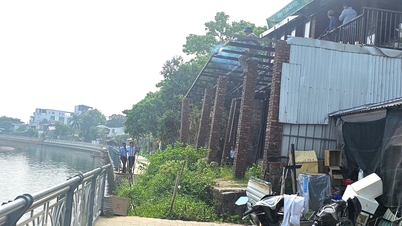
Thanh Hoa province has the highest number of communes and wards in the country, but most of them have abandoned farmland to varying degrees. A survey in the lowland district of Hau Loc revealed that for nearly a decade, the Ngo Thap rice fields of Son village in Tien Loc commune have been overgrown with countless weeds, some reaching a meter in height. This is understandable, given the area's traditional blacksmithing industry, which provides a much higher income than farming. Not far away, large rice paddies along National Highway 10 in the Trung Phu area of Hau Loc town are covered with layers of sedges and rushes that have not been cleared for years, now reaching head height. For decades, this half-kilometer stretch of land along National Highway 10 was used for rice and other crops due to its fertile soil. The land opposite the Hau Loc District Health Center, formerly part of Thinh Loc commune, has also become abandoned land after its merger with the town.
Heading towards the coastal area of the district, it's easy to find vast, abandoned rice paddies in Hoa Phu and Cao Xa hamlets of Hoa Loc commune. Right at the foot of De Bridge in Minh Loc commune, a vast, low-lying field spanning tens of hectares has shown no signs of agricultural activity for many years. Here, wild plants thrive in saline soil, such as sedges and reeds. Running along the land is the De canal, connecting to the Lach Truong river mouth, making this field perfectly suitable for the development of aquaculture farms...
Across that red, silt-laden river lies Hoang Hoa district, which also has many fertile fields left idle for years. From Hoang Yen commune, across the Cach bridge, the many hectares of land near the cemetery in Ngoc Dinh village, Hoang Ha commune, are completely covered with water hyacinths and various types of natural aquatic plants. Similarly, the fields behind the Ngoc Dinh Parish Church are also covered in a wild green color year-round. This 100-acre field along the Cung River dike has been left fallow for nearly a decade. Recently, the local government requested approval to rezone the land along the village road, approximately 200 meters long and extending more than 100 meters into the fields, into residential land, leaving about 80 acres in their original state.
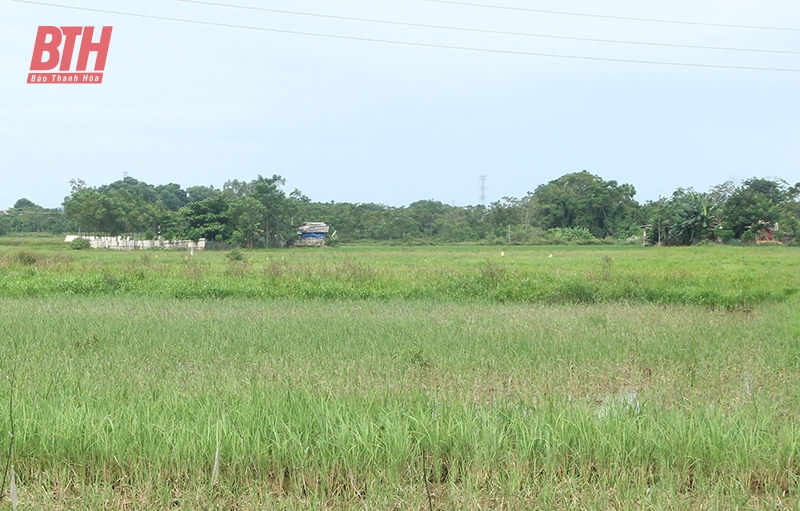
According to local residents, out of nearly 300 households in the village, every family owns land in this field. The area benefits from selling popcorn, toys, and snacks as a side occupation, leading many families to abandon farming. Another reason is that each household is allocated many plots in different areas, resulting in fragmented land that makes it difficult to introduce mechanization or apply scientific advancements to change crop patterns. “Previously, it was a fertile rice field, but for about a decade, it started to be left uncultivated, and for more than five years now, the entire field has been abandoned. My family owns 4 sao (approximately 0.4 hectares) of land, but it's divided into 6 separate plots in 6 different locations, so the fragmentation prevents the development of a family farm. Seeing the field wasted for a decade makes me anxious. Many people want to consolidate and rent more land to create a larger area for farming, aquaculture, or large-scale production, but many households refuse to exchange or rent land, and the local government hasn't yet stepped in to facilitate land consolidation. Because of the lack of production, in recent years, the land hasn't been reclaimed for those who have passed away, and newborns haven't received any additional land…” – a resident, who wished to remain anonymous, stated.
According to the Thanh Hoa Provincial Department of Crop Production and Plant Protection, in recent years, the abandonment of farmland in Thanh Hoa has typically occurred during the main cropping season, affecting a total area of approximately 1,300 to 1,400 hectares, mainly rice paddies, not including the winter crop. The reasons include the fragmented and small-scale nature of household farming; the fact that income from crop production is no longer the primary source of income for many families, and it cannot adequately support and meet the needs of farmers; and the inherent risks of agricultural production, including natural disasters and diseases.
Thousands of other examples can be cited throughout the districts, towns, and cities of Thanh Hoa province regarding the abandonment of farmland and hills. Many people own land that they do not cultivate, but are unwilling to give it up for various reasons, causing a tremendous waste of agricultural land. The consolidation and transformation into modern agricultural models, the development of integrated farms and family farms to maximize land use, or agricultural models that attract tourists... have become essential requirements.
Text and photos: Reporting Team
Lesson 2: "Bottlenecks"
Source: https://baothanhhoa.vn/co-che-troi-buoc-nong-nghiep-xe-rao-de-dot-pha-bai-1-bo-xoi-ruong-mat-bo-hoang-khap-noi-235105.htm





![[Photo] National Assembly Chairman Tran Thanh Man attends the policy seminar to promote Vietnam-Türkiye cooperation.](https://vphoto.vietnam.vn/thumb/1200x675/vietnam/resource/IMAGE/2026/04/16/1776351415367_vna-potal-chu-tich-quoc-hoi-tran-thanh-man-du-toa-dam-chinh-sach-thuc-day-hop-tac-viet-nam-tho-nhi-ky-8705791-jpg.webp)







































































Comment (0)