

In the heart of the land known as "Ha Long Bay on land," the ancient capital of Hoa Lu stands as a tranquil, silent landmark, marking a golden age of the nation. For over 1,000 years, Hoa Lu has remained a historical witness, a symbol of the aspiration for independence and the sense of origin in the Vietnamese psyche.
The legacy of our ancestors
Hoa Lu, located about 10 km from the center of the former Ninh Binh city, is nestled amidst towering limestone mountain ranges.
According to historical records, in 968, after suppressing the rebellion of the 12 warlords, Dinh Bo Linh ascended the throne as Emperor, establishing the national name Dai Co Viet and choosing Hoa Lu as the capital. For 42 years (968 - 1010), this place served as the political , economic, and cultural center of the entire country, closely associated with the Dinh and Early Le dynasties, ushering in a long era of national independence and self-reliance.
It was on this very land that young Dinh Bo Linh, along with his friends, erected a flag made of reeds on the grass, simulating a battlefield scene, nurturing his great ambition to unify the country. And then, as an adult, Dinh Bo Linh became the hero who unified the country after the chaos of the Twelve Warlords, establishing the first centralized feudal court and laying a solid foundation for an independent nation.
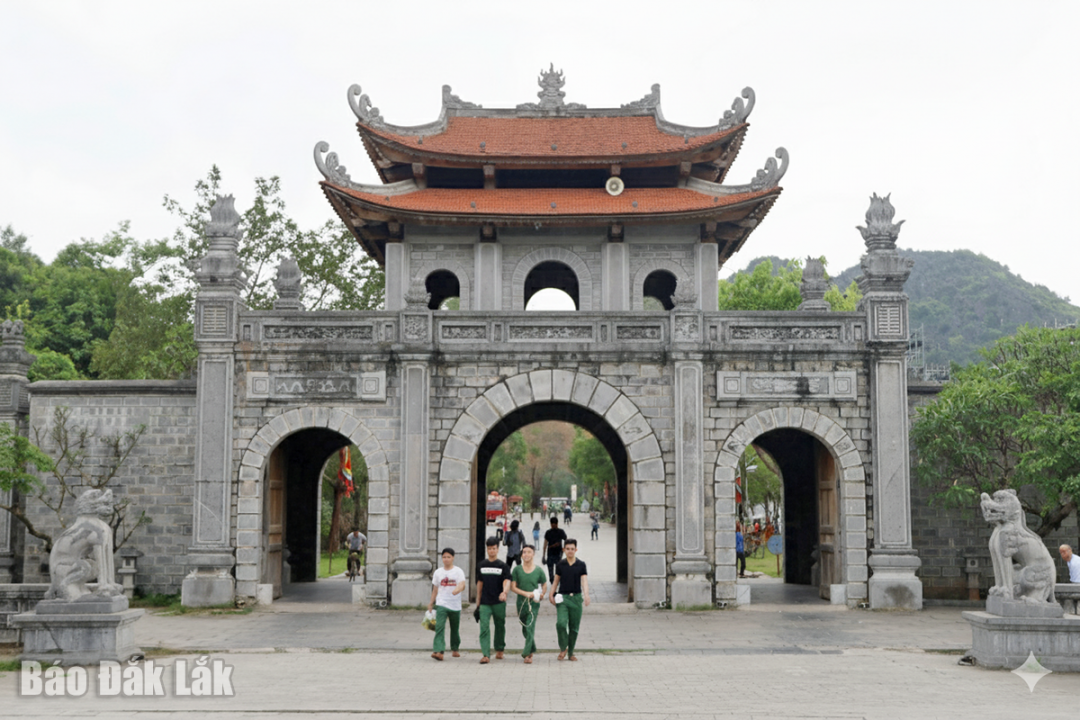 |
| The main gate to the Hoa Lu Ancient Capital National Special Monument site. |
Leaving the temple of King Dinh, visitors continue their journey to the temple of King Le Dai Hành - the king who continued the legacy of the Dinh dynasty and played a crucial role in preserving the nation's fledgling independence.
The Le Dynasty temple is not only a place to commemorate the wise ruler who defeated the Song Dynasty, suppressed the Champa Kingdom, and consolidated national independence, but also preserves the special story of Queen Duong Van Nga. When the country faced imminent danger, with invaders from the North threatening to encroach, she set aside personal feelings, gave the imperial robe to Le Hoan, and placed him on the throne to command the army. This decision helped Dai Co Viet overcome a great challenge and preserve its newly gained independence. The story of Le Hoan and Duong Van Nga thus became a symbol of the spirit of putting national interests above all else, a vivid testament to the stature and wisdom of our ancestors.
Strategic location, strategic vision.
Looking at the topography of Hoa Lu, one can see the strategic vision of our ancestors. The limestone mountain ranges form a natural defensive wall, encircling the central area; the Hoang Long River meanders around it like a defensive moat. This "mountain-embracing, river-encircling" configuration provides an almost impenetrable military advantage while ensuring water resources and favorable farming conditions for the people. It was this geographical advantage that made Hoa Lu the ideal choice for the early stages of nation-building.
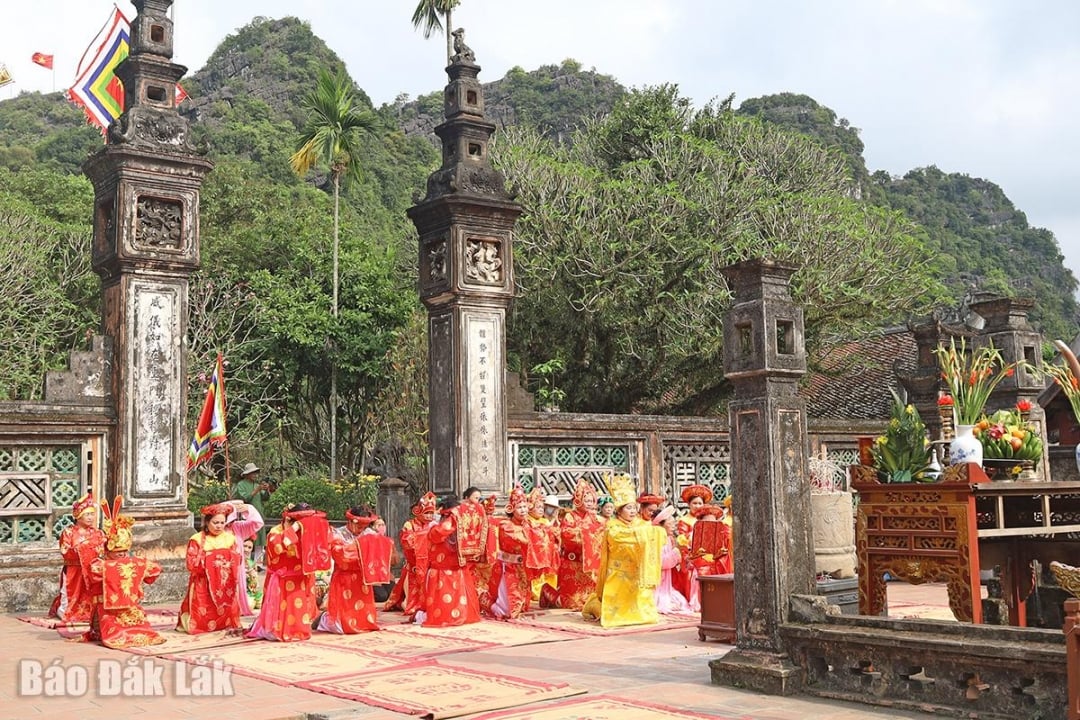 |
| Local people held a ceremony at the temple of King Dinh Tien Hoang. |
For 42 years, Hoa Lu, the capital city, served as the political, military, economic, and cultural center of the entire country. From this land, glorious victories such as defeating the invading Song army and halting the advance of Champa were recorded, affirming the nation's independence. Hoa Lu was also the cradle of Dai Viet civilization, where centralized monarchical institutions were established, the court was built, laws were formulated, and diplomatic relations with neighboring countries were established. All of this became an important foundation for development in subsequent dynasties.
Today, Hoa Lu is classified as a special national historical site, an indispensable destination on any Ninh Binh travel itinerary. Beyond its sightseeing value, it also holds pilgrimage significance, a place for future generations to reconnect with their roots and express gratitude to their ancestors. Every year, in the third lunar month, the Truong Yen festival is held to commemorate the contributions of King Dinh and King Le. The processions, flag-waving rituals, and other ceremonies recreate the heroic spirit of the early days of nation-building, becoming a link between the past and the present.
Viet An
Source: https://baodaklak.vn/van-hoa-du-lich-van-hoc-nghe-thuat/202509/co-do-hoa-lu-vang-son-mot-thuo-bac0702/


![[Photo] Enchanted by the deciduous forest during the leaf-changing season.](/_next/image?url=https%3A%2F%2Fvphoto.vietnam.vn%2Fthumb%2F1200x675%2Fvietnam%2Fresource%2FIMAGE%2F2026%2F02%2F04%2F1770196861704_2066642_8ffd5f25c3c9433be0e644abe71613ae.jpeg&w=3840&q=75)


![[Photo] Prime Minister Pham Minh Chinh presides over the regular Government meeting in January 2026.](/_next/image?url=https%3A%2F%2Fvphoto.vietnam.vn%2Fthumb%2F402x226%2Fvietnam%2Fresource%2FIMAGE%2F2026%2F02%2F04%2F1770209446450_hopcp-jpg.webp&w=3840&q=75)


Comment (0)