

SGGP
In terms of advantages, a Mobile Virtual Network Operator (MVNO) does not need to invest in infrastructure; instead, it simply purchases traffic from a network operator with existing infrastructure and then sells it.
Therefore, MVNOs focus on designing products that suit specific customers and target a niche market, rather than a broad market like traditional carriers.
Five virtual mobile networks have been licensed.
In June 2023, the Ministry of Information and Communications granted an MVNO license to FPT Retail Joint Stock Company. Leveraging its large distribution network, digital ecosystem, and the technological strength of its parent company, FPT, FPT Retail's MVNO network is expected to attract and convince users. Prior to this, the Vietnamese market already had several MVNOs, including: iTel (belonging to Indochina Telecom Joint Stock Company, with the prefix 087), Wintel ( Masan Group, prefix 055), Local (Asim Telecommunications Joint Stock Company, prefix 089), and VNSKY (part of the VNPAY ecosystem, with the prefix 0777).
Mr. Nguyen Van Dung, Director of VNSKY mobile network, believes that with the explosion of online platforms for connection, learning, entertainment, and business, the first SIM card with traditional telecommunication services no longer meets the ever-increasing mobile data needs of consumers. VNSKY's presence, positioned as a second SIM card, offers large data allowances at affordable rates, giving customers more options for unlimited daily connectivity with the digital world .
 |
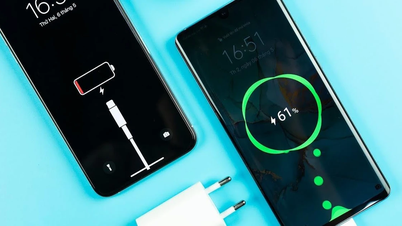
Children use internet-connected smart devices. Photo: HOANG HUNG |
Currently, the cheapest MVNO (Mobile Network Operator) package in Vietnam is the "Data 6GB" package from VNSky. This package costs 27,500 VND and includes 6GB of high-speed data, 1,000 free minutes of calls within the VNSky and MobiFone networks, and 50 free minutes of calls to other networks, ideal for users with basic data and call needs. Meanwhile, the cheapest package from a "traditional" mobile network in the Vietnamese market is the "ST5K" package from Viettel, priced at 5,000 VND, which includes 500MB of high-speed data and 50 free minutes of calls within the Viettel network. "If I prioritize cost-effectiveness, I could choose the VNSky Data 6GB package for studying and entertainment…," said Son Thanh, a student at Ho Chi Minh City Open University.
According to data from the Ministry of Information and Communications, the Vietnamese mobile telecommunications market currently has nearly 130 million subscribers. Of these, the three major mobile networks – Viettel, VinaPhone, and MobiFone – account for approximately 95% of the market share; the remainder belongs to Vietnamobile and other MVNOs. MVNOs alone currently have about 2.6 million subscribers, accounting for nearly 2% of the total mobile subscribers in Vietnam.
Diverse range of services
Globally, MVNOs hold a subscriber market share of 15%-20% and are showing signs of increasing, with projected revenue of approximately US$123.4 billion by 2028. In Vietnam, with investment from large economic groups, new MVNOs are establishing their brands and business models. Bitexco was the first with its iTel network, followed by Masan with Wintel and VNPAY with VNSKY. All three MVNOs are currently experiencing strong brand recognition and subscriber growth.
With iTel, after 3 years of entering the market, it has approximately 1 million subscribers with regular billing and has generated tens of billions of dong in profit. In the first quarter of 2023, Wintel developed more than 122,000 subscribers, achieving revenue of 16.48 billion dong, a 457% increase compared to the same period in 2022. VNSKY aims to connect 5 million users by 2025 and become one of the 5 largest MVNOs in Vietnam…
MVNOs are no longer a new concept. However, the number of over 2.6 million MVNO subscribers is modest, and the services these virtual network operators are currently offering are relatively limited, lacking truly competitive advantages. To promote the development of MVNOs, given the rapidly increasing internet access speeds and extensive coverage of over 89% of the population, telecommunications experts recommend that MVNOs should seek to provide internet-based services that truly benefit users, such as financial services, educational services, and market-related services that large network operators do not offer.
According to Mr. Nguyen Phong Nha, Deputy Director of the Telecommunications Department (Ministry of Information and Communications), the Vietnamese mobile market currently has a low ARPU (average revenue per customer) and faces strong competition from OTT services. Therefore, the participation of virtual telecommunications operators in providing services is expected to contribute to diversifying the types of services supporting digital transformation in the fields of finance, education, health, entertainment, etc.
"During the revision of the Telecommunications Law, we incorporated a wholesale capacity policy to create a more structured and easier legal framework for network operators to negotiate with each other in the process of purchasing traffic and providing high-quality services at competitive prices," Mr. Nguyen Phong Nha added.
According to the Ministry of Information and Communications, compared to other countries in the region, the number of MVNOs in Vietnam is still limited, and the market is underdeveloped. Globally, there are approximately 1,300 MVNOs operating in 79 countries; of which Europe has 585, Asia-Pacific 129, and North America 107. Currently, some countries have a large market share of MVNOs, such as Japan with 83 companies (10.6% market share); the US with 139 companies (4.7%); Germany with 135 companies (19.5%); Australia with 66 companies (13.1%); and South Korea with 44 companies (12%). Countries in the region also have developed MVNO markets, offering many new services to users, such as Thailand with 12 companies and Malaysia with 8 companies.
Source



![[Photo] Speaker of the National Assembly meets with the Vietnamese community in Türkiye](https://vphoto.vietnam.vn/thumb/1200x675/vietnam/resource/IMAGE/2026/04/18/1776483346102_1-8136-jpg.webp)























































































Comment (0)