

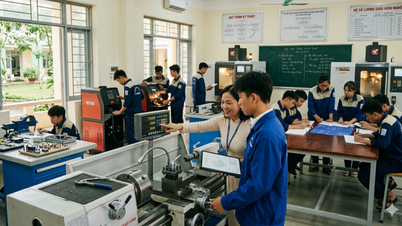
The Law on Teachers is the first specialized law that fully regulates the legal status, rights, obligations, and policies for the teaching staff. This is a significant milestone affirming the major policy of the Party and the State in honoring, caring for, protecting, and developing the teaching staff – the key force in the education system. The Law on Teachers establishes a complete legal status for teachers in both public and private educational institutions.
For the first time, teachers in private schools are recognized as a distinct profession with professional standards, rights, and obligations similar to those of contract workers, rather than simply being contract employees as before. The law clearly stipulates the right to respect, protection of honor and dignity, and a mechanism for strictly dealing with acts that insult teachers. This is a crucial point aimed at protecting teachers from unreasonable social pressures and maintaining a safe and civilized educational environment.
Furthermore, the Law on Teachers stipulates that "teachers' salaries shall be ranked highest in the administrative and public service salary scale system" and assigns the Government to regulate in detail the salary policy for teachers to ensure their living standards, helping them to work with peace of mind and dedicate themselves to the cause of education. Preschool teachers, if they wish, may retire up to 5 years earlier without a reduction in pension (provided they have contributed to social insurance for 15 years).
Meanwhile, professors, associate professors, doctors, or educators working in specialized fields are allowed to retire at an older age to retain talent. In particular, the Law on Educators also grants the education sector greater autonomy in recruiting and employing educators…
In preparation for the implementation of this important law, the Ministry of Education and Training has drafted two decrees and nearly 20 guiding circulars for the Government and ministries to issue simultaneously with the Law on Teachers on January 1, 2026.
Also on June 16th, the National Assembly discussed the following draft resolutions: the National Assembly Resolution on tuition fee exemption and support for preschool children, primary and secondary school students, and learners in general education programs at educational institutions within the national education system; and the National Assembly Resolution on universal preschool education for kindergarten children aged 3 to 5 years old.
The draft resolutions received strong support from the delegates. The Law on Teachers and these two draft resolutions (expected to be passed during this session) will contribute to building a solid foundation for the development of the country's education system in the coming decades, representing a breakthrough opportunity for the education sector in the new era of the nation.
Despite the country's challenging socio-economic conditions, these policies demonstrate the Party and State's profound concern and strategic vision for education, contributing to the nation's sustainable development and the people's well-being. The high level of consensus in the National Assembly also reflects the unity and agreement within society regarding a major policy that aligns with public sentiment and meets the demands of reality.
The crucial legal framework is already in place, therefore, more than ever, the education sector needs to urgently strengthen its infrastructure, ensure a sufficient number of qualified teachers, and actively implement the Law on Teachers and the two resolutions so that children can soon benefit from these advantageous policies starting from the 2025-2026 school year. Because preschool and general education are the important starting points in education for us to achieve the goal of developing a prosperous and happy nation.
Source: https://www.sggp.org.vn/co-hoi-dot-pha-cua-nganh-giao-duc-post799756.html




















































































Comment (0)