

Currently, Big Tech companies like Facebook and Google are facing intense criticism because their platforms have become fertile ground for the proliferation of fake news, misinformation, and harmful content – things that could degrade entire societies in the future. Even truth, and reality, is being manipulated by social media platforms through tricks and algorithms to encourage users to create controversy and instability. In early December 2023, the state of New Mexico even accused Meta, Facebook's parent company, of being a space for "degenerates" with malicious intentions targeting children.
Several laws will cut off the "tentacles" of Big Tech.
That's why policymakers around the world are increasing their scrutiny of Big Tech. The European Union (EU) has spearheaded this fight. The EU's Digital Services Act (DSA), passed and officially effective from January 1, 2024, aims to control harmful and misleading content on platforms with 45 million or more users, such as Facebook, YouTube, and TikTok. Under this law, platforms will face fines of up to 6% of their global revenue if they violate the regulations.
The European Union has long controlled the unauthorized seizure of users' personal data by Big Tech companies through the General Data Protection Regulation (GDPR). Most recently, in September 2023, TikTok was fined €345 million for violating this rule. Prior to that, in May 2023, Meta was fined €1.2 billion by the EU for violating regulations on transferring user data to the US. Furthermore, Europe has enacted the Digital Markets Act (DMA), one of the world's toughest laws aimed at controlling the monopolies of Big Tech companies.
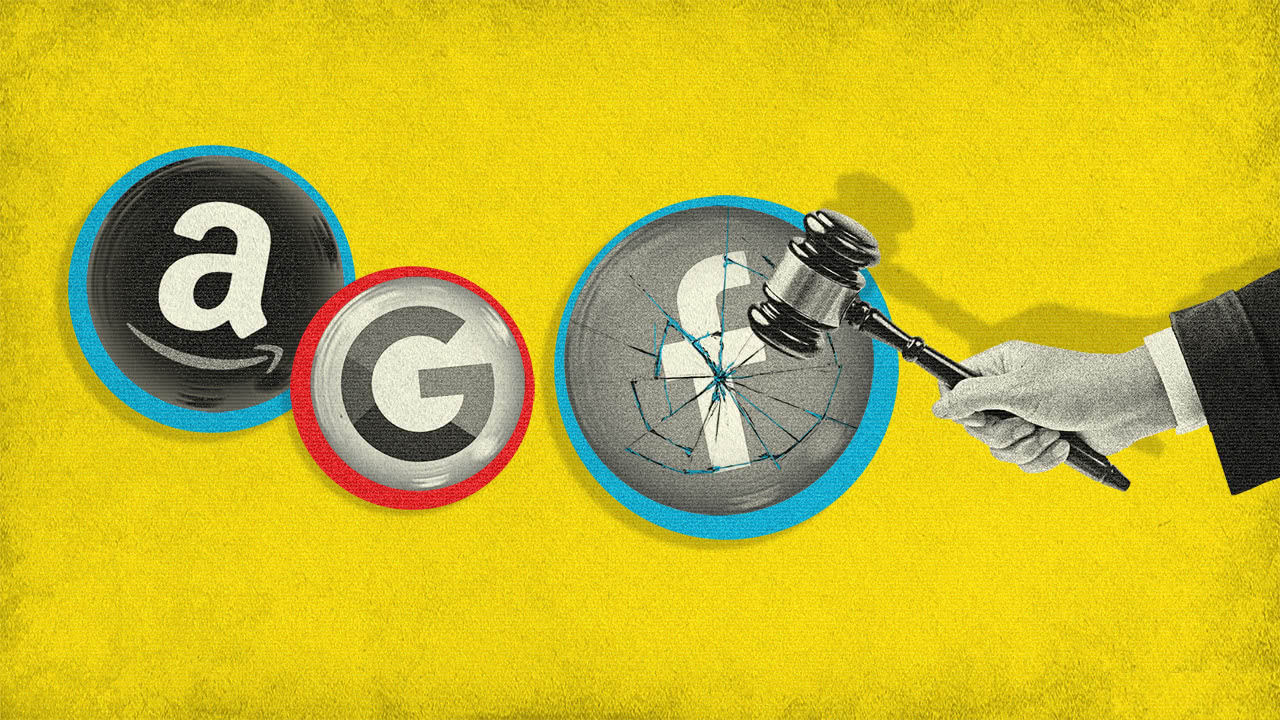
Many countries and international organizations are taking decisive action to punish Big Tech companies for copyright infringement and personal data violations. (Illustration: GI)
Regarding the specific area of requiring Big Tech to pay for journalism, besides Australia and Canada, which have already implemented this, many other countries are beginning to see it as a way to directly protect their journalism – thereby not only promoting high-quality journalism but also preventing the spread of fake news, misinformation, and harmful content on social media.
The biggest anticipation is in the US, where the country is expected to enact the Journalism Competition and Preservation Act (JCPA) in mid-2024. This will give news publishers more bargaining power to force Big Tech to pay for journalism. Additionally, a historic trial by the US Department of Justice against Google has been ongoing throughout 2023 and will resume in 2024, aiming to force the world's leading Big Tech company to end certain monopolistic practices in search or advertising. This increased competition in the market is predicted to strengthen the power of journalism, as Big Tech companies will then have to negotiate with the press to gain an advantage.
New Zealand also planned legislation to force Big Tech to pay for news as early as 2022 and is still working on it. Meanwhile, in September 2023, the Malaysian Media and Multimedia Commission (MCMC) stated in a press release following a meeting with Google and Meta that the country was discussing a legal framework to compel the two tech companies to negotiate commercial terms with media outlets.
In Taiwan (China), Google also had to agree to a three-year, $10 million deal with news organizations, after facing pressure from a regulation similar to those in Australia and Canada. In South Africa, the South African Editors' Forum and the South African Press Association are also requesting Google to fund news organizations within their group.
A battle between journalism and Big Tech is still ongoing in India. In early 2022, the Digital News Publishers Association of India publicly accused Google of abusing its dominant position in news aggregation, resulting in lost advertising revenue for news organizations.
Big Tech suffers a "barrage of fines"
In addition to countries tightening regulations on Big Tech, 2023 also saw a "rain of fines" imposed on technology platforms, especially social media sites, with penalties totaling billions of dollars.
In mid-December 2023, Google agreed to pay up to $700 million to settle a lawsuit in San Francisco alleging monopolistic practices in its Play Store. Google has also paid billions of dollars in numerous other antitrust and data breach lawsuits.
Meanwhile, Meta, Microsoft, and OpenAI were frequently targeted by copyright infringement lawsuits related to AI training in 2023. Meta was even fined €5.85 million for advertising gambling in Italy at the end of December.
Meanwhile, TikTok – a social media platform that employs various tricks, algorithms, copyright infringements, and sensationalist content to "addict" users – even became the number one target of bans and technology-related penalties in 2023. Many countries, including Vietnam, implemented bans, penalties, or content controls on the platform.
From now on, Big Tech will no longer be able to act with impunity, illegally using personal data and infringing on copyrights to gain profits at all costs. And as Big Tech weakens, journalism will have the opportunity to break free from the control of these giants and potentially thrive again. Of course, this opportunity will only be available to high-quality journalism that meets the increasingly sophisticated demands of its readers!
Big Tech companies make huge profits thanks to the press. According to research by the Policy Dialogue Initiative (IPD), Google's search advertising revenue in the US alone reached approximately $56 billion in 2022. The authors estimate that information searches account for about 50% of all searches, with 70% of those being news searches. Therefore, Google's advertising revenue from news content is estimated at around $20 billion. Meanwhile, Facebook generated nearly $114 billion in advertising revenue globally in 2022. The research shows that Facebook users spend 13.2% of their time on the platform viewing or interacting with news content, estimating that news content brings Facebook approximately $4 billion annually.  Google earns tens of billions of dollars annually from advertising revenue generated from news articles. Photo: Unsplash |
Tran Hoa
Source














































































































Comment (0)