TP - The international train service departing from Song Than station (Binh Duong) to China and then to a third country offers simplified procedures, reduced travel time, and cost savings, opening up new opportunities for import and export businesses.
Goods passing through border checkpoints are exempt from post-inspection.
Located in Tay Ninh province, Hung Duy Import-Export, Trade and Service Company Limited chose to transport goods by rail on an international train departing from Song Than station (Binh Duong province) instead of by water or road as before. A company representative stated that the first shipment exported from Song Than station to China was cassava starch, a food-grade product.
Nearly 500 tons of goods belonging to Hung Duy Import-Export, Trade and Service Co., Ltd. were packed in 19 40-foot containers and transported to Song Than station, then to Yen Vien station ( Hanoi ). There, the shipment was transferred to 1,400 mm gauge train cars for transport to Dong Dang station (Lang Son) and export procedures to China. Despite passing through several checkpoints, the process was very quick because the customs declaration was classified as green channel by the Vietnam Automated Customs Clearance System (VNACCS-VSIS) (exempt from detailed document checks, physical inspection of goods, and automatic customs clearance).
Operating in the agricultural sector in Binh Duong, Mr. Le Thanh Hai - Director of Hai Au Goods Trading and Service Joint Stock Company, said: “The advantage of rail transport is that goods are not damaged by impact, and travel on schedule without delays like other transport methods. Goods transported by rail can go directly across the border, avoiding congestion at border gates as was the case with road transport in the past. For agricultural products, which have a short shelf life, rail transport is the most optimal option to reduce costs and increase profits for businesses.”
Meanwhile, Mr. Le Manh Ha, CEO of TBS Logistics (Binh Duong), shared that intermodal shipping opens up a new avenue for goods to other countries. Typically, for a 40-foot refrigerated container, sea freight costs account for about 10% of the total product value, while air freight is twice as high. Businesses can open customs declarations directly at the Binh Duong Customs Department and Song Than railway station to ship goods directly to neighboring countries. This shortens transit time and reduces transportation costs by about half.
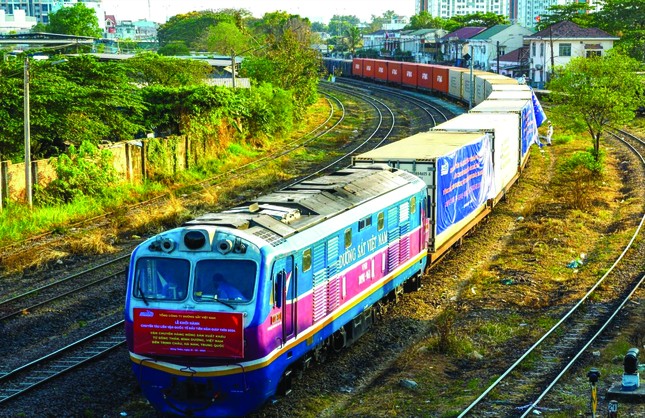 |
The international freight train from Song Than station to China. Photo: HC |



As the operator of railway transport routes from Vietnam to China and from China to third countries, Mr. Nguyen Xuan Hung - Deputy General Director of the Railway Transport and Trade Joint Stock Company (Ratraco) - stated that political conflicts in some countries have affected and disrupted the flow of goods. To overcome this, the company has chosen the solution of transporting goods from Vietnam to China via Kazakhstan to Turkey, then across the Caspian Sea to Europe.
According to Mr. Hung, choosing the railway channel for exporting to China also opens up opportunities to boost exports to Central Asian and European countries through intermodal railways. In particular, given the risks and escalating freight costs associated with sea transport through the Red Sea, diversifying transportation routes will help businesses minimize risks.
Two-way flow of goods
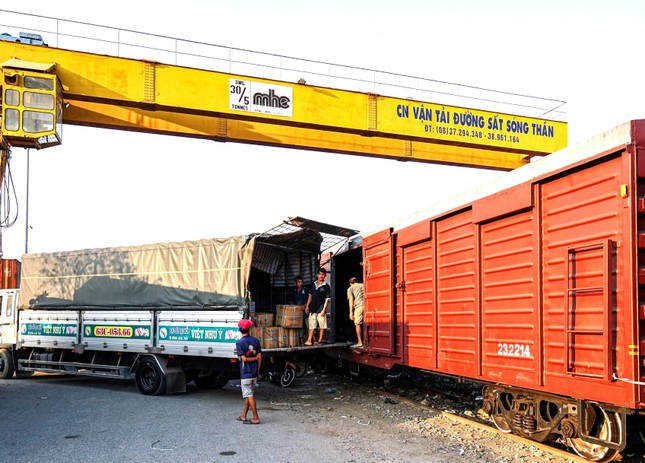 |
Loading goods onto train cars at Song Than station. |
Some businesses are concerned about potential congestion of goods as many companies choose to transport them by rail. Regarding this, Mr. Dang Sy Manh, Chairman of the Board of Members of Vietnam Railways Corporation, stated that the Song Than station currently manages an area of over 20 hectares. The station has 17 tracks with a capacity of over 350 carriages and 5 warehouses. Its loading and unloading capacity reaches 2,000 tons of goods per day and night.
In the near future, the Ministry of Transport will invest in upgrading Song Than station to achieve an operating capacity of 3.5 million tons of cargo per year. After the investment, intermodal trains departing from Song Than station will run directly to China, transit to a third country, and vice versa, instead of having to make transfers at domestic stations as is currently the case. Therefore, Song Than station is capable of handling a large volume of cargo.
According to Ngo Van Mit, Director of the Binh Duong Provincial Statistics Department, in January 2024, the total import and export turnover of Binh Duong reached US$4.5 billion, of which exports reached US$2.7 billion, an increase of 44% compared to the same period last year. Several key export items showed high growth, including wood and wood products (up 205.3%); iron and steel and iron and steel products (up 162.3%); handbags, wallets, backpacks, hats, and umbrellas (up 161.2%); footwear (up 127.9%); and textiles and garments (up 126.4%).
According to Mr. Nguyen Tran Hieu, Director of the Binh Duong Customs Department, the locality regularly has 3,483 businesses exporting and importing goods with partners in 213 countries and territories. However, the majority of goods exported and imported by businesses in the area are transported by sea.



According to Mr. Hieu, bringing Song Than station into service for export and import cargo transportation will expand options for businesses. After the Lunar New Year of 2024, Song Than station transported its first shipment of agricultural products to Zhengzhou, Henan province (China) with 21 train cars; including 9 refrigerated containers carrying fruits and food. The journey time from Song Than station to Zhengzhou is expected to be 9-10 days, and according to the plan, one trip per week will be operated.
A representative from the Vietnam Railways Corporation added that intermodal trains can transit through China to reach several countries such as Russia, Europe (Germany, France, Belgium, the Netherlands, Poland...), Kazakhstan, and Mongolia. The reason there is only one train per week is because rail-based import and export of goods is a new operation, and customers are gradually shifting from other modes of transport to rail. As demand increases, the railway industry will gradually increase the frequency of trains, aiming for daily service.
The Vietnam Railways Corporation will soon receive trial shipments from various consignors importing materials from China at the Tan Van CFS - TBS warehouse (Binh Duong General Port, under the Binh Duong Provincial Customs Department). Subsequently, depending on the situation and intended use of the imported materials, the businesses (consignors) will register customs declarations according to the corresponding categories (business, processing, manufacturing, export, etc.) to serve sustainable production, business, and consumption.
Source









![[Video] Weather forecast for July 3, 2026: Tropical depression likely to strengthen into typhoon number 1, increased thunderstorms from Northern to Southern Vietnam.](https://vphoto.vietnam.vn/thumb/402x226/vietnam/resource/IMAGE/2026/07/03/1783033484927_ngay-3-png.webp)