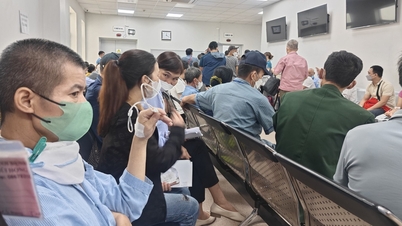
Pregnant women going for a prenatal check-up - Illustration photo: QUANG DINH
Many cases of home remedies require emergency hospitalization...
The mother has anemia, and the fetus has slow growth.
Ms. NTH (30 years old, residing in Binh Thanh Ward, Ho Chi Minh City) is three months pregnant. As it's her first time being a mother, she joined a social media group for pregnant women to learn about self-care and prenatal care.
However, within the group, she was surprised to see many people sharing unverified "tips" such as drinking beer to ensure the baby is born with fair, rosy skin, or avoiding sour foods to prevent the baby from having dark skin or tooth decay...
A 28-year-old pregnant woman, 22 weeks pregnant, was admitted to Tu Du Hospital in Ho Chi Minh City with severe anemia, dizziness, and fatigue.
Upon investigating the cause, doctors discovered that she had completely avoided red meat, eggs, and fish because she had read online that "eating too much protein makes the baby big and difficult to deliver" and "eating fish can easily cause birth defects due to mercury contamination." As a result, the mother suffered from severe anemia, and the fetus experienced slow growth in the womb. After treatment and nutritional counseling, the pregnant woman's condition gradually stabilized.
"That's not a rare case," said Dr. Le Thi Thu Ha from Tu Du Hospital.
Dr. Thu Ha shared that many pregnant women, trusting the advice of "online experts," self-prescribe dietary restrictions or consume dietary supplements without control, leading to unfortunate consequences. "Many people believe that drinking beer will help their babies be born with fair skin, or that avoiding sour foods will prevent their babies from having dark skin or tooth decay. These are completely unscientific beliefs," Dr. Ha affirmed.



Specifically, drinking beer during pregnancy not only doesn't help the baby's skin become brighter, but on the contrary, it can cause the child to develop Facial Alcohol Disorder (FASD) – a syndrome that leads to intellectual disability, facial deformities, low birth weight, and increased risk of cardiovascular disease. "Ethanol in beer crosses the placenta directly into the fetus's body. The baby's liver is not yet capable of processing the toxin, and the consequences can be permanent brain damage," Dr. Ha warned.
Similarly, advice like "don't eat sour foods" is also wrong. According to Dr. Thu Ha, naturally sour foods like oranges, lemons, mangoes, strawberries, etc., are very good for pregnant women because they contain a lot of vitamin C, which helps absorb iron and boost immunity. "Only when mothers eat too much industrially produced sour food, pickled vegetables, or spicy foods will it affect their stomach or tooth enamel, not the baby's," she said.
It also affects the pregnant woman's mental health.
Many anecdotal "pregnancy tips" are causing daily headaches for obstetricians. As Dr. Thu Ha explains, during her prenatal examinations, she encounters many pregnant women who believe in misconceptions such as drinking coconut water early in the morning to make their baby's skin fair and beautiful. In reality, coconut water only helps replenish electrolytes and has absolutely no effect on the baby's skin color; in fact, drinking it too early can easily cause bloating and indigestion.
Some people avoid bathing in the evening for fear of miscarriage, but according to Dr. Thu Ha, bathing with warm water properly helps pregnant women relax and sleep better, just avoid water that is too hot or too cold. Many pregnant women also avoid exercise to "preserve the pregnancy," while in reality, gentle exercise such as walking, yoga, or swimming helps improve blood circulation, reduce stress, and support easier childbirth, except in cases where absolute rest is required by a doctor.
Many pregnant women enjoy eating goose eggs hoping their babies will be intelligent, but doctors assert that this has absolutely no scientific basis. Goose eggs do not contain any "special" nutrients that help brain development; on the contrary, they have high cholesterol levels, which is not good if consumed in large quantities.
Besides affecting physical health, excessive exposure to negative information also has a detrimental impact on the mental health of pregnant women. During pregnancy, hormonal changes make women more sensitive, prone to anxiety, insomnia, or stress. "If they read threatening news every day, mothers will always be in a state of confusion, and may even be at risk of depression," Dr. Ha warned.
Prolonged stress increases cortisol secretion – a hormone that can cause uterine contractions, reduce blood flow to the fetus, and affect the baby's development. "A smart pregnant woman isn't the one who reads the most, but the one who knows how to filter the most accurate information," Dr. Ha emphasized, adding that medical advice from the doctor directly monitoring the pregnancy remains the most reliable "guide," helping pregnant women avoid misunderstandings and protect both their physical and mental health.
Pregnant women should prioritize official sources of information such as the Ministry of Health , the World Health Organization, UNICEF, reputable hospitals, or licensed doctors; and also attend prenatal classes for scientific guidance and to maintain a calm mindset, because "no two pregnancies are the same, and what is true for others may not be true for you."
Beware of clickbait information that lacks scientific basis.



According to Dr. Bui Chi Thuong, head of the obstetrics department at Gia Dinh People's Hospital in Ho Chi Minh City, in the context of social media being flooded with misinformation, many people, for their own purposes such as selling products or gaining views, have deliberately spread unscientific "tips" or "secrets." To obtain accurate information, pregnant women should rely on scientific evidence and seek advice from professionals instead of trusting social media.
Currently, there are many self-proclaimed "doctors" on TikTok and Facebook, but it's impossible to know if they are actually professionals in the field. There have even been cases of veterinarians advising and treating humans, as reported in the press. Therefore, pregnant women should not easily trust information circulating online.
Pregnancy is an extremely important period, directly affecting the health and future of the child. Therefore, mothers need to be very careful, only consulting and following the instructions of the doctor monitoring the pregnancy, as well as updating information from official and reputable sources.
Source: https://tuoitre.vn/coi-chung-meo-dan-gian-hai-me-hai-con-20260107055617184.htm