

Human resources are a crucial factor in determining the quality of science and technology . Besides attracting talent, policies are needed to train highly skilled human resources domestically.
POLISHING A ROUGH GEM INTO A PRECIOUS GEM
When discussing the Vietnam-Japan IT Program (HEDSPI), Hanoi University of Science and Technology introduces it as a program where "graduates have the highest average salaries among all IT-related training programs at Hanoi University of Science and Technology."
According to Associate Professor Ta Hai Tung, Rector of the School of Information and Communication Technology, 18 years ago, when the HEDSPI program was launched to train IT personnel oriented towards working in Japan, there were many doubts about whether a training program in Vietnam could meet the requirements of a demanding market like Japan. In reality, HEDSPI has proven to be one of the most successful IT training programs in Vietnam . Despite studying entirely in Vietnam , with Vietnamese tuition fees, the majority of graduates (approximately 80%) have gone to work directly in Japan, receiving similar compensation to engineers graduating from local universities, creating a HEDSPI workforce brand highly sought after by Japanese corporations and companies.
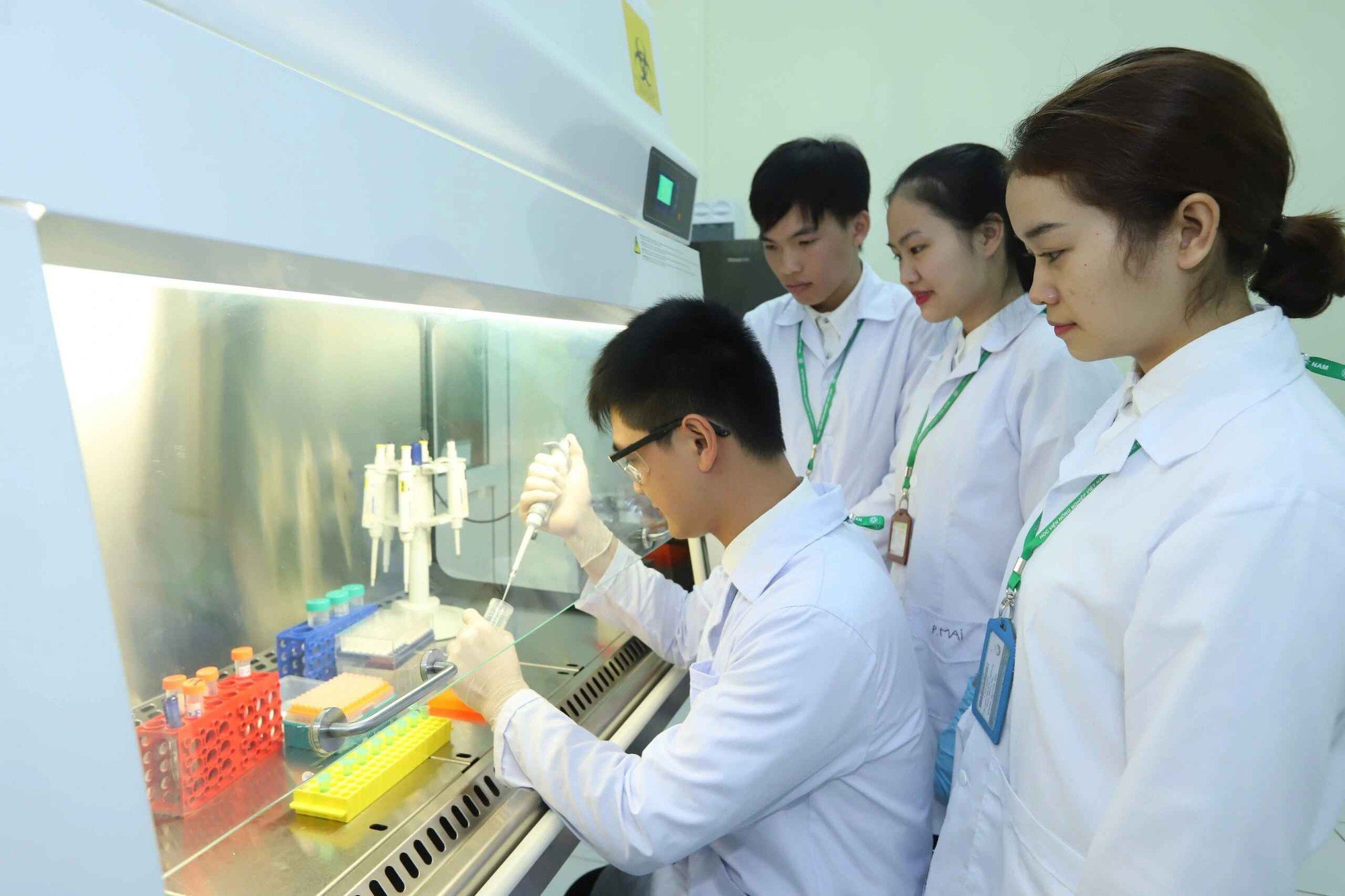
Human resources should be considered key to creating breakthroughs in science and technology development and innovation.
Another example is a Vietnamese electric vehicle manufacturer where, initially, foreign experts worked in every stage of production, but gradually, the highest-level technology management positions were transferred to Vietnamese personnel. Graduates from Vietnamese universities, after a period of supplementary training and under the guidance of foreign experts, were ready to take on crucial roles and quickly master the fundamental and core technologies in a very new field, which is the future of humanity. To date, after seven years, three-quarters of the more than 2,000 engineers at this automaker are graduates from Hanoi University of Technology.
The two examples above, and many other similar examples, show that young Vietnamese talents, if properly trained with a fully internationalized orientation, can master new and strategic technologies, undertake challenging tasks, and succeed in competitive environments with the highest industrial standards. They give us more confidence in asserting that our human resources—the energy of youth, talent, and the desire to prove ourselves—are Vietnam 's competitive strength in the new era, the era of national progress.
"Recognizing that enormous potential also puts pressure on the training system to figure out how to truly polish these talents, these rough gems, into precious jewels. The solution to this problem lies in developing the higher education system, focusing on training high-quality human resources, quickly creating a team of technological talents, globally integrated with a strong sense of self-reliance," Associate Professor Ta Hai Tung shared.
INCREASE INVESTMENT IN HIGHER EDUCATION
Dr. Bui Hai Hung, Director of VinAI Research Institute, Vingroup, stated that his institute has also had positive experiences in providing in-depth and elite training in the field of AI in Vietnam . To date, VinAI has trained over 100 AI interns through the first AI internship program in Southeast Asia, a model similar to Google's. This AI internship program initiative shares many similarities with the fourth task (developing and utilizing high-quality human resources and talent) among the seven tasks outlined in Resolution No. 57 of the Politburo.
"Currently, we have very promising young talents. However, for them to truly break through, we need to focus on problems that the world is genuinely interested in. At the same time, we need to equip them with the necessary infrastructure and tools to support their work. With adequate support in these areas, young talents can absolutely take off, becoming a key resource contributing to the development of artificial intelligence and technology in our country in the future," said Dr. Bui Hai Hung.
According to Associate Professor Ta Hai Tung, to develop a high-quality workforce, the first solution the government needs to implement is to increase investment budget to rapidly develop the higher education system to approach international standards. If higher education relies solely on tuition fees without state investment, universities may stray from their mission of maintaining and developing the human resources and scientific and technological foundation for the country. The entire system faces the risk of eliminating a series of essential (but unattractive in terms of enrollment) fields such as materials science, metallurgy, automotive engineering, nuclear physics, etc. Thus, the determination to build high-speed railways, nuclear power plants, electric cars, etc., will become mere wishful thinking goals, because without a team of educators, experts, and resources to create a scientific and technological foundation,
"Currently, the investment budget for the entire Vietnamese higher education system is very modest, reaching only over 11,000 billion VND in 2020, accounting for 0.18% of GDP, while ASEAN countries like Malaysia, Thailand, and Singapore are at 0.65-0.75% of GDP. Our investment figure is only about 9% of the budget of a leading university in China (Tsinghua University)," Associate Professor Ta Hai Tung shared and proposed: "In the current stage, investment must be accompanied by accountability, with a commitment to measurable outcomes, and the more effective a training and research unit operates, the more investment it should receive to further develop and act as a driving force to propel the entire system forward."
Abolish the "Vietnam-specific procedure"
According to Professor Le Anh Tuan, Chairman of the University Council of Hanoi University of Science and Technology, Government Decree No. 179/2024/ND-CP dated December 31, 2024, is a groundbreaking legal document in attracting and utilizing talent. It clearly stipulates policies for attracting and utilizing talent, specifying details from initial recruitment incentives, training and development, working conditions and equipment, to policies for recommending and recognizing talent, placement and utilization, and honoring talent. These provisions address all current institutional bottlenecks in attracting talent, from a comprehensive, healthy, transparent, and genuinely democratic working environment to solutions for preferential treatment, utilization, and honoring talent.
However, to sustainably implement Decree 179/2024, it is necessary to promptly issue guidelines related to financial resources for attracting talent, specific financial mechanisms for rewarding talent, mechanisms for investing in infrastructure and equipment to provide talent with opportunities for career development; and specific regulations and rules to enable talent to pursue their passions and realize their aspirations.
"Currently, there are many bottlenecks that need to be addressed promptly so that scientists have the opportunity and environment to develop. A good environment and opportunities are crucial motivators for attracting talent," Professor Le Anh Tuan stated.
According to Associate Professor Ta Hai Tung, to build a technological talent pool that becomes a national competitive advantage, promote strategic technology development and digital transformation, in addition to increasing investment in high-quality domestic training, attracting external resources to rapidly develop a team of internationally qualified scientists and technologists is the right approach. He proposed that the state should allow universities to assess and appoint professors and associate professors, treating these professional titles as job positions within a university. "It's difficult for a scientist who has achieved success abroad with the title of professor or associate professor to still have to go through a specific Vietnamese assessment process in stages to be recognized," Associate Professor Ta Hai Tung stated.
Source: https://thanhnien.vn/coi-troi-de-dot-pha-khoa-hoc-cong-nghe-con-nguoi-la-mau-chot-185250122195102296.htm


![[Photo] Announcement Ceremony of the Art Program “Light Concert – Welcoming the New Year 2026”](/_next/image?url=https%3A%2F%2Fvphoto.vietnam.vn%2Fthumb%2F1200x675%2Fvietnam%2Fresource%2FIMAGE%2F2026%2F01%2F27%2F1769514762857_le-cong-bo-ct-hoa-nhac-anh-sang-1772-9042-jpg.webp&w=3840&q=75)
![[Photo] Commemorating the unwavering friendship between Vietnam and Laos](/_next/image?url=https%3A%2F%2Fvphoto.vietnam.vn%2Fthumb%2F1200x675%2Fvietnam%2Fresource%2FIMAGE%2F2026%2F01%2F27%2F1769518372051_ndo_br_1-jpg.webp&w=3840&q=75)


![OCOP during Tet season: [Part 3] Ultra-thin rice paper takes off.](/_next/image?url=https%3A%2F%2Fvphoto.vietnam.vn%2Fthumb%2F402x226%2Fvietnam%2Fresource%2FIMAGE%2F2026%2F01%2F28%2F1769562783429_004-194121_651-081010.jpeg&w=3840&q=75)

![OCOP during Tet season: [Part 2] Hoa Thanh incense village glows red.](/_next/image?url=https%3A%2F%2Fvphoto.vietnam.vn%2Fthumb%2F402x226%2Fvietnam%2Fresource%2FIMAGE%2F2026%2F01%2F27%2F1769480573807_505139049_683408031333867_2820052735775418136_n-180643_808-092229.jpeg&w=3840&q=75)
![OCOP during Tet season: [Part 1] Ba Den custard apples in their 'golden season'](/_next/image?url=https%3A%2F%2Fvphoto.vietnam.vn%2Fthumb%2F402x226%2Fvietnam%2Fresource%2FIMAGE%2F2026%2F01%2F26%2F1769417540049_03-174213_554-154843.jpeg&w=3840&q=75)




Comment (0)