

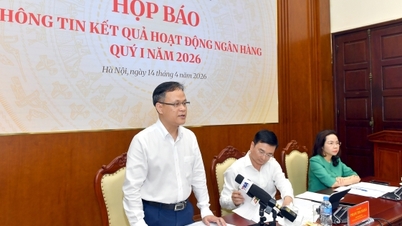
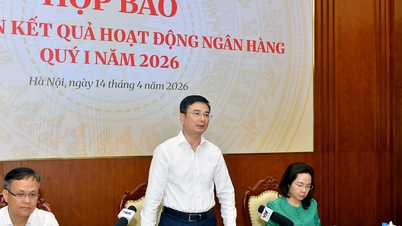
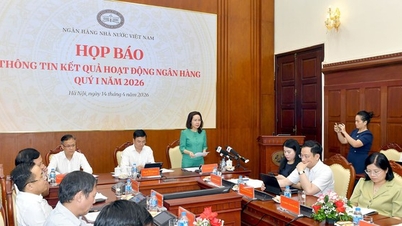
On April 14, 2026, at the first quarter regular meeting of the State Bank of Vietnam (SBV), Deputy Governor Pham Thanh Ha stated that in the first months of 2026, the complex and unpredictable global context continued to put pressure on the monetary policy management of emerging and developing economies with a high degree of openness, such as Vietnam.
However, adhering closely to the Resolutions of the Party, the National Assembly , the Government, and the directives of the Prime Minister, in March and the first quarter of 2026, the State Bank of Vietnam proactively and flexibly managed monetary policy, coordinating closely with a reasonable and focused expansionary fiscal policy and other macroeconomic policies to steadfastly prioritize the target of controlling inflation in 2026 at an average of approximately 4.5%, contributing to maintaining macroeconomic stability and supporting economic growth at 10% or higher.
Specifically, in credit management, in 2026, the State Bank of Vietnam (SBV) projects credit growth across the entire system to be around 15%, with adjustments made to reflect actual developments and circumstances, ensuring inflation control, macroeconomic stability, support for economic growth, and the safety of the credit institution system.
The State Bank of Vietnam also requested credit institutions to strictly control the rate of credit disbursement to high-risk sectors and the real estate sector in 2026 in order to direct credit flows into production and business sectors, priority sectors, and growth drivers of the economy, while ensuring the stability of monetary market liquidity and the safety of the operations of the credit institution system.
Credit solutions for specific industries and sectors are being actively and synchronously implemented to direct credit towards production and business sectors, priority sectors, and growth drivers as directed by the Government and the Prime Minister ; increasing access to bank credit and contributing to supporting and promoting economic growth.
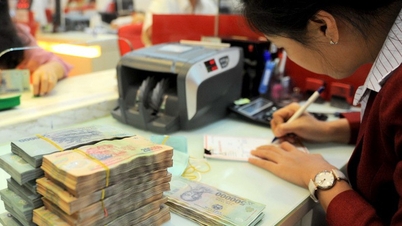
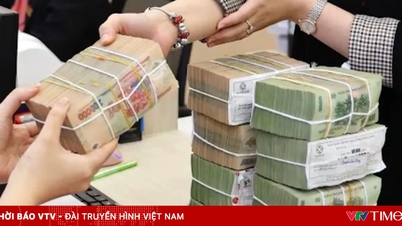
By March 31, 2026, outstanding credit in the entire system will reach over 19.18 million billion VND, an increase of 3.18% compared to the end of 2025. Credit will be focused on production and business activities and priority sectors.
Regarding interest rate management, a representative from the State Bank of Vietnam (SBV) stated that interest rates fluctuated somewhat in the first few months of the year, and the SBV implemented various measures to reduce them in accordance with the government's directives. However, due to the recent rapid increase in interest rates, the SBV has issued a document and held meetings with banks to discuss reducing interest rates.
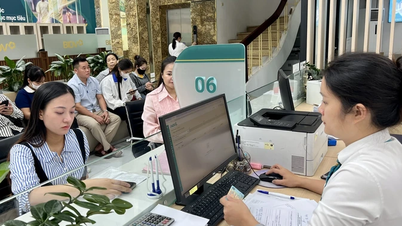
According to Mr. Pham Chi Quang, Director of the Monetary Policy Department, preliminary monitoring after the meeting shows that as of April 14th, 26 banks had reduced interest rates at both branch counters and online channels, with adjustments of approximately 0.1-0.5% per year, mainly for terms of 6 months or more. This provides a basis for reducing lending interest rates to support economic growth. Looking ahead, the State Bank of Vietnam believes there is room for banks to continue reducing deposit interest rates, which will help reduce input costs and contribute to lower lending interest rates.
Source: https://baophapluat.vn/con-du-dia-de-giam-lai-suat.html
![[Image] Expediting land clearance at Alley 310 Nghi Tam to facilitate the construction of Tu Lien Bridge](https://vphoto.vietnam.vn/thumb/1200x675/vietnam/resource/IMAGE/2026/04/14/1776160406551_ndo_br_z7724148990408-9e5d4777e3c4504998b4286178b2e66e-jpg.webp)




![[Photo] General Secretary and President To Lam visits and delivers a policy speech at Tsinghua University.](https://vphoto.vietnam.vn/thumb/1200x675/vietnam/resource/IMAGE/2026/04/14/1776164592318_vna-potal-tong-bi-thu-chu-tich-nuoc-tham-va-phat-bieu-chinh-sach-tai-dai-hoc-thanh-hoa-trung-quoc-8700658-5437-jpg.webp)


















































































Comment (0)