

Initially, I didn't know what kind of vegetable those green shoots were or who the split stems were sold to. Gradually, I learned they were water spinach; people discard the leaves and split the stems to deliver to restaurants. Their presence makes the dish more appealing and easier to eat. Perhaps that's why restaurant owners need people to split the vegetables. That's how the job came about. Splitting vegetables is easy work, not very strenuous. You just sit in one place. Occasionally, if your back aches, you stand up, stretch a few times like exercise, and then continue working.
The owner was quiet and didn't speak much, but she often smiled. Every time she saw me pass by, she would subtly curve her lips. I sensed it was a gentle and friendly expression, a greeting from a Saigon native to a nine-year-old boy from Quang Ngai like me. And I would return her greeting with a shy, pouty smile, my tiny mouth curving slightly.
That acquaintance gradually turned into affection. So, from time to time, she would give me juicy red apples and yellow pears. And I first recognized her voice when she said, "Here you go."
Her voice was as soft as a smile, barely audible to me. I thanked her in return. That was it. The conversation ended without further ado. To this day, I still don't know her name.
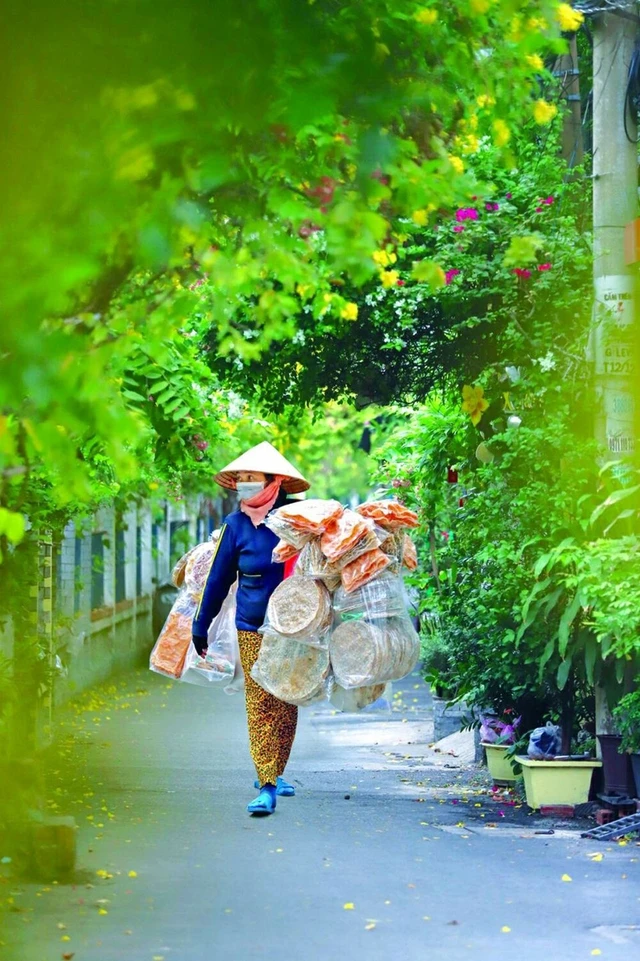
An old woman carrying a basket of snacks on her shoulder called out to the children, inviting them to buy her wares.
2. A few more steps and you'll reach the house of a middle-aged couple named Phuc Mai. I don't know their son's name. I only know they're neighbors across from my parents' rented room.
This couple is more talkative and cheerful than the vegetable vendor at the end of the alley. The husband, in particular, is incredibly approachable. Among my neighbors from Saigon, the husband, named Phuc, is the closest and interacts with me the most.
My uncle and I were like close friends, regardless of age. There was no distinction between us, even though, judging by our social standing, he was probably old enough to be my grandfather. There was no fear of class differences, even though his family was much wealthier than mine – one affluent man who hired foreign tutors to teach his son, and the other living in a tiny, cramped room, struggling to make ends meet.
The older the street, the more mature it becomes. The older people get, the easier it is to forget. But I will always remember the places in my heart. I remember the familiar alley. I remember the dear people. And the beloved city named after Uncle Ho.
My uncle often played riddles, asking quick questions about addition, subtraction, multiplication, division, and the multiplication table to see if I knew the answers. He'd ask a barrage of questions, making my head spin. Of course, the easy ones couldn't faze my brain. He'd laugh, pat my head, and praise me.
Not only did he praise me, but he also gave me generous money. Every time he craved cigarettes, he would give me an empty pack along with some money and ask me to go to the nearby cafe to buy some for him. I kept whatever was left over. He smoked just for fun, not because he was addicted at all. He'd puff on a few cigarettes a day, just to show off a little and let people know he was a man. It was quite easy. Just a few diligent steps and I'd get a reward. Not much, five or ten thousand dong, but for a child back then, that was a huge treat. At least I could buy a couple of bowls of jelly or some flan to enjoy.
Then, one time, my uncle gave me something like twenty or fifty thousand dong. I'm not sure which number was between the two. I only remember that it wasn't money for buying medicine, but money for offerings to wandering spirits on the 15th day of the seventh lunar month. After the offerings, my uncle told the children to gather around and take the sweets, snacks, and money. He knew I was weak and clumsy, so he set aside some money specifically for me.
3. Right next to my parents' rented room was the house of two sisters named Mai and Lan. They were also very friendly and outgoing, speaking with a distinctly city accent. The teenagers were sociable, loud, and natural, without any regional differences.
Next to Mai and Lan's house lives Oanh. This woman is a bit plump. She sells drinks and coffee from her home to make a living. The prices are reasonable, quite affordable for working people. The cheapest is iced tea. Only a thousand dong, but it's a large pitcher, enough to quench your thirst.
Whenever I had money, I'd rush over to buy iced coffee with milk, sarsaparilla, or Number One soda. I'd sit alone on a bench, sipping and enjoying the breeze, while also watching the rats scurrying around in the damp patch of ground behind me.
If I had to name another memorable person from Saigon, it would probably be Ms. Ha. She was the owner of a row of boarding houses and a newspaper stand. My parents and the other tenants all bought newspapers and spring rolls from her. Whenever people were short of money, she would let them pay later, or even if they didn't pay, she wouldn't demand it.
4. That alone was enough for me to breathe in the city air in this narrow alleyway, where the path is wide with human kindness.
It was in this alley that I met people from the city who lived beautiful lives, even if only through their glances, initial smiles, or intimate conversations. They lived with a spirit of caring and sharing, showing neighborly kindness.
It was here that I deeply understood what life was like for those who lived in rented accommodations. The struggles of food, clothing, and money, the endless cycle of worries and hardship. Each person had their own circumstances, but they all came from the same hometown in Quang Nam province, far from home, seeking happiness and prosperity in this promised land. They lived close together, sheltering in one large house, loving each other like siblings.
It was here that I also witnessed the vibrant scene of people from all walks of life struggling to make ends meet, venturing into every nook and cranny to scavenge for every penny, their familiar and endearing cries echoing through the air.
"Anyone want sticky rice with quail... sticky rice with corn... sticky rice with black beans...?"
"Lychee, dried lychee, rambutan, longan here..."
And then there's the clacking sound of the sandals of the sweet-voiced woman selling Hue-style beef noodle soup, the young man selling noodle soup late at night, or the old woman carrying her wares selling jelly and snacks, inviting children to buy her wares.
Where are they all today in this vast world ? Did anyone get hurt by the pandemic? I don't know anymore. It's been so long since my feet last wandered back to find a memory in that old alley. I only heard the newspaper owner say that Ky Dong is very different now. I imagine the difference she's talking about is nothing more than tall buildings, crowded streets, and a more opulent, luxurious atmosphere. The surrounding households have all moved away, each going their own way. Most of the tenants in the row of houses have returned to their hometowns. A few people cling to Saigon, continuing their daily struggle for survival. The newspaper owner has also given up on the newspaper. How many people read print newspapers anymore?
The older the street, the more mature it becomes. The older people get, the easier it is to forget. But I will always remember the places in my heart. I remember the familiar alley. I remember the dear people. And the beloved city named after Uncle Ho.

Source link


![[Photo] President Luong Cuong receives Speaker of the Jordanian House of Representatives Mazen Turki El Qadi](/_next/image?url=https%3A%2F%2Fvphoto.vietnam.vn%2Fthumb%2F1200x675%2Fvietnam%2Fresource%2FIMAGE%2F2026%2F02%2F03%2F1770112220330_ndo_br_1-3704-jpg.webp&w=3840&q=75)


![[Photo] Prime Minister Pham Minh Chinh receives Philipp Rösler, Chairman of the Switzerland-Vietnam Economic Forum.](/_next/image?url=https%3A%2F%2Fvphoto.vietnam.vn%2Fthumb%2F402x226%2Fvietnam%2Fresource%2FIMAGE%2F2026%2F02%2F03%2F1770121222295_ndo_br_dsc-8709-jpg.webp&w=3840&q=75)




Comment (0)