

Newcomers to Shanghai may be surprised by the large clothes drying racks protruding from high-rise apartment buildings, especially in older residential complexes.
But in the eyes of the locals, these drying racks resemble colorful flags fluttering in the wind.
Clothes drying racks in Shanghai are typically rectangular frames fixed to the wall, measuring approximately 3x2 meters, extending from balconies or windows. After washing, clothes are arranged on long poles and carefully hung on the frame. Each bamboo or steel pole is long enough to dry 3-4 bedsheets at a time.
These drying racks are popular because people believe they are more efficient than clothes dryers and save electricity.
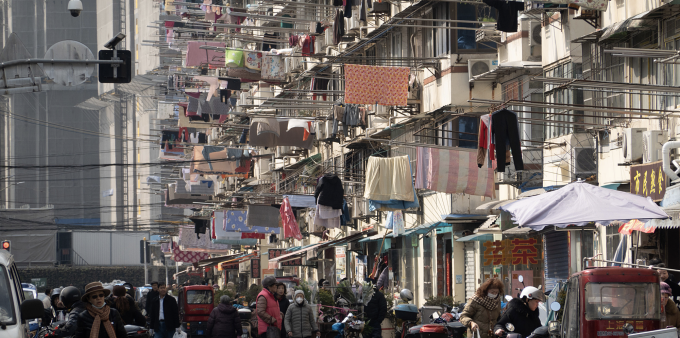
Clothes drying rack in an old apartment building in Shanghai, February 2024. Photo: Wang Gang/VCG
On sunny days, the sight of clothes drying in layers can inspire many artists and writers. But from another perspective, privacy is lost when people are willing to expose all their clothes, including underwear, to the street.
This may be one reason why the Shanghai authorities believe that clothes drying racks are unsightly and negatively impact the city's image. In 2010, officials announced a ban on people hanging clothes in windows on main streets. But for locals, this habit should be considered an "intangible cultural heritage" that cannot be eradicated.
Using these clothes racks requires skill. The long, two- or three-meter-long steel bars are very heavy, loaded with wet and heavy laundry, so it's difficult to avoid touching the dusty windowsill while maintaining balance.
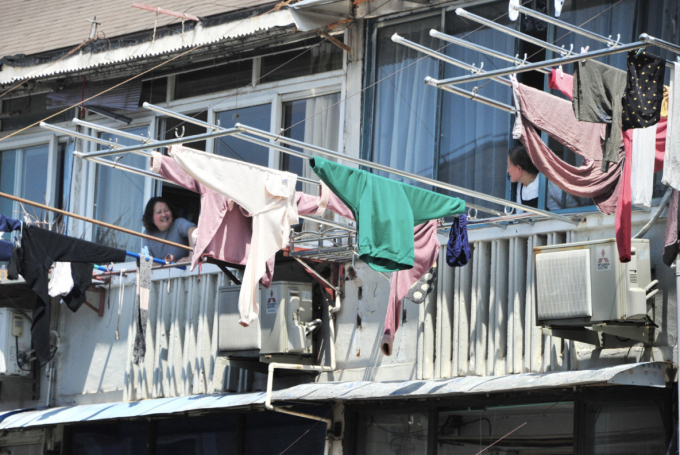
Two people chat while drying clothes in Shanghai, April 2022. Photo: VCG
There are still many differing opinions about the origins of the clothes drying racks in Shanghai.
Writer Ma Shanglong suggests that workers were the first to use this method. He speculates that drying racks may have appeared in one of the residential areas built in the 1980s or 1990s, to meet essential needs.
"Firstly, because the humidity in Shanghai is relatively high, people who move from houses to apartments still maintain the habit of drying clothes outdoors. Secondly, the cramped living space means residents lack room to dry clothes," writer Ma said.
According to statistics from the 1980s and 1990s, the average apartment in Shanghai was 13-15 square meters. A couple with children and basic furniture almost completely filled the room. Therefore, many families came up with the idea of expanding their balconies to increase living space.
"Because balconies are used as living space, residents are forced to install hangers outside their windows," the male writer shared.
Ji Bisou, another writer in Shanghai, also built a clothes drying rack that juts out onto the street. The popularity of these racks is linked to Shanghainese people's sensitivity to living space—a characteristic Ji calls "space hunger."
Zhou Liyuan, who lived on Huanghe Road in Huangpu District during the 1980s, was most struck by the sight of her mother-in-law fighting with neighbors over clothes-drying spots. Every morning, her mother-in-law—a petite woman—would grab seven or eight large bamboo poles and run outside to claim the sunniest spots. This often led to arguments with the neighbors.
"The scene was very tense; my daughter-in-law didn't dare go outside during those times because it was so chaotic," Zhou recounted. "Even now, when we meet again, my mother-in-law's old neighbors still call her a 'heroine'."
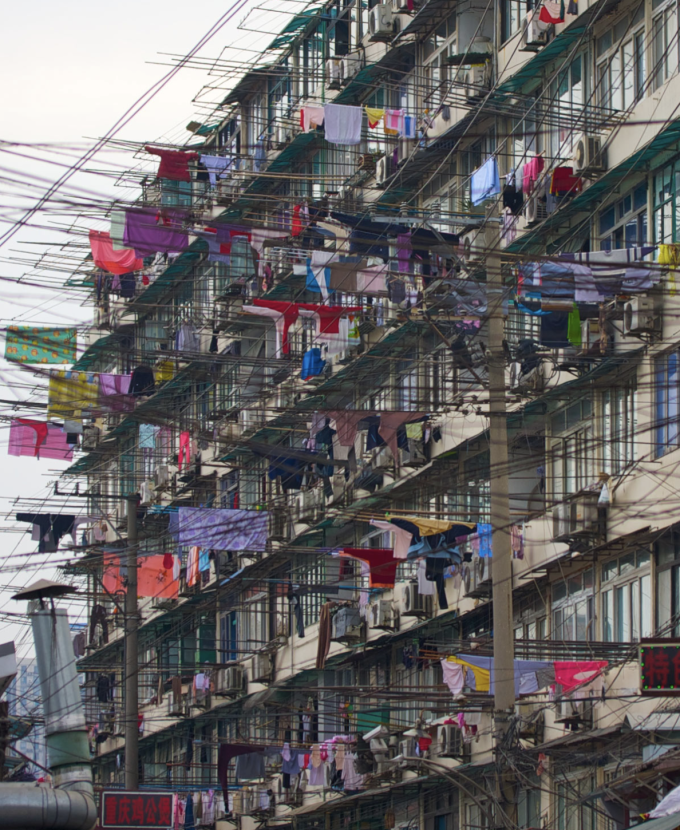
A clothesline extends onto the street at a high-rise apartment building in Shanghai in 2011. Photo: Reneby/VCG
Pan Yuhua, who lives in an apartment building in Jing'an District, said that a south-facing balcony and a large clothes drying rack are criteria for choosing a home.
Instead of clotheslines that extend up to 3 meters, many residents where Pan lives are now using smart clothes drying racks. However, she says the new devices can only extend up to about one meter and are not as convenient for drying clothes as traditional bamboo or steel poles.
While acknowledging their convenience, these traditional clothes drying racks have actually been the subject of several accidents. Previously, in an apartment building on Qinchun Road, Minhang District, a rack on the fourth floor was blown away by the wind, damaging the glass ceiling of a ground-floor apartment. Several residents have also fallen out of windows while trying to secure the racks. This has led some buildings in Shanghai to ban the use of these old-style racks, despite resident protests.
Minh Phuong (According to Sixth Tone )
Source






































































































Comment (0)