

In 2012, Ms. Tra (a midwife at Tu Du Hospital) faced two life milestones simultaneously: having a child and taking the university entrance exam. At 30, she longed to be a mother, but also didn't want to miss the opportunity to earn a bachelor's degree – a step forward in her career. Regretting that the opportunity to attend the program "isn't offered every year," she decided to study for the entrance exam to the Ho Chi Minh City University of Medicine and Pharmacy despite being pregnant.
Four days before the exam, she went to the hospital on her own. The young mother wanted a natural birth to recover quickly, but labor became difficult, and the doctor said she needed a C-section.
"There's no pain worse than childbirth. It's excruciating," she described her experience of going through both natural and cesarean deliveries.

Mother and child are both healthy. She cradled her baby, suckling on the first drops of colostrum, while still diligently studying for her exams, despite her colleagues' attempts to dissuade her. Three days after giving birth, the young mother took painkillers and entered the university entrance exam even though her surgical wound hadn't yet healed.
That was her first and last time giving birth. Despite working in a place where over 200 babies are born every day, she had long decided to stop at one child, ignoring the city's two-decade-long call to "have two children."
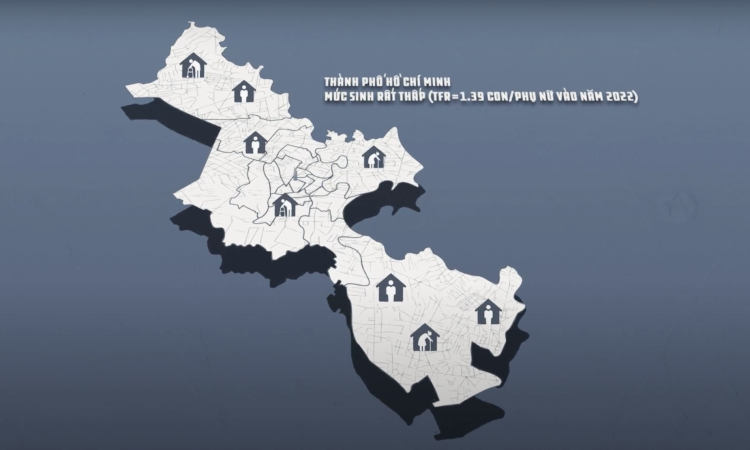
Ms. Tra is typical of a generation of women in Ho Chi Minh City after 2000 – where each woman gives birth to an average of 1.24-1.68 children, 20-30% lower than the national average. Meanwhile, the replacement fertility rate – the average rate to maintain a stable population size – is about 2.1 children per woman. For many years, Ho Chi Minh City authorities have expressed concern about a future population decline, meaning a shrinking workforce and slowing down the growth of this "economic powerhouse".
Economic growth coupled with declining birth rates is a trend observed in many developed countries. In South Korea, the country with the lowest birth rate in the world (0.78 children per woman), the economic hub of Seoul has the lowest birth rate (0.59). In China, a country that implemented a one-child policy for nearly 40 years, megacities like Beijing and Shanghai have birth rates of only around 0.7.
In Ho Chi Minh City, this trend has lasted for nearly two decades. Except for 2017, for the past 16 consecutive years, the city of 10 million people has ranked last in the country in terms of fertility rate, according to data from the General Statistics Office. Having two children has become a long-standing "desire" of the population sector in Ho Chi Minh City, instead of efforts to encourage people to "stop at two children to raise them well" as in many other localities.
In 2020, for the first time, fertility rate became a target in the city Party Committee's five-year resolution. The goal is for Ho Chi Minh City to achieve a total fertility rate of 1.4 children per woman by 2025, and increase to 1.6 in the following five years.
Each year, Ho Chi Minh City allocates approximately 700 million VND to communication activities aimed at raising awareness about population issues, such as hanging banners, producing propaganda films, and organizing seminars. However, this solution has proven ineffective, as the city has maintained its position at the bottom of the list in terms of birth rate for nearly two decades.
Women like Ms. Tra have many reasons to refuse to "solve" the city's shortage of newborns.

As the fifth of seven sisters, Tra witnessed a generational shift – from a generation where parents simply gave birth without any concept of family planning, to smaller families of one or two children – a complete reversal of the trend 20 years prior. At the heart of this change lay the mothers and wives.
Growing up during a time when women were confined to the ideal of "being good at both public and private affairs," Ms. Tra started working at 13, moved to Saigon alone at 22 to start her career, and became the main breadwinner for her family. Unlike her mother, who sacrificed her own desires to care for seven children, she had her own plans for herself.
"For me, family is family, career is career; you have to balance them well, you can't prioritize one over the other," the 41-year-old woman said.

When her daughter was three months old, Ms. Tra received notification that she had been accepted into university. A month later, she ended her maternity leave early and returned to work. From there, the 30-year-old woman began her journey of "three roles": mother, student, and midwife at the hospital.
Just like during her nine months of pregnancy, she did almost everything alone. Her husband is a soldier stationed in Dong Thap , only coming home once every three to four months. Both sets of grandparents live in Ben Tre, a three-hour drive from Ho Chi Minh City, and they particularly dislike coming to the city, only staying for a maximum of one week.
Even now, she's still haunted by those days of struggling to find ways to leave her child with relatives or neighbors, or carrying the baby to the hospital while on night shifts. When her child was in kindergarten, she paid extra for a private school teacher to look after the child until 9 or 10 pm – when she finished her second job at the clinic after her hospital shift. When her child went to primary and secondary school, she chose schools near her workplace for convenience in dropping off and picking up the child.
Every day at 5:45 a.m., the mother and daughter leave the house. Although she loves noodle dishes like vermicelli and pho, the child can only quickly eat breakfast behind her mother on the way to work, sometimes sticky rice, sometimes steamed rice rolls, or dumplings... Outside of school hours, the child spends most of her time at the hospital, finding her own ways to entertain herself, such as reading and drawing, waiting for her mother until evening before going home.
Witnessing many pregnant women coming for check-ups and giving birth every day, and seeing her daughter occasionally wishing for a sibling to play with, Ms. Tra once wavered. However, this thought was quickly dispelled after 11 hours of work each day, plus 2-3 hours of commuting.
"I feel sorry for my child because I don't have enough time for her. Having another child would be even worse, so I'll just give up," she said, expressing her regret throughout her 12 years of motherhood.
According to Pham Chanh Trung, head of the Ho Chi Minh City Population and Family Planning Department, marrying later and having fewer children is a growing trend. This is partly a result of the long-standing family planning policies of the past and a shift in perceptions about starting a family.
The average age for first marriage in Ho Chi Minh City is currently 29.8 – a record high in Vietnam, and nearly three years older than the national average. The city also tops the list for the single rate – 36% of adults in the city are unmarried, while the national average is 24%.

Mr. Trung analyzed that there are two groups of reasons for the decline in Ho Chi Minh City's birth rate: couples do not want, or do not dare, to have more children.
The first group is plagued by concerns about family burdens, living environment, healthcare, education , and especially opportunities for personal development and advancement. Over 83% of workers in Ho Chi Minh City work more than 40 hours per week, while the national average is nearly 72%, according to the General Statistics Office. As a result, the time available for rest and family is extremely limited.
For example, Ms. Tra is currently the Deputy Head of the Endoscopy Department at the largest maternity hospital in the South and also works part-time at a clinic, dedicating 11 hours a day to her work. The couple's average monthly income is 30 million VND, and they already own their own house. For this midwife, what she lacks isn't money, but time to care for her children.
For those who want to have children but are hesitant, the biggest pressure is economic. The high cost of raising a child discourages them from having many children. According to the General Statistics Office, the average income of workers in Ho Chi Minh City is 9.1 million VND per month. Meanwhile, a family with two young children needs at least 12 million VND per month to maintain a minimum standard of living, according to calculations by the Living Wage Alliance (before the 2020 pandemic).
Furthermore, the high level of urbanization also leads to a low birth rate in Ho Chi Minh City – where nearly 80% of the population lives in urban areas. Census results consistently show that rural families tend to have more children. In comparison, Hanoi has a more evenly distributed population in urban and rural areas (50-50), resulting in a birth rate of 2.1 children per woman – one and a half times higher than Ho Chi Minh City.
The low birth rate means Ho Chi Minh City has one of the lowest natural population growth rates among localities. However, this is offset by a net migration rate – the difference between immigration and emigration – that ranks among the top 5 in the country.

Ho Chi Minh City is a prime example of the demographic paradox in large cities: it has the lowest birth rate in the country, yet one of the highest population densities. Every five years, this southern economic hub adds nearly a million people – equivalent to the population of Binh Phuoc province. This megacity not only doesn't lack people, but is also facing overcrowding.
"Ho Chi Minh City is a magnet for immigrants," said Professor Giang Thanh Long (senior lecturer at the National Economics University), an expert on population and development.
Ho Chi Minh City's low birth rate is offset by higher birth rates elsewhere due to migration. Therefore, the city maintains a plentiful labor force. On average, for every 100 residents in the city, 75 are of working age (15-64), higher than the national average of 68%, according to the most recent 2019 census.

With a population density 15 times higher than the national average, nearly 4,500 people per square kilometer, Ho Chi Minh City's infrastructure is overloaded in many aspects. Each square kilometer has only 2.26 kilometers of roads, one-fifth of the standard. The high population density leads to pressure on housing. The average living space per person is less than 22 square meters, 5 square meters less than the national average.
Along with limited living and transportation space, infrastructure for childcare and education is also a problem. The average number of primary school students per class in Ho Chi Minh City is currently 39.4, among the highest in the country. Assuming Ho Chi Minh City's birth rate increases to the replacement level of 2.1 children per woman, this means the number of children born annually would have to be at least one and a half times the current rate. If the city doesn't prepare additional schools, the average class size could reach 60 students per class.
This reality puts the megacity of Ho Chi Minh City in a difficult position: it wants to encourage childbirth while simultaneously solving the problem of overcrowding.
"Increasing the birth rate is not yet a pressing issue for Ho Chi Minh City," Professor Long stated. Instead, the city should allocate resources to alleviate infrastructure pressure and meet essential needs such as transportation, housing, and education for its residents.
Conversely, Pham Chanh Trung, head of the Ho Chi Minh City Population and Family Planning Department, argued that the city must improve its birth rate soon to reduce its dependence on migrant labor.
"Many localities are in dire need of young talent to drive economic development," he explained.
Besides Ho Chi Minh City, 24 localities nationwide, mainly in the southeastern provinces (excluding Binh Phuoc) and the Mekong Delta, also have birth rates below replacement level. Without sufficient local labor, Ho Chi Minh City will struggle to achieve sustainable development as surrounding provinces compete to attract immigrants.
Furthermore, migrants face difficulties accessing housing and lack family support, leading to reluctance to have children. According to the 2019 census results from the General Statistics Office, migrant women on average gave birth to 1.54 children, while those who did not relocate had 2.13 children. This indicates that the higher the proportion of migrant workers, the lower the birth rate.
"The city's population is aging rapidly," warned Pham Chanh Trung, head of the Ho Chi Minh City Population and Family Planning Department.
The persistently low birth rate has led Ho Chi Minh City to begin falling into the upper half of the aging index, with the proportion of people aged 60 and over among children reaching 56%, while the Vietnamese average is 53%. This figure raises concerns in the health sector about the prospect of a rapid increase in the elderly population, putting pressure on the existing social security and healthcare systems, which are not yet ready to adapt.
According to Mr. Trung, the health sector is preparing for a significant turning point in population policy. The city will use "real money and resources" to encourage people to have two children, instead of just relying on verbal persuasion as before.

In the draft of the Population Policy for Ho Chi Minh City until 2030, expected to be submitted to the City Council at the end of this year's session, Ho Chi Minh City is planning to reward families with money or gifts for having two children, following a policy encouraged by the Ministry of Health since 2021.
If approved, the city is expected to support families having a second child through hospital fees, social housing packages, changes to preschool childcare arrangements, personal income tax exemptions and reductions, and adjustments to maternity leave policies. The estimated amount for this birth control program is up to 50 billion VND per year, significantly higher than the current 700 million VND, which is mainly spent on communication activities.
Even though a city of 10 million people is willing to increase its budget for childbirth by 70 times, Dr. Le Truong Giang, Chairman of the Ho Chi Minh City Public Health Association, believes it is still insufficient. Meanwhile, Professor Giang Thanh Long argues that the budgets of megacities like Ho Chi Minh City should focus first on improving infrastructure, education, and housing, thereby enhancing the quality of life for its residents.
"The cost of raising a child will become increasingly expensive, not to mention the opportunity cost in terms of career and employment. If we provide financial support, how much will be enough, and can our budget handle it?", Professor Long said.
The two experts cited several developed countries that have failed to reverse this trend.
Japan was one of the first countries in the world to use monetary incentives to encourage childbirth, starting in 1972 when the birth rate fell to 2.1 children per woman. The birth rate only briefly improved before plummeting again, currently standing at 1.3 children per woman. Similarly, the South Korean government is estimated to have spent over $200 billion over the past 16 years to encourage women to have children, but the birth rate remains the lowest in the world – less than 0.8 children per woman.
According to Mr. Giang, the policy to encourage childbirth should be linked to the practical goal of maintaining the current level or slightly increasing it, rather than drastically raising the birth rate back to replacement level. He recommended that Ho Chi Minh City should not stop at encouraging families to have two children, but should provide more support to families having a third child.
"A family having a child must calculate whether they have the financial means to invest in the child until adulthood. Therefore, support policies must be continuous, long-term, and comprehensive to be effective," he said. The expert believes that state support must follow the entire process from pregnancy, childbirth, healthcare, and child-rearing to encourage couples to have more children.
Labor shortages will be an unavoidable reality; therefore, he believes that Ho Chi Minh City needs appropriate policies to attract immigrants, prioritizing skilled and highly qualified groups, in line with the principles of knowledge-based economic development.
Meanwhile, Pham Chanh Trung, head of the Ho Chi Minh City Population and Family Planning Department, warned that today's low birth rate will become a burden for the "only child generation" in the future. These children, once protected by both their paternal and maternal families, will bear the responsibility of providing for the welfare of a super-aging society, which means a shortage of labor.
"Low birth rates are a very difficult problem. The lesson from countries that have only one child shows that Ho Chi Minh City must anticipate population aging, and having two children is one of the most important measures," concluded the head of Ho Chi Minh City's population department.
Viet Duc - Le Phuong - Thu Hang
Source link







































































































Comment (0)