

The morning in Cuôr Đăng B village (Cuôr Đăng commune) was still chilly. In the quiet space, the creaking sound of bare feet on the stilt house floor echoed. Ms. H Lơk Êban woke up before the sun rose above the trees. The first thing she did, like generations of Êđê women, was to light a fire.
The crackling sound of dry firewood filled the air, and the pungent smell of smoke began to permeate the space, seeping through every crack in the walls. Ms. H. Lơk gently blew on the glowing embers, igniting a flame that dispelled the chill of the early morning. For her, that fire was the heartbeat of the longhouse.
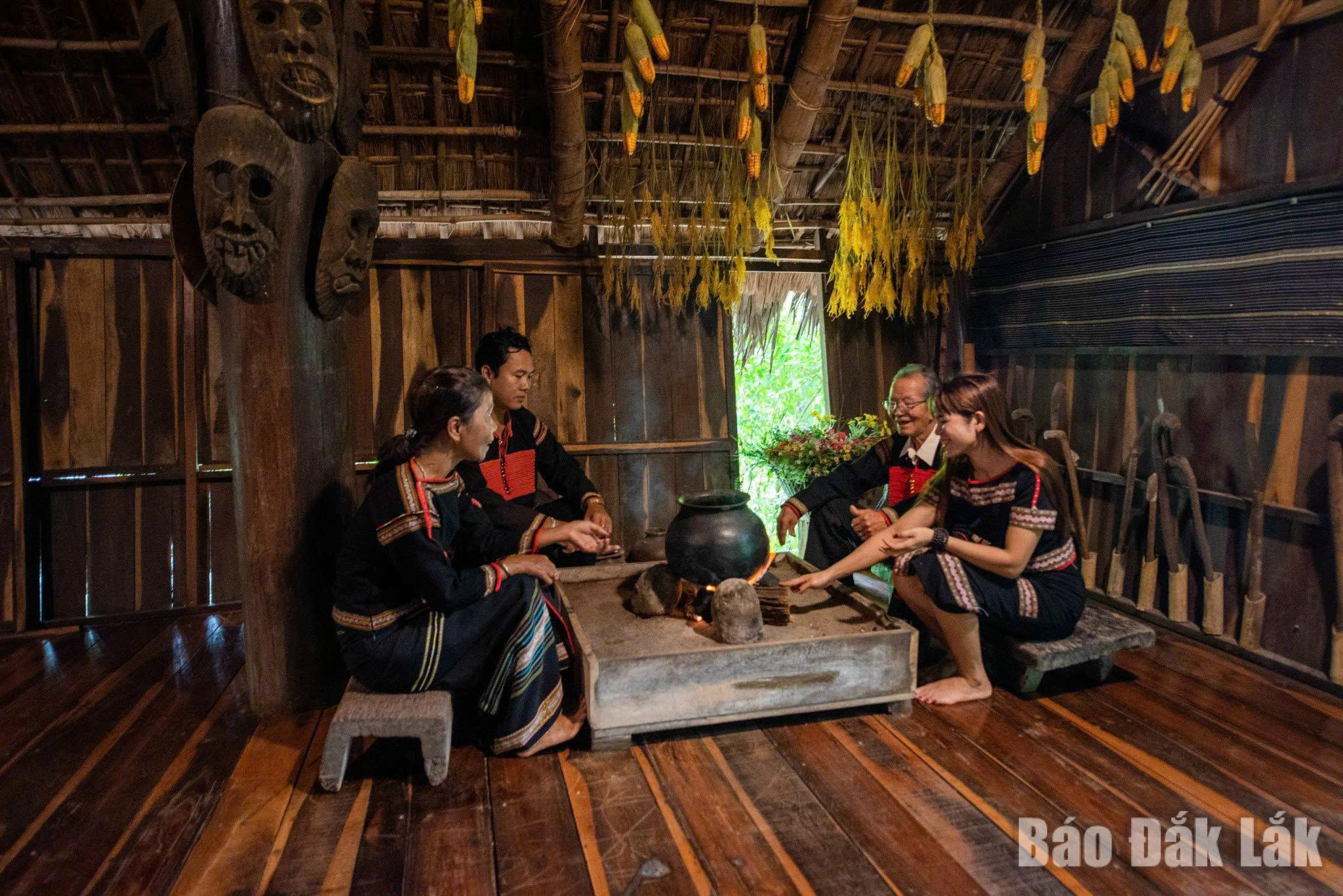 |
| For the people of the Central Highlands, the hearth is more than just a hearth. It holds a distinct and authoritative space. Photo: Huu Hung |
“My family preserves the tradition of cooking with wood-fired stoves, a traditional practice of the Ede people, because the hearth is closely linked to the cultural and spiritual life of the community. For the Ede people, the hearth is not only a place for cooking but also a shared living space, where families gather, share stories, and connect generations. The fire symbolizes prosperity, the continuation of the lineage, and a harmonious way of life with nature. Maintaining the wood-fired stove is how my family preserves customs, respects the traditional way of life of our ancestors, and passes on to our children and grandchildren an awareness of cherishing the cultural identity of the Ede ethnic group…,” Ms. H. Lok shared.
In her story, the hearth appears as a living entity. Situated on a sturdy rectangular wooden frame with tightly packed clay, the hearth acts as a barrier between the heat and the wooden floor, protecting the house from fire while allowing warmth to spread throughout the space. Above the hearth, gourds filled with water, dried yellow corn cobs, and woven baskets, stained by time and gleaming brownish-gray from smoke, create a small "museum" containing the memories of an entire family lineage.
A few houses away, the family of Ms. H. Juôl Niê was also preparing breakfast by their wood-burning stove. Sitting by the fire, chatting together, is a familiar part of their family life. She confided: “In modern life, even with convenient gas or electric stoves, they can't provide the true warmth. For us, the fire is where the whole family gathers every day. Just sitting together, listening to the sound of the wood burning, sharing a bowl of hot rice, chatting, and sharing joys and sorrows, all fatigue disappears. Keeping the fire burning in the longhouse is about preserving family warmth, maintaining community life so that our children and grandchildren don't forget the beautiful cultural values of our people in the flow of modern life…”
It is precisely this small space around the hearth that fosters strong bonds of affection. It is where the elderly recount stories of the past, passing on knowledge and culture; where women learn to weave brocade; and where children learn to appreciate the scent of the kitchen smoke. Therefore, the fire in Ms. H Juôl's stilt house never goes out; it continues to smolder, warming and illuminating human values.
Meritorious Artist Vu Lan, a researcher of folk culture, has dedicated his love to the sun-drenched and windswept land of Dak Lak . According to him, the hearth in the longhouse of the Ede people is not simply a tool for daily life, but a space for oral culture. He observes with profound knowledge and passion: “If we liken the longhouse to a wooden boat gliding through the vast forest, then the hearth is the engine, the heart that propels that boat. In the mystical space of the firelight and smoke, the heroic epics (khan) truly come alive. The artist who sings and tells epics by the hearth doesn't just tell with their mouth, but with their soul warmed by the fire god Yang Pui.”
Meritorious Artist Vu Lan further emphasized that Ede culture is a culture of unity. The women's perseverance in keeping the fire burning is an act of preserving a "living heritage." "The hearth is the origin of gong music , the place where the fragrant rice wine is brewed, and where rhyming verses (klei duê) are passed down. If the hearth is lost, the longhouse will become cold and desolate, and the ethnic identity will gradually fade. Keeping the fire burning is preserving the source of life," Meritorious Artist Vu Lan affirmed.
As spring arrives, walking through the villages of the Ede people, watching the gentle blue smoke rising from the longhouses, one suddenly feels an overwhelming sense of peace. The fire in the longhouse hearth is like a whisper from the past to the future; a reminder that, no matter how much the world changes, no matter how far technology advances, the values of kinship, togetherness, and respect for one's roots remain precious.
Lan Anh
Source: https://baodaklak.vn/van-hoa-xa-hoi/van-hoa/202602/con-vuong-huong-bep-nha-dai-9247d9a/

![[Image] 20 islands in the Spratly Islands special administrative region hold early elections.](https://vphoto.vietnam.vn/thumb/1200x675/vietnam/resource/IMAGE/2026/03/08/1772949669607_img-20260308-112026-90-jpg.webp)
![[Photo] Urgent efforts to mitigate the consequences of the barge colliding with the Ghenh Bridge.](https://vphoto.vietnam.vn/thumb/1200x675/vietnam/resource/IMAGE/2026/03/08/1772956866931_ndo_br_dji-20260308105506-0016-d-resize-5169-jpg.webp)






















































Comment (0)