AI and data: The doctor's "second brain".
One of the recurring themes in the presentations at the international scientific conference "Breakthroughs in the Diagnosis and Treatment of Cardiovascular Diseases," organized by Binh Dinh Hospital on April 3rd in Gia Lai, was the increasing role of artificial intelligence (AI) in cardiovascular diagnosis.
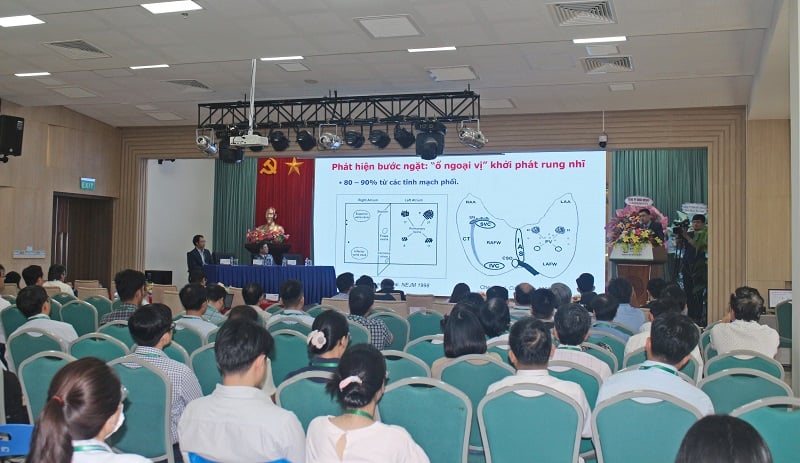
The international scientific conference on cardiology attracted a large number of doctors and medical professionals from within and outside the province.
The application of AI to echocardiography, CT, and multislice MRI helps in the early detection of coronary artery lesions and structural cardiac abnormalities, thereby significantly improving disease prognosis.
Beyond simply "seeing the damage," data analytics tools extend to risk prediction, helping doctors develop treatment plans tailored to each individual patient. This marks a significant shift from empirical medicine to data-driven medicine.
According to Dr. Nguyen Do Anh, Head of the Interventional Cardiology Department at Gia Dinh People's Hospital, the biggest breakthrough in recent years lies not in interventional techniques alone, but in the ability to deeply understand the nature of vascular damage.
Previously, coronary angiography primarily provided two-dimensional images, while vascular structures are complex three-dimensional spaces. The emergence of techniques such as IVUS and OCT has allowed physicians to "go inside the vessel," accurately assessing the morphology of lesions and thereby optimizing intervention strategies.
According to him, this change has contributed to a reduction in the rate of major cardiovascular events, while also improving the long-term effectiveness of treatment – something that previous methods struggled to achieve.

Professor Minh Bui – a cardiologist from the University of Colorado (USA) – shared his insights at the conference.
From an academic perspective, Professor Minh Bui – a cardiologist from the University of Colorado (USA) – believes that the combination of AI and big data will continue to profoundly change cardiology in the future.

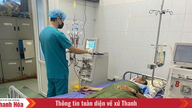
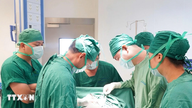
"We are moving towards a stage where each patient will have a complete 'digital data profile,' which will help doctors make more accurate treatment decisions, instead of relying on general models," Professor Minh Bui stated.
This also means that the lines between diagnosis and treatment are gradually blurring, as data becomes a pervasive element throughout the entire patient care process.
Minimally invasive interventions are on the rise.
Alongside the development of AI and data, next-generation cardiovascular devices are creating significant changes in clinical practice.

Professor Huy Phan – a US cardiologist, shared this information.
In a report on handling complex implant cases, Professor Huy Phan – a US cardiologist – shared his experience in applying modern devices such as wireless pacemakers and subcutaneous implantable defibrillators.
According to him, these devices significantly reduce the risk of infection, limit complications related to catheters, and improve the quality of life for patients.
"We are shifting from 'deep penetration' devices to more minimalist, yet highly effective solutions," Professor Huy Phan observed.
Furthermore, conduction-system pacing techniques are also considered a significant advance in the treatment of arrhythmias. Dr. Pham Tran Linh from Bach Mai Hospital believes that selecting a pacing site that aligns with the heart's natural physiology can improve heart function and reduce the risk of heart failure in the long term. This demonstrates that modern cardiovascular interventions not only aim for immediate results but also consider the long-term impact on the entire cardiac system.
Minimally invasive techniques such as transcatheter atrial fibrillation (TAVI) are also mentioned by many experts as an inevitable trend, especially in the context of an aging population.
Replacing open surgery with percutaneous intervention not only reduces risks but also shortens recovery time, expanding treatment opportunities for patients who were previously ineligible for surgery.
In the field of internal medicine treatment, a report by Dr. Luong Cao Son, Head of the Cardiology Department at the University Medical Center of Ho Chi Minh City, on the role of SGLT2-agonist drugs has shown a new approach in heart failure management.
According to him, treatment should no longer focus on symptom control but rather on comprehensive management of disease progression, from inpatient to outpatient care, helping to reduce hospitalization and mortality rates.
While these technologies are reshaping cardiology worldwide , at Binh Dinh Hospital, these trends are gradually being implemented in practice. Dr. Phan Nam Hung, Director of Professional Services at Binh Dinh Hospital, said that the unit has mastered many advanced techniques, from coronary intervention to research on biological indicators for diagnosis and risk stratification.



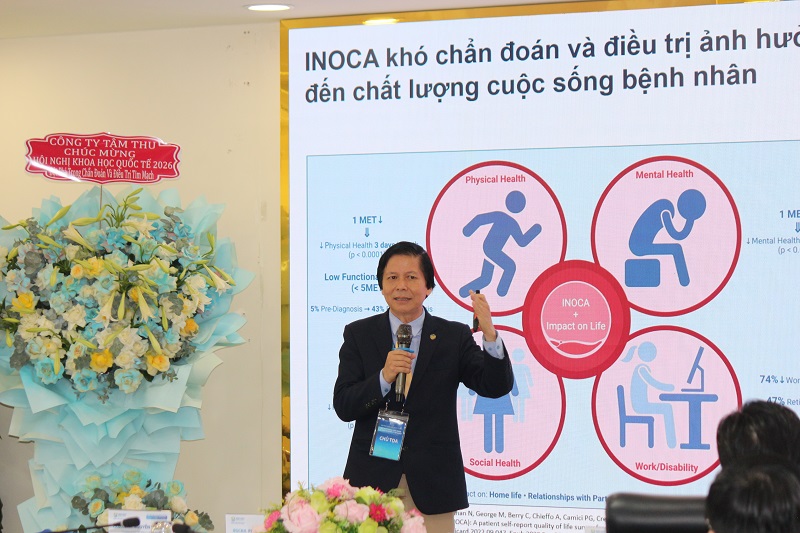
Dr. Phan Nam Hung, Director of Professional Services at Binh Dinh Hospital, shared information at the conference.
According to Dr. Hung, in the treatment of chronic coronary syndrome, the hospital has shifted from a symptom-based approach to a comprehensive, optimized treatment strategy, combining risk assessment, the extent of coronary artery damage, and comorbidities to select the appropriate method for each patient. In the field of heart failure, new treatment protocols are applied in parallel with continuous management procedures from inpatient to outpatient care, helping to reduce readmission rates and improve long-term prognosis.
"We believe that professional development is not just about implementing new techniques, but must go hand in hand with scientific research and standardizing treatment procedures. The ultimate goal is to bring real effectiveness to patients, right at the provincial level," emphasized Dr. Phan Nam Hung.
Source: https://doanhnghiepvn.vn/cong-nghe/cong-nghe-dang-viet-lai-nganh-tim-mach/20260403103251977