

Along the border from Thanh Hoa province to Hue city, ethnic minorities such as the Thai, Mong, Kho Mu, Pa Co, and Van Kieu live scattered in remote villages, facing many difficulties in socio-economic development. In practice, to effectively disseminate the Party's guidelines, the State's policies and laws, and to encourage people to abandon outdated customs, develop the economy, and maintain security and order, the most important thing is for officials to understand the customs and traditions of the ethnic minorities and speak their languages.
 |
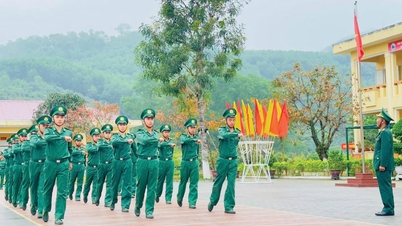
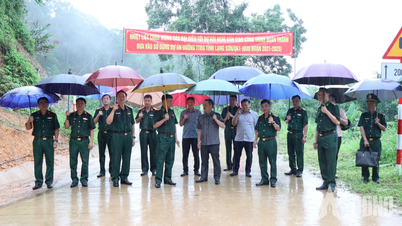
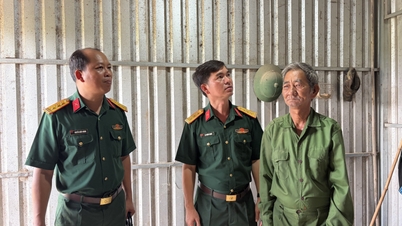
| Soldiers and militia in Thanh Hoa province use ethnic minority languages to disseminate legal information, September 2025. |
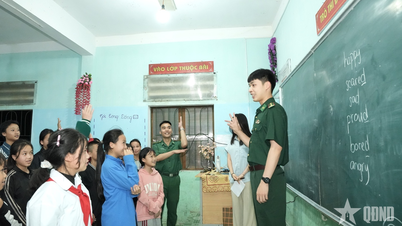
In Thanh Hoa province, the Provincial Military Command organizes 2-3 classes annually to teach ethnic minority languages to approximately 100-150 students, including officers and soldiers. Colonel Nguyen Xuan Toan, Deputy Political Commissar of the Thanh Hoa Provincial Military Command, said: "When soldiers understand the customs and traditions and can speak the language of the ethnic minorities, the people will be more open. Thanks to this, propaganda and mobilization efforts among the people become much easier."
In the western part of Quang Tri province, where nearly 66% of the population are Van Kieu ethnic minorities, the 337th Economic-Defense Brigade has clearly identified that learning the ethnic language and understanding their customs and traditions is a mandatory requirement for officers working in civilian affairs. The unit maintains Van Kieu language classes and invites village elders and influential figures to directly teach the customs and traditions of the ethnic group. Lieutenant Colonel Tran Dinh Cong, Assistant for Civil Affairs of the 337th Economic-Defense Brigade, shared: “In the early days of arriving in the villages, whenever we needed to communicate with the people, we had to rely on interpreters. Once we understood their customs and could speak their language, the people treated us like family, often sharing their difficulties so that the soldiers could overcome them together.”
During the rainy season, Huong Lap commune (Quang Tri province) frequently faces the risk of flash floods, seriously affecting the lives of its people. In response, the 337th Economic-Defense Brigade proactively coordinated with local authorities to raise awareness, mobilize support, and assist residents in relocating to safer areas. At the end of 2021, when heavy rains continued and flash floods threatened Trang village (Trang Ta Puong hamlet, Huong Lap commune), unit officers went directly to the village and persistently persuaded residents to move their homes. Thanks to their fluency in the Van Kieu language, the officers successfully persuaded 30 households to voluntarily relocate to higher ground in a short time. Ms. Ho Kha Chai, a resident of Trang village, shared: “The soldiers spoke our language, and we understood and followed their instructions immediately.”
At the Ka Trên village cultural center (Na Ngoi commune, Nghe An province), we witnessed a large number of people participating in a campaign to raise awareness and discourage the illegal storage, buying, selling, and use of weapons, explosives, and supporting tools. This campaign was organized by the Na Ngoi Border Guard Post (Border Guard Command, Nghe An Provincial Military Command) in coordination with the 4th Economic-Defense Group and the local authorities. The soldiers explained the legal regulations in the Hmong language, combining them with real-life stories and visual aids, making it easy for the villagers to understand. At the end of the campaign, in the villages of Ka Trên, Tham Hon, Tang Phan, and Huoi Thum, over 350 people signed pledges and surrendered 10 firearms along with many dangerous supporting tools. Lieutenant Colonel Luong Hai Kien, Deputy Political Commissar of the 4th Economic-Defense Brigade, emphasized: "In mass mobilization work, you must understand the culture and language of the people so that the mobilization will be effective. Many economic models and bright spots in border areas have succeeded thanks to cadres who speak the same language as the people."
Currently, the 4th Military Region organizes dozens of training courses on ethnic minority knowledge and language instruction each year, attracting thousands of officers and soldiers. Thanks to propaganda in the languages of the ethnic minorities, people's awareness of law compliance has significantly improved; the incidence of slash-and-burn agriculture, illegal border crossings, illegal proselytization, and the possession of homemade weapons has decreased sharply. Many effective models such as "Model Military-Civilian Cultural Villages," "Border Region Voices," and "Joining Hands to Implement 3 National Target Programs" all bear the strong imprint of officers and soldiers who understand the customs and are fluent in the languages of the ethnic minorities.
From ethnic language classes to border villages, the voices of the people have become a bridge connecting the military and civilians, a "soft power" that helps soldiers stay close to the villages and people, accompanying them in socio-economic development and building a new life. It is from this that the "milestones of the people's hearts" are increasingly strengthened, contributing to the security of the nation's borders from the roots of the people.
Source: https://www.qdnd.vn/nuoi-duong-van-hoa-bo-doi-cu-ho/cot-moc-long-dan-noi-bien-gioi-1021366



![[Photo] General Secretary and President To Lam presides over a working session with the Central Policy and Strategy Committee on the development of the materials industry.](https://vphoto.vietnam.vn/thumb/1200x675/vietnam/resource/IMAGE/2026/05/21/1779359935432_a3-bnd-3129-1412-jpg.webp)




























































Comment (0)