


The old boat dock from Ward 1 to the islet.
In the article "Forest in the City" published in the Tay Ninh Newspaper on June 14, 2023, there is a name often mentioned with pride by Mr. Nam, the caretaker of the islet. That is the land belonging to his neighbor, Mr. Van, a teacher. Furthermore, we learned that this land once belonged to a descendant of Mr. Nguyen Cu Hien, also known as Quoc Bieu—one of the sons of the famous Tay Ninh teacher Duong Minh Dang.
Searching through the Dương family genealogy in Ninh Thạnh village, Tây Ninh province, I learned that Teacher Văn was actually the son-in-law of Quốc Biểu. He was the husband of Việt Nữ, Quốc Biểu's eldest daughter, commonly known as Nguyễn Thị Hiệp, also known as Ngọc Bích.
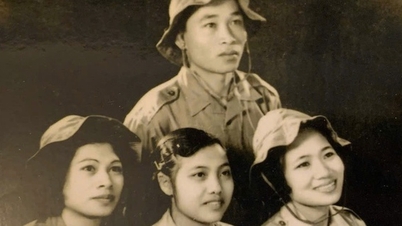
Ms. Viet Nu is also a figure recorded in most historical books of Tay Ninh from the early period, after the Autumn Revolution took place on September 25, 1945 in Tay Ninh. As stated in the book "Revolutionary Traditions of Tay Ninh Women" (Tay Ninh Provincial Women's Union, 1991): "In the Tay Ninh town area, we had a leadership organization, with Ms. Viet Nu in charge from the beginning."
After several months of activity, when the enemy occupied the town, the Provisional Executive Committee of the Provincial Women's Association withdrew and dispersed. Sister Viet Nu, along with Sisters Tu Chia, Sau, and Lien, remained to operate secretly. They organized and mobilized the people in the town to make dried rations for the soldiers withdrawing to the provincial capital to continue the resistance... When the Information Department needed printing type, she personally went to Saigon to buy it, mixed it with rice, transported it by ox cart, sifted out the type, and washed the rice clean so that she could use it as well... She was imprisoned twice by them (French colonialists - TV)..." (pages 49-50).
The 66th Anniversary Yearbook of Tay Ninh Newspaper (2012) also notes that the first revolutionary newspapers published in Tay Ninh were the Tin Tuc (News) newspaper, released in October 1946. After 3 issues (3 months), it was upgraded to the Dan Quyen (People's Rights) newspaper: "Lawyer Duong Minh Chau (former Chairman of the Tay Ninh Provincial Administrative Resistance Committee - TV) assigned a niece of his in Tay Ninh town, Ms. Viet Nu, a logistical support base of the Propaganda Department, to find a way to connect with Mr. Phan Minh Chon (also known as Phan Van), a revolutionary working in the French printing factory in Tay Ninh."
Issues 1 and 2 of Dan Quyen (People's Rights) printed on clay were delivered to Mr. Phan Van. He took the newspapers back to the Truong Tien Department to reprint them using sandpaper and secretly distributed them among the Nam Thanh Youth Union, a progressive organization of intellectuals, civil servants, students, and urban petty bourgeoisie…”.
Thus, Ms. Viet Nu was not only a pioneer in the revolutionary movement of women in the town (now Tay Ninh City) but also a pioneer in the founding and development of Tay Ninh Newspaper.
Mrs. Viet Nu's husband, Mr. Le Chi Thanh, also known as Co Le, was the one who registered the land on Go Chet islet. This information comes from the Duong-Ninh Thanh family genealogy. The genealogy states that one of Mr. Le Chi Thanh and Mrs. Viet Nu's six children was Colonel Le Su (now deceased). During his lifetime, Colonel Su returned to the islet to continue managing the land his father left behind.
Notably, not only was he the son-in-law of the National Assembly's representative, but Co Le - Le Chi Thanh was also a member of the National Assembly's literary circle established in 1923. Therefore, he "bought out" a part of the islet to use as a meeting place for discussing literature and poetry, and of course, "national affairs" related to the fate of the country.
Speaking of Mr. Quoc Bieu, considered the "leader" of the literary world, he is one of the ten historical figures of Tay Ninh mentioned in the book "Ancient Tay Ninh." Of these, only two are mentioned in modern times: Mr. Vo Van Sam and Mr. Quoc Bieu. According to the detailed records of author Huynh Minh, Mr. Quoc Bieu was a patriotic scholar.
Among his "associates" were revolutionaries Tran Huy Lieu and Nguyen An Ninh. Therefore, "his revolutionary spirit began to blossom, often using poems to awaken the people to rise up against the French…".
From a poem considered a masterpiece, Huynh Minh analyzes: “Borrowing verses that call for unity, expressing the indomitable will to rise up, the poem urges people to persevere, parting the clouds to let the sun shine on our country. Literally, it means that the empire has laid a solid foundation like a tree on our land, so he advises everyone to strive together, until the tree's roots are eventually uprooted, parting the clouds to let the sun shine on the entire land. The powerful cry of the cranes resounds, the land and water are uniquely ours! Who knows who it is?” Literally, it means: we are like a flock of cranes flying across the sky, united in resisting invasion, then this land and water will belong to us alone, no one else will…
Regarding the purchase of land on Go Chet islet, there was a reason for it. Initially, Mr. Quoc Bieu "bought a square plot of land in Suoi Don (on the road to Ba Mountain) and built a thatched hut in the middle of a deserted forest and stream. During the day, he grew vegetables, but many nights there were meetings between Saigon literati, especially Mr. Nguyen An Ninh, who often frequented the place in the cold late hours of the night..."
At that time, a revolutionary monk named Nhat Thien accompanied him to Dan Bac (Ba Den Mountain) to build a fake hermitage, abandoning his life so that the French would no longer have any suspicions, but in his heart, he was planning something important. The Secret Police sent someone disguised as a visitor to see the scenery. Seeing this, Quoc Bieu went to Go Chet - an island surrounded by water on all sides, also with the intention of using poetry to encourage the anti-French movement…”
As we know, the members of the National Assembly's literary circle "bought out" a portion of the hill on the island (registered under the name of the Literature teacher Le Chi Thanh) to serve the aforementioned purpose. This story took place in the 1920s.
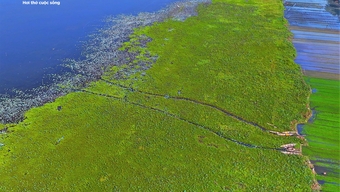
One hundred years have passed since the founding of the National Literary Circle. The water continues to flow tirelessly around Go Chet. Only a couple of poems by the elders remain, transcribed by Huynh Minh. But the nature of the island region probably remains the same as before.
The descendants of the elders still persistently preserve a few memories of their ancestors, even though the hilly land remains a plain and a forest, shaded by tall trees and thickets. Not only are there birds chirping, but also countless mosquitoes and leeches. The old huts where literary groups used to gather are gone. Only the hut of Mr. Nguyen Su—a Colonel and Political Commissar of a regiment in the Southern Liberation Army—remains, where he met with his friends after his retirement.
There was also a makeshift stilt house, supported by corrugated iron sheets, where descendants from afar could rest temporarily. Furthermore, there was a tomb tower and memorial plaque for the Duong family, built by Mr. Nguyen Su, containing the remains of some relatives when the State cleared the "Sacred Land" cemetery to build the market in Ward 3. The tower, about 2 meters high, had a pointed triangular spire, standing isolated in the grass amidst the forest. Perhaps these were the last remnants of the Quoc Bieu literary circle.
Ultimately, preserving it required immense effort and perseverance. Over a hundred years, three or four generations, the barren land yielded almost no profit. However, the only neighbor of Mr. Su's descendants, Mr. Nam's family, recently sold more than half of the remaining hillock. The buyer likely had a positive outlook on the future of the land known as Go Chet. Perhaps he was right, for sooner or later, this once glorious land will be restored, even more glorious than before.
Tran Vu
Source link

![[Photo] Prime Minister Pham Minh Chinh receives the Chinese Ambassador to Vietnam](https://vphoto.vietnam.vn/thumb/1200x675/vietnam/resource/IMAGE/2026/04/05/1775397481797_ndo_br_dsc-5512-jpg.webp)




























































Comment (0)