

 |
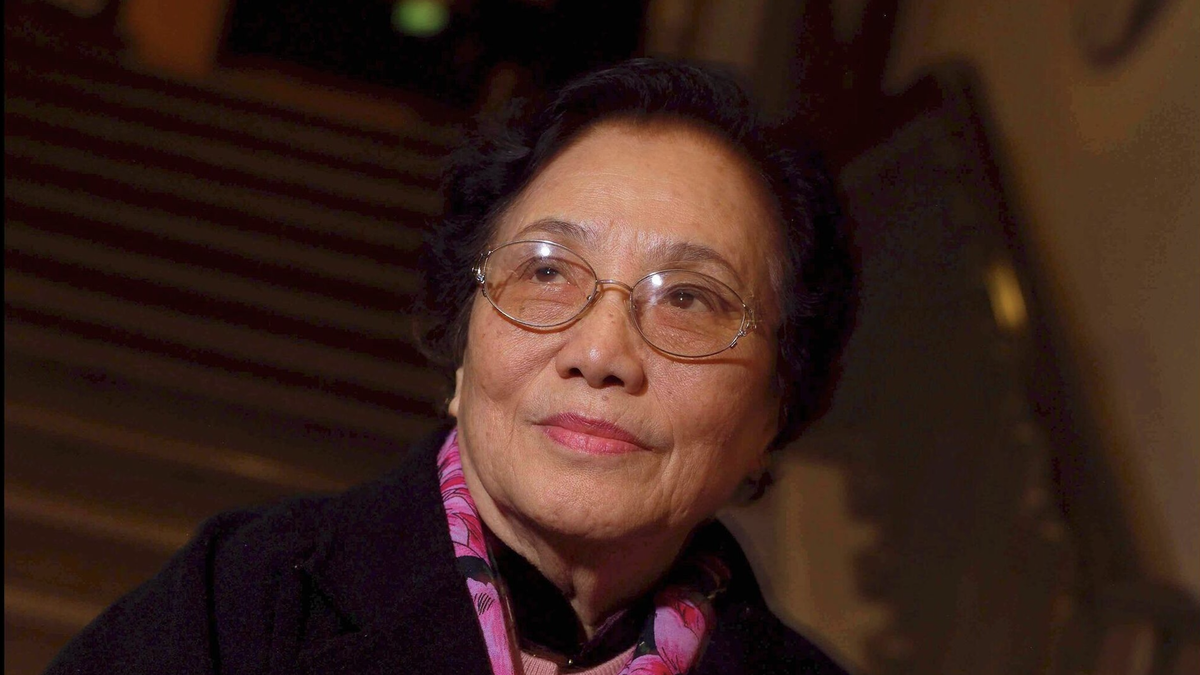
| The author of the article (on the right) with the female poet Chau Thu Ha. |
Throughout history, not everyone who loves each other ends up together. There are hundreds of reasons why they have to part ways. Such relationships often leave behind "emotional wounds." The deeper the love, the more persistent the "emotional wounds" become over time. As To Huu once said, "poetry is a melody of the soul," and that "melodies of the soul" seek out "kindred spirits." Reading the two lines of lục bát poetry in "My Realm," many will surely be startled, as if the female poet has seen right into their hearts:
Let me finish this glass.
Drink up and pour out your heart.
Drinking alone isn't just for men. Some women also turn to alcohol to drown their sorrows. It was thanks to the alcohol that Chau Thu Ha was able to "pour out" her "heartfelt words." These two lines of poetry, once read, are etched into memory.
How many people in this world suffer from heartbreak like the author of "Recognizing Time": Dreaming of a realm of a hundred years / Startled awake / Pain along with the dream (Excuse me). That is a constant pain, a pain deeply embedded in the subconscious. That is why, while standing alone at the tip of Ca Mau , Chau Thu Ha:
Listen to the rain falling in my life
spread your hands
count
falling drops
changing seasons
(Rain at the Cape of Ca Mau)
Using line breaks instead of commas to punctuate the rhythm, the author seems to depict each raindrop falling. Perhaps she counts the rain to remember? Or perhaps she counts the rain to try and dispel the sadness of being separated from her lover? These are verses brimming with emotion.
 |
| Cover of the poetry collection "Recognizing Time" by Chau Thu Ha |
Not only does she count the raindrops, but when winter comes, Chau Thu Ha also "gathers dry leaves around the house," "hugs her single blanket and pillow" to "warm the ashes." It's unknown whether the pile of ashes in the poem "For You" can "warm" her cold heart. All we know is that in such lonely moments, she often sulks at her lover: "Stop counting, my dear / Why pity a single leaf falling carelessly…" (Counting). She feels she still owes him so much: "I owe you those daring kisses / In the heart of a volcano, burning me" (Remembering Ly Son). She still has so much "expectation" from him: "I only want to bury ourselves in each other in every moment / All the small joys and sorrows." Even though they are far apart, she still dedicates all her feelings to him: "It seems the season passes so quickly / Only I - just for you" (Calling Spring). She imagined him always being by her side: Reaching out, she could touch her dreams / Hearing the scent of his hair falling onto her lips (The Island Remains Peaceful). It's amazing that even dreams can be touched.
Overwhelmed by longing, Chau Thu Ha "resolutely set out on her journey":
Returning home has become a habit.
I'm going to look for it again.
The tower is silent and the road stretches far into the distance.
Which compartment is it hidden in?
Moments of silence in the heart?
(Autumn at My Son)
For places she hasn't had the chance to return to, Chau Thu Ha sits in pensive reflection. There's Cua Lo: "The place where we met / To be remembered forever"; there's Nam Dong: "the green forest and sweet sunshine" where "we once had each other"; there's Da Lat: "the traveler through many seasons of mist / weaving through memories of golden wild sunflowers..." The verb "weaving" in this line of poetry is a "focal word" (a word with eyes), making the color of the wild sunflowers in the lyrical persona even more beautiful. Chau Thu Ha's poetry occasionally features such "unique and unusual" words.
And here is her message to the beloved city of Da Nang :
Da Nang, in my heart, is a place of nostalgia.
silently
Through sunshine and rain, we still wait for each other.
longing
The night at My Khe is filled with the gentle breeze.
The Han River is like an embrace.
The wind doesn't become "intense" for no reason, and the Han River isn't compared to "an embrace" for no reason. That explains why she silently remembers and anxiously awaits it so much.
The poet Nguyen Cong Tru once wittily remarked: "What is love? Whatever it is, it's still love." And Xuan Dieu asserted: "How can one live without love!" Love is an eternal theme. What I admire most about Chau Thu Ha's love poems is how sincerely, passionately, and intensely she expresses her feelings. It's not easy for women (especially married women) to write love poems. They must be very strong-willed and courageous. They have spoken for millions of women who have loved and are loving in this world but dare not express it.
As for me, whenever I feel down, I quietly raise a glass of homemade rice wine and read Chau Thu Ha's poetry:
Drink this cup all up, I'll drink it all.
Drink up and pour out your heart.
Source: https://baothuathienhue.vn/van-hoa-nghe-thuat/tac-gia-tac-pham/cung-chau-thu-ha-nhan-mat-thoi-gian-142500.html

![[Photo] Ho Chi Minh City decorated with flags and flowers ahead of election day.](https://vphoto.vietnam.vn/thumb/1200x675/vietnam/resource/IMAGE/2026/03/13/1773392076518_anh-man-hinh-2026-03-13-luc-15-53-29.png)








































































Comment (0)