

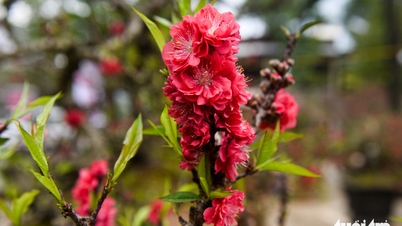
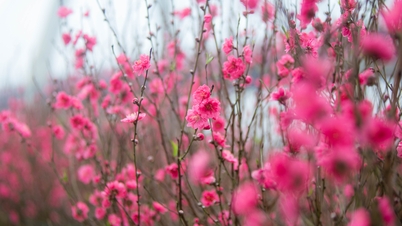
The tradition of displaying peach blossoms started during the Lunar New Year.
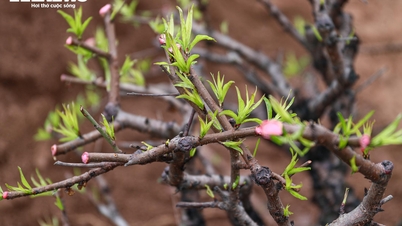
Although the Lunar New Year is still more than a month away, traders have already arrived in O Dien commune, Hanoi, to select peach blossom trees. Nowhere else are peach blossom trees planted in such abundance as here. Most of the orchards have bare branches and leaves, but some have already bloomed thanks to early leaf-removing techniques. Ms. Bui Thi Hien, the owner of one such orchard, is cutting peach blossoms to export to Saigon and Da Nang. She explains, "Unlike people in the North, for the past 4-5 years, people in the South have been enjoying peach blossoms from the Gregorian New Year onwards, so we have to remove the leaves early. Usually, the flowers will bloom about 50 days after we finish removing the leaves. This year is a leap year, so most of the peach blossoms bloom before Tet."

Traders come to select peach blossoms. Photo: Duong Dinh Tuong.
Ms. Hien has been involved in peach cultivation for 15 years. Although not a pioneer, she owns the largest orchard, nearly 15 hectares. Because the orchard is so large, she employs 20 workers regularly, and hundreds more are needed during the leaf-pruning season. After deducting all expenses, she and her husband can earn several billion dong from each peach harvest.
Mr. Nguyen Van Quyet is credited with bringing the Nhat Tan peach tree to be planted in the land of Hong Ha commune, former Dan Phuong district (now O Dien commune).
Mr. Quyet recounted: “Previously, I was the village head. In 2005, I tried planting Nhat Tan peaches, but it was unsuccessful because I hadn't mastered the techniques, and the soil was waterlogged, so I had to abandon the crop. After that, I switched to planting winter soybeans. I had two successful harvests, but in the third harvest, when I borrowed an entire field to plant several tens of hectares, the historic flood of 2008 wiped everything out.”
"My wife and I had to give up farming to work in construction, but many nights I'd come home to find our child sleeping outside, and it broke my heart. So I went to my uncle's house in the Nhat Tan peach-growing area to learn the trade again, and then I applied it back home. Initially, I bought 200 peach saplings and planted them in the backyard. In Tet 2012, I sold them for 5 million dong. I was so happy that I bought more saplings and planted a few more acres. In Tet 2013, I sold them for 40 million dong. I gradually expanded the area like that..."

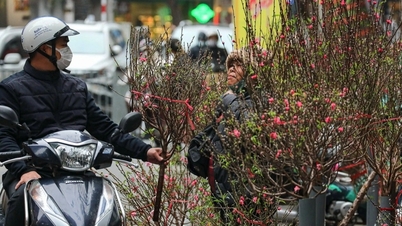
Peach blossoms are being sold early, starting from the Lunar New Year. Photo: Duong Dinh Tuong.
No secrets kept.
Seeing that the children and grandchildren in the village were unemployed, Mr. Quyet taught them how to grow peach trees, even though his uncle had warned him to keep the secret when passing on the trade. Moreover, with many people growing peach trees in O Dien, selling them became much easier. Previously, when he grew peach trees alone, he had to transport them to Nhat Tan to sell, but later, traders came directly to his orchard to buy them. During the Covid-19 pandemic, when travel was restricted and sales were slow, he saw his nephew's idea of selling peach trees on Facebook and followed suit, selling them very well.
By last year, the peach orchards of Mr. Quyet's family, consisting of ten or so nephews and brothers, had reached 30 hectares, with his family alone cultivating over 10,000 peach trees for selling branches and more than 1,000 bonsai peach trees. The peach branches are further divided into two types: the traditional round type, also known as "fishing basket peach," mainly used for worship, and the trendy curved type, primarily used for decorating living rooms. All are based on rootstock from wild peach trees, purchased when the seeds are just sprouts, then planted in rows like vegetable beds, cared for from the beginning to the end of the year, and then grafted.
After harvesting flowers for many years, the peach tree's branches shrink, but its trunk becomes gnarled, making it ideal for bonsai display in small pots. Currently, Mr. Quyet has over 1,000 such bonsai peach trees, selling for an average of 1-3 million VND per tree, with very good sales.

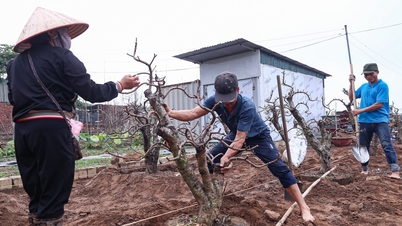
Mr. Nguyen Van Quyet stands beside his peach orchard, pruning branches into the shape of a fishing basket. Photo: Duong Dinh Tuong.
He said that in the past, peach blossoms in Nhat Tan were vibrant and lasted longer thanks not only to the soil quality but also to the meticulous care they received, even being fertilized with composted human waste. Later, due to the depletion of soil in the fields, the people of Nhat Tan had to plant peach trees in the open fields, and they no longer used compost because it was unhygienic, so the quality of the flowers deteriorated, the petals were thinner, and they didn't last as long. "My uncle, when he visited the peach orchards in his new hometown of O Dien, even praised the flowers as being as beautiful as those grown in the fields of Nhat Tan, even though the pruning techniques weren't as skillful," Mr. Quyet recounted.
While in Nhật Tân each family typically owns only 1-2 sao (approximately 1000-2000 square meters) of peach trees, in Ô Diên each family has 3-4 hectares, which is why they can become wealthy from this profession. A few years ago, the Hồng Hà Peach Blossom Growers' Association was established with 7 members, led by Mr. Quyết. Through face-to-face meetings or indirect phone calls, they exchange information about techniques and the market for peach branches and bonsai trees.
Each plot of land (360m2) used for peach tree cultivation, with an initial investment of 10 million VND, yields 20 million VND by the end of the year. Similarly, each plot used for bonsai cultivation, with an initial investment of 20 million VND, can yield over 100 million VND by the end of the year. Thanks to this, Mr. Quyet earns an average profit of 700-800 million VND per peach harvest. In 2013, thanks to the support program for near-poor war invalid households that his father received, the family was able to build a tiled-roof house. Yet now, it seems small and humble next to his newly built multi-story house worth 3 billion VND.

Mr. Nguyen Van Quyet next to a branch of peach blossoms caught with a fishing basket. Photo: Duong Dinh Tuong.
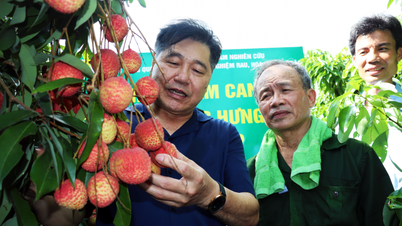
Most members of the Hong Ha Peach Blossom Growers' Association have become quite well-off; some have built new houses, others have bought more land. A prime example is Mr. Pham Van Hung, who cultivates 10 hectares of peach trees and earned several billion dong last year. Peach tree cultivation not only enriches the orchard owners but also provides employment for hundreds of local women in their 60s and 70s, who work from morning to night, and dozens of laborers from mountainous provinces who live and work on-site, earning an average daily wage of 250,000 dong.
Mr. Quyet shared that, in the past, due to difficult living conditions, people only dared to buy peach blossoms during Tet (Lunar New Year). But now, with a better economy , this hobby is practiced a month before Tet, and the selling price is even one and a half or twice as expensive because peach blossoms are rare and not commonly found. Last year, the former Hong Ha commune officially lost all its rice land because it was converted to flower cultivation, especially peach blossoms, with a total area of nearly 50 hectares.
Despite its thriving growth, the entire area is unfortunately being redeveloped into an urban zone. Therefore, the Nhat Tan peach trees will likely have to "migrate" further to more distant regions, with soil and climates quite different from their original homeland.
"The hobby of growing peach blossoms is associated with the traditional Lunar New Year. As long as there is Tet, there will be people growing peach blossoms, and this profession will continue to provide income," said Mr. Nguyen Van Quyet.
Source: https://nongnghiepmoitruong.vn/cuoc-di-cu-cua-dao-nhat-tan-d793319.html



















































Comment (0)