

 |
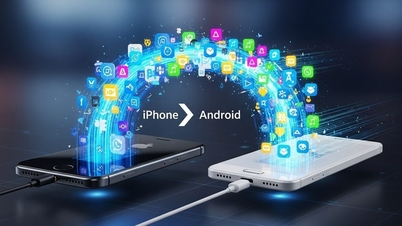
| Northeast Asian countries are rapidly developing information technology sectors to serve the lives of their citizens. (Illustrative image. Source: engenhariae) |
China - "The Cyber Powerhouse"
China has begun operating what it claims is the world's most advanced internet network.
According to technology manufacturer Huawei, this network can transmit at speeds of approximately 1.2 terabits (1,200 gigabits) per second, meaning it's fast enough to transmit 150 movies in a second.
At a press conference last week, Huawei and China Mobile officially announced the launch of China's next-generation "backbone network," a result of collaboration with Tsinghua University (Beijing) and Cernet, a Chinese government-funded education and research network.
The "backbone network" is the network infrastructure that helps route Internet traffic to different locations and can transmit data using 5G technology.
According to the press release, the new network system operates on nearly 2,900km of fiber optic cable connecting Beijing and southern China. It has been undergoing testing since the summer of 2023.
Chinese President Xi Jinping once stated that developing the "backbone network" would transform China into a "cyber superpower" and "accelerate the advancement of core Internet technologies."
Professor Wu Jianping, from the Department of Computer Science and Technology at Tsinghua University, who is overseeing the project, said: "This system, including both software and hardware, is manufactured entirely in China. He considers it the most advanced network in the world."
Society 5.0 in Japan
While China is busy operating the "world's most advanced internet network," its neighbor Japan is striving to promote digital transformation to build a digital society. The country recognizes digital transformation as an inevitable trend and a matter of national survival.
For a long time, developing the internet has been a top priority for the Japanese government, with high-speed fiber optic networks available in many areas. Currently, the average internet speed in the country is 42.2 Mbps.
The proposal to build a super-smart society, also known as Society 5.0, was announced by the Japanese government in its "Fifth Basic Plan for Science and Technology 2016-2020" to promote the development of science and technology, starting in January 2016.
The goal of Society 5.0 is to solve social problems by connecting systems using digital technology as a foundation to unify the physical and digital spaces. This is a society that provides goods and services according to individual needs.
Japan's Society 5.0 initiative aims to create an economic model that leverages technological innovations to drive digitalization in government agencies and service industries.
According to forecasts by the UK-based data analytics and consulting firm GlobalData, the Society 5.0 initiative is driving Japan's Internet of Things (IoT)-based information technology market to grow from $42.1 billion in 2021 to $60 billion in 2026, with an annual growth rate of 7.4%.
The Japan Digital Agency is encouraging local governments to fully transition to government cloud computing services by fiscal year 2025. An official stated that a complete shift to the cloud could reduce annual IT spending by approximately 30%, currently at $7 billion.
In 2022, Prime Minister Kishida Fumio announced that the government would promote the development of services based on the latest Internet technologies (the third generation Internet or Web 3.0), including new services such as digital assets using blockchain technology (NFT) and the virtual universe (metaverse).
As one of the first countries to launch commercial 5G services, Japan aims to achieve 5G coverage for 98% of its population by the end of Q1 2024.
With 5G identified as a key tool supporting digital transformation, Japan has been promoting 5G development in industrial environments and other use cases to positively impact its economy.
Besides promoting the development of 5G technology, the Japanese government is funding research and development of future 6G mobile technology.
Lifestyle in South Korea
With bright market prospects, many countries are actively engaging in efforts to promote the Internet of Things (IoT) as a core industry.
Following this trend, in Northeast Asia, the South Korean government has identified IoT as a core industry and has outlined clear strategies to promote its development.
In South Korea, "ubiquitous connectivity" isn't just an inspirational term; it's a lifestyle term in the country.
With direct, high-speed mobile internet connections across a range of digital devices, South Koreans pride themselves on being among the most connected people on the planet.
The South Korean government believes that IoT not only helps increase productivity and production efficiency by promoting innovation, but also creates new industries and growth opportunities.
The South Korean government encourages the focused development of promising IoT services based on the needs of the government, the private sector, and the people, such as healthcare, smart homes, smart cities, transportation, logistics, energy, and safety.
South Korea's smart cities encompass various sub-sectors such as smart transportation, smart resource management, and smart healthcare. Within these sub-sectors, the South Korean government fosters seamless collaboration between local governments, large technology corporations, and small and medium-sized enterprises (SMEs). Local governments coordinate with corporations to provide the necessary platforms and networks, while SMEs are responsible for developing the relevant hardware and software.
The South Korean government encourages joint ventures and partnerships between small and medium-sized enterprises (SMEs) and universities to support the development of business services.
According to Bui Dong Hung, a researcher at the Institute of Northeast Asian Studies (Vietnam Academy of Social Sciences), the South Korean government still has much work to do to promote the development of IoT. South Korea will face far greater challenges compared to the technological and technical challenges in the IoT deployment phase.
These challenges relate to people, socio-economics, and society, where IoT will have far-reaching impacts. These will be valuable lessons that Vietnam can learn from in implementing its current and future IoT development strategy.
Source



![[Photo] General Secretary and President To Lam presides over a working session with the Central Policy and Strategy Committee on the development of the materials industry.](https://vphoto.vietnam.vn/thumb/1200x675/vietnam/resource/IMAGE/2026/05/21/1779359935432_a3-bnd-3129-1412-jpg.webp)











































































Comment (0)