The "preparatory" steps
The draft Law on Vocational Education (amended), currently being reviewed by the Ministry of Education and Training , aims to build an open, flexible, and diverse vocational education system oriented towards standardization, modernization, democratization, socialization, and international integration.
At the same time, the draft also places special emphasis on the articulation between different levels within vocational education and training, as well as articulation with other training levels.
Vocational education and training (VET) is prioritized in socio-economic development plans, human resource plans, and the allocation of state budget for education and training. The state focuses on improving the quality of training, developing a network of training facilities according to the plan, and prioritizing the construction of a number of high-quality key VET institutions and colleges that play a central role at the regional and national levels.
In particular, the State prioritizes comprehensive investment in training human resources for key national industries and professions, and those reaching regional and international standards; while simultaneously implementing a mechanism of commissioning and assigning training tasks for specialized industries and professions, belonging to key economic sectors or those with high demand but difficult to socialize. The goal is to adjust the structure of industries and professions, improve the quality of human resources, especially in high-tech and digital economy fields such as artificial intelligence, data science, semiconductor technology, and new materials...
Agreeing with this strategy, Mr. Nguyen Duy Tien, Head of Admissions and Communications at Ho Chi Minh City College of Technology, said: "For more than a year, the school has been developing a plan to anticipate trends and provide high-quality human resources for the knowledge economy."
During the implementation of the project, Ho Chi Minh City College of Technology conducted a survey of business needs in the coming years, identifying specific requirements for knowledge, skills, and professional expertise in high-tech fields such as artificial intelligence (AI), big data, and renewable energy. This serves as the basis for the college to organize training that closely matches the needs of businesses and society.
According to MSc. Nguyen Duy Tien, in addition to surveying businesses, Ho Chi Minh City College of Technology also invites leading experts to participate in consulting and developing training program content together with businesses. Having the collaboration of these parties will provide valuable advice, helping the school develop proposals for opening training programs that are suitable for cutting-edge technology fields, meeting both the practical needs of businesses and the national development strategy.
MSc. Le Hoang Binh Nguyen - Vice Principal of iSPACE College, commented: For many years, the State has had clear directions in developing industries belonging to the knowledge economy with new technologies such as AI, semiconductors, digital economy… And this time, those directions have been concretized in the draft Law on Vocational Education.
iSPACE College proactively adheres to this direction by developing research projects to open new majors related to AI, semiconductors, and big data. In addition to inviting leading experts to advise on curriculum development, the college also receives significant support from businesses and training organizations both domestically and internationally.
"We can refer to training programs in developed countries. This provides a basis for the school to access effective international training models, then research, modify, and update them to suit the actual conditions in Vietnam," Mr. Nguyen said.
This initiative aims to ensure that training programs are both up-to-date and relevant to the domestic educational context. iSPACE College is researching the construction of practice rooms, laboratories, and the expansion of facilities to meet the training requirements for high-tech industries.
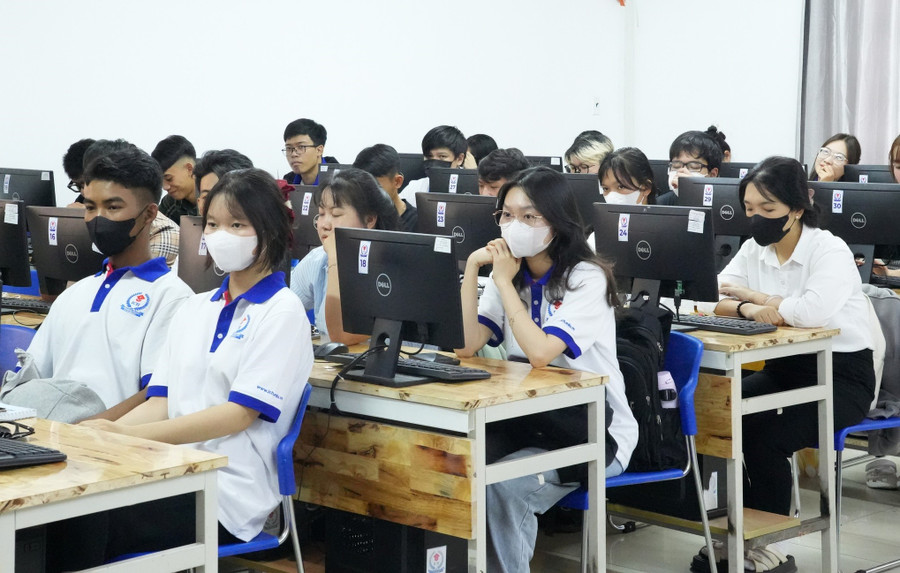
The Vice Principal of iSPACE College also emphasized that when opening new majors and developing new training programs, the physical infrastructure must go hand in hand with the quality of the program content. Given the unique nature of the college system, where 70% of the learning time is dedicated to practical training, good preparation of infrastructure and equipment is a key factor in helping students quickly access modern technology.
"Hopefully, in the near future, colleges will be qualified to train human resources for key national industries and meet the demands of the labor market," Mr. Nguyen expressed his hope.



Standardize the curriculum framework.
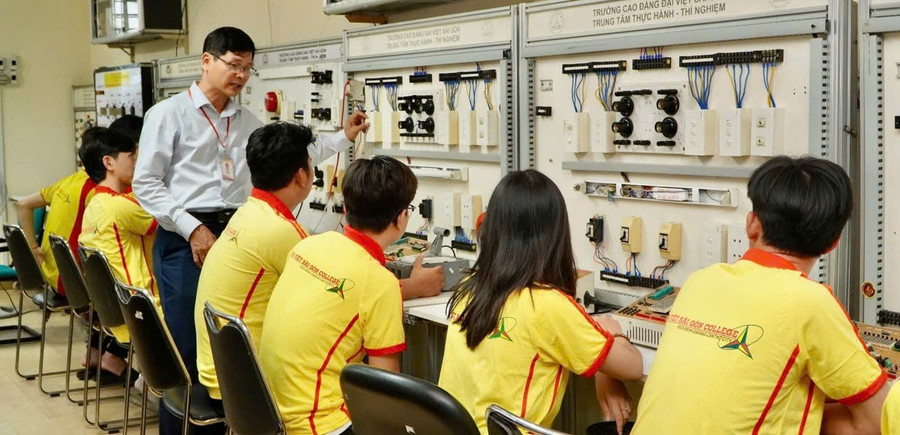
Supporting the draft Law on Vocational Education with its focus on developing human resources for high-tech industries, Ms. Le Hoang Bich Thao, Vice Principal of Dai Viet Saigon College, stated that previously, training for these industries was primarily concentrated in the university system. However, this draft law encourages vocational schools to participate in training, opening up opportunities to expand the supply of high-quality human resources.
However, according to Ms. Thao, for effective implementation, the Ministry of Education and Training and relevant agencies need a comprehensive and clearly defined training program framework. This is because if each educational level develops its own curriculum framework for the same major, the transition from college to university will be difficult, especially in transferring specialized knowledge and skills.
Regarding facilities, Ms. Thao stated that not all vocational training institutions have the capacity to train students in high-tech fields. To organize effective training, schools must fully meet the requirements for equipment, technology, and a teaching staff with qualified expertise. These are significant obstacles, especially for colleges today.
"Training programs need clear direction: what knowledge and skills do college-level students need to work in high-tech fields, and what are the specific job requirements? Only then can we properly orient and train human resources effectively," Ms. Thao emphasized.
Mr. Nguyen Van Minh Tien, Deputy Principal of Saigon Polytechnic College, stated that to promote the development of high-tech human resources at vocational education institutions, it is necessary to soon have a training program framework that allows for articulation between college and university levels.
In reality, even when schools develop programs and register according to the correct procedures, adjustments are still made during implementation to suit the conditions and resources of each school. This leads to a lack of connection between college and university training programs, causing difficulties in transferring and articulating.
Recently, Saigon Polytechnic College received a multi-billion VND server system from a major technology corporation to support AI training. However, to utilize it effectively, Mr. Tien believes that a standardized, interconnected training program framework is needed to help the school develop curricula and arrange subjects to suit its existing facilities.
Collaboration between universities and colleges is needed.
According to MSc. Nguyen Van Minh Tien, high-tech fields such as AI and semiconductor microchips are "hot," attracting significant interest from students. However, the admission scores for these majors at universities are usually very high. Meanwhile, in developed countries like Japan, South Korea, and Taiwan (China), AI majors have moderate entrance scores to encourage students and make them more accessible.
Therefore, Mr. Tien suggested that universities and colleges in Vietnam should set appropriate admission standards for high-tech programs and strengthen international cooperation to provide students with opportunities to experience semesters abroad.
Students can study foreign languages in Vietnam, then pursue higher education at colleges or universities abroad, specializing in AI or semiconductors. The government or universities should also implement policies to waive tuition fees and provide living expense support for talented students, thereby creating a high-quality workforce that is skilled in their profession and proficient in foreign languages.



Furthermore, to develop human resources in the high-tech industry, Mr. Tien suggested that universities need to design programs that allow students in broad fields like Information Technology to transfer to specialized fields like AI, or for students in Electrical and Electronics Engineering to pursue additional specialization in semiconductors.
"Instead of studying for three years to obtain an associate degree, students studying Electrical and Electronics Engineering could study for an additional year to earn a second degree in semiconductors, thereby expanding their career opportunities and meeting national workforce needs," Mr. Tien proposed.
The Vice Principal of Saigon Polytechnic College also believes that transfer programs from broad to specialized fields will help shorten training time and rapidly increase the number of high-tech personnel. At the same time, students studying these fields also need to be proficient in foreign languages, especially English – the global language for communication, cooperation, and the implementation of technology projects with international partners.
In Ho Chi Minh City, several colleges have officially joined the race to train personnel in the semiconductor industry at the college level. From the 2024-2025 academic year, Ho Chi Minh City International College has been enrolling students in its college-level program and the 9+ college program (enrollment from grade 10), for students who have graduated from high school and junior high school.
A unique feature is that after completing their college program in Vietnam, students will have the opportunity to receive a full INTENSE scholarship to continue their studies in Taiwan (China) for two years in semiconductor and finance fields. The scholarship program is organized at accredited universities in Taiwan, providing students with access to modern education and advanced technology.
At Cao Thang Technical College, among the 18 majors/professions planned for enrollment in 2025, the school has officially opened the Semiconductor and Microchip Engineering Technology major under the Electronic and Telecommunications Engineering Technology field.
Source: https://giaoducthoidai.vn/cuoc-dua-nhan-luc-nganh-cong-nghe-cao-post750054.html

![[Photo] Strengthening character and expertise: Intense training for artillery soldiers.](https://vphoto.vietnam.vn/thumb/1200x675/vietnam/resource/IMAGE/2026/06/30/1782815602541_lu-368-1875-4571-jpg.webp)