

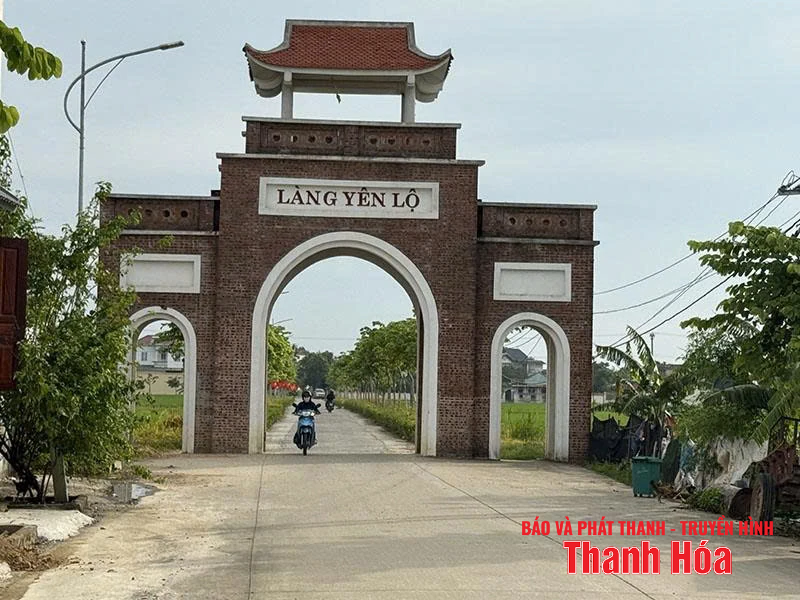
The entrance gate to Yen Lo village.
During the period 1930-1945, Yen Lo village connected with Dong Minh, Dong Chi, Dong Tam, Dong Tien, Dong Thanh, and Dong Bao villages of Thieu Toan commune to form a revolutionary rural area, sparking a movement to fight against the high taxes and levies imposed by the Japanese fascists, and to seize power for the people. Yen Lo village, formerly known as An Lo village (also called Lo village), had many historical events and secret activities of the revolutionary movement at its temples and shrines.
Yen Lo Pagoda was built on a rocky mountainside. It was renovated in 1928. In 1935, Comrade Hoang Van Que, a member of the Communist Party of Vietnam and later a member of the Thieu Hoa District Party Committee (August 1945), took charge of the pagoda to carry out revolutionary activities. During the period of 1935-1936, the Thanh Hoa Provincial Party Committee held many conferences here to consolidate the organization and revolutionary movement. The pagoda served as a secret meeting place for revolutionary cadres. Through historical upheavals, the pagoda was at one point in ruins. However, with the attention of various levels of government and the collective efforts of generations of Yen Lo villagers, the pagoda has been restored and renovated, becoming more spacious and beautiful, while still retaining its original tranquility and peacefulness. To this day, the pagoda remains a spiritual haven and a path back to the roots for all the people of Yen Lo and their children living far from home, as well as a destination for tourists from all over.
Located at the foot of Yen Lo Mountain is the Yen Lo Temple. The temple is dedicated to the deity Nguyen Tung, also known as Tan Vien Cong Hung. It is also the site of many historical events related to the revolutionary movement, the steadfast communist fighters, and the people of Yen Lo. In 1930, a ceremony was held here to induct members of the Red Peasant Association. In 1934, the Yen Lo Temple served as a printing location for revolutionary documents...
From 1927 to 1945, Yen Lo village communal house served as a meeting place for various organizations and the site of the founding conferences of the Anti-Imperialist Front and the Viet Minh Front. Notably, in May 1950, the 4th Congress of the Thieu Hoa District Party Committee was held here, outlining the direction for leading the people in implementing the Party's policy of resistance and national construction.
In 2000, the Yen Lo pagoda, shrine, and communal house were recognized as a provincial-level historical revolutionary relic complex.
Entering the stage of national integration and development, Yen Lo village has always upheld its revolutionary traditions, with cadres and people united in building a homeland that is constantly improving. Yen Lo was the first village of the former Thieu Vu commune to be recognized as a model new rural village in 2023.
Nguyen Chi Thanh, Party Secretary and Head of Yen Lo village, shared: “Building on the revolutionary traditions of our homeland, the village Party branch always maintains unity and cohesion within the Party. The Party branch focuses on leading and directing comprehensive development in all aspects in the spirit of promoting democracy, transparency, and putting the people first... therefore, everything is trusted and supported by the people. This is a lesson that the Party branch always upholds and promotes, especially in building a clean Party branch and achieving the status of a model village earliest in the former Thieu Vu commune.”
During the process of building a model village, Yen Lo mobilized nearly 2.5 billion VND through social contributions to invest in rural infrastructure; expanding and concreting roads; constructing model fences; and beautifying many roads according to the criteria of being bright, green, clean, beautiful, and safe. The village Party branch has propagated and encouraged the people to actively apply scientific and technical advancements and transform the structure of crops and livestock to achieve high economic efficiency. As a result, the material and spiritual lives of the people have been increasingly improved. Currently, the average per capita income of Yen Lo village reaches nearly 70 million VND/year.
Eighty years after the uprising that brought power back into the hands of the people, Yen Lo village, like many other villages, still maintains the flame of revolutionary tradition and strives forward. The name of the land and village is steeped in the sweat and blood of our ancestors as we embark on a new path. The "revolutionary torch" continues to shine, guiding the people of Yen Lo to write the next golden chapter of their homeland's history, contributing alongside the Thieu Tien commune Party committee to the effort of becoming a rural area with a "friendly, civilized, and modern" lifestyle, rich in identity and a desirable place to live.
Text and photos: Le Ha
Source: https://baothanhhoa.vn/cuoc-life-moi-o-lang-que-cach-mang-yen-lo-258595.htm

![[Image] National Assembly discusses the implementation of the socio-economic development plan.](https://vphoto.vietnam.vn/thumb/1200x675/vietnam/resource/IMAGE/2026/04/20/1776696707422_ndo_br_img-20260420-185419-jpg.webp)

![[Photo] General Secretary and President To Lam meets with National Assembly delegates from ethnic minorities.](https://vphoto.vietnam.vn/thumb/1200x675/vietnam/resource/IMAGE/2026/04/20/1776696701056_a1-bnd-8331-3342-jpg.webp)





![[Photo] Opening of the Second Conference of the Central Committee of the 14th Party Congress](https://vphoto.vietnam.vn/thumb/402x226/vietnam/resource/IMAGE/2026/03/23/1774233781483_anh-1-bnd-4146-7258-jpg.webp)




















































Comment (0)