

If the government can regulate the cryptocurrency market, in addition to collecting taxes for the budget, it can also leverage it to develop technology.
During a recent parliamentary group discussion on the draft Law on Digital Technology Industry, Prime Minister Pham Minh Chinh stated that "the virtual world mirrors the real world." The Prime Minister raised the question: "Bitcoin is currently worth nearly $3 trillion USD globally. In reality, Bitcoin transactions exist in our country, but why aren't they regulated?"
Very large scale
Bitcoin and many other cryptocurrencies have existed for decades but have not been recognized in Vietnam. The country also lacks legal regulations concerning the issuance, buying, selling, and exchange of these assets. However, investment and trading activities involving cryptocurrencies are very active within Vietnam.
On forums and financial investment groups, the topic of investing in Bitcoin is being discussed actively, especially as this cryptocurrency has experienced a record surge and is heading towards the $100,000 mark.
Statistics released in mid-2024 by the cryptocurrency payment gateway Tripple-A show that the UAE leads the world in the percentage of its citizens owning cryptocurrencies, at 34.4%. Vietnam ranks second with 21.2% of its population owning cryptocurrencies - higher than the US, which is in third place (15.6%).
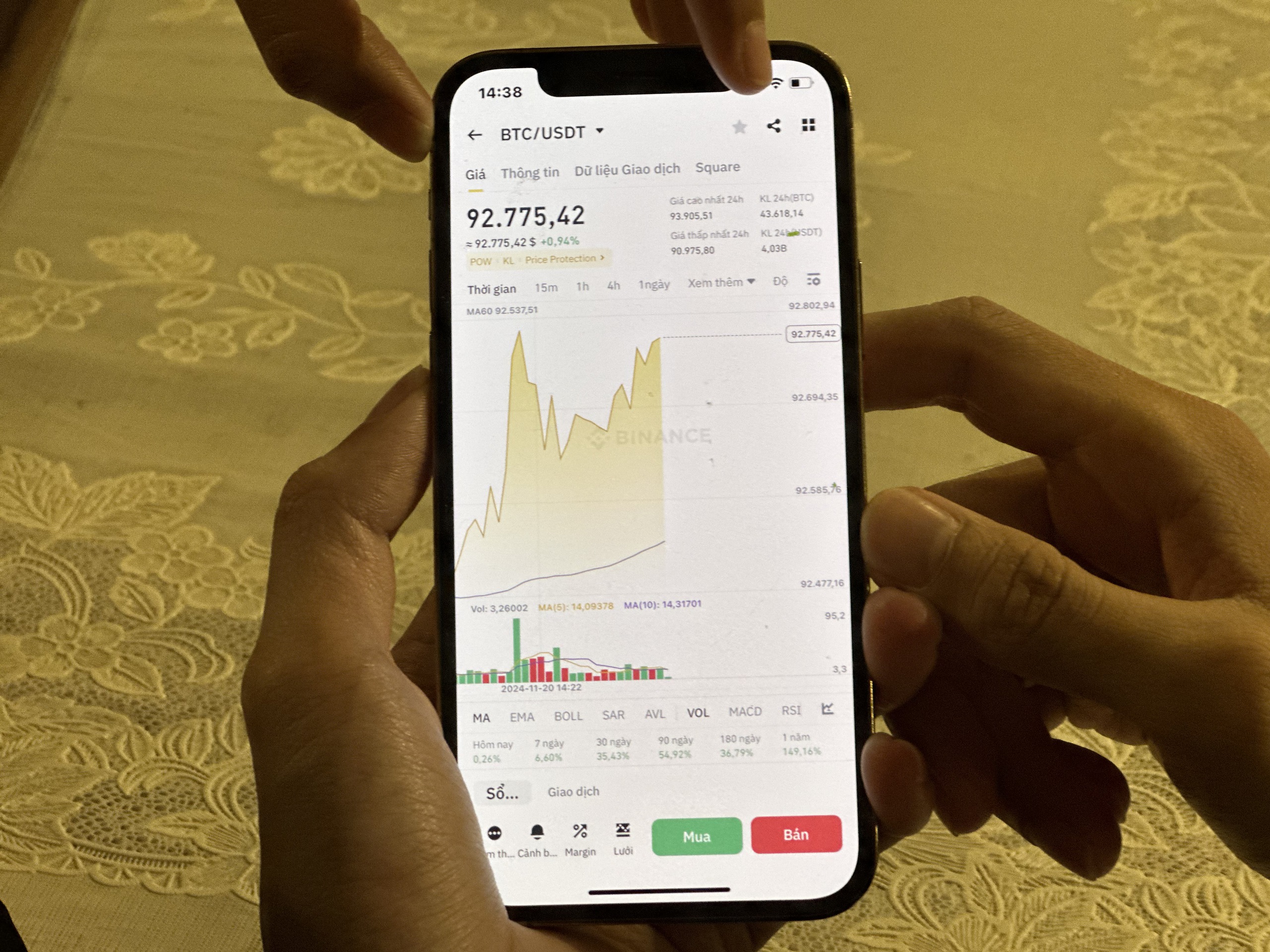
Bitcoin is currently the most popular digital asset in the cryptocurrency market. Photo: PHAM DINH
According to a comprehensive report from Chainalysis (a leading company in the digital asset industry, based in the US), in 2023-2024, Vietnam was the country with the most cryptocurrency adoption, with over 20 million investors and a massive capital of $120 billion - ranking 4th.
Investors are primarily young people (18-36), concentrated in major cities such as Ho Chi Minh City (50%-54%), Hanoi (25%-30%), and Da Nang (3%-5%). Additionally, the Chainalysis report indicates that in 2023-2024, 35.9% of Vietnamese investors made a profit, 44.5% suffered losses, and 19.6% broke even from their crypto investments.
This explains why most of the world's major cryptocurrency exchanges operate in Vietnam, such as Binance, Bybit, OKX, Kucoin, etc. These exchanges all have Vietnamese interfaces, making it easy for users to create accounts with just a Gmail address, phone number, and link to a bank account to start trading. These exchanges have trading volumes of billions of USD per day, with Binance alone reaching over 100 billion USD at its peak.
On social media platforms like Facebook, Zalo, and X, numerous cryptocurrency information communities are thriving. Users simply need to enter keywords like "Crypto," "Bitcoin," etc., to find many groups with large memberships. Some groups even have nearly a million members. They constantly share articles about the potential of the cryptocurrency market and encourage users to invest to profit during the "uptrend."
Mainly short-term trading.
Mr. Phan Duc Nhat, Chairman of Coin.Help & BHO.Network, said that people, especially investors born in the 80s and 90s, often invest in Bitcoin and other cryptocurrencies for speculative purposes, hoping to profit when the coins increase in price. Only a small number invest in Bitcoin as a store of value (like gold).
However, Vietnamese law does not recognize cryptocurrencies and there are no regulations regarding the use of cryptocurrencies or any other virtual assets as a substitute for VND. Therefore, when wanting to pay for goods, investors must convert from cryptocurrency to Vietnamese Dong for convenient use. The most common form of conversion is P2P – one person selling to another.
However, because many people buy and sell cryptocurrencies based on trends and lack understanding, losses, damages, and even scams still frequently occur. Mr. Hoang Khai, an office worker in Ho Chi Minh City, said he once searched for cryptocurrency groups on Facebook and received investment guidance to make a profit, but ended up losing everything.
"I was guided by someone to register and deposit money into my wallet on the Onus platform. Initially, I deposited 50,000 VND, and the platform gave me 200,000 VND, but I couldn't withdraw it for a year. Trading using the Futures method, I initially earned about 150,000 VND. Then, I deposited 5 million VND to trade but my account was wiped out. I deposited another 10 million VND but still got nothing. When I understood how the game was played, I had lost 15 million VND in less than 3 days," Mr. Khai lamented.
According to Coin98 Insight's Vietnam Crypto Market Report, in 2023, the number of new Vietnamese investors joining the Bing X exchange increased by approximately 138% compared to the previous year, reaching 143,025 people. However, nearly 65% of them did not make a profit and 43% suffered losses.
Tax evasion and fraud
According to financial expert Phan Dung Khanh, statistics published by several international financial organizations show that Vietnamese people are among the top countries holding digital assets, including Bitcoin.
Unofficial data also shows that Vietnamese people have more accounts on international digital asset exchanges than on stock exchanges, and they trade in large quantities… Therefore, if the government can regulate them, in addition to collecting taxes for the budget, it can also be used to develop technology.
"Currently, although Vietnam does not yet have specific regulations on digital assets, related digital technologies are not prohibited. Vietnam already has a Blockchain Association. Data published by them in 2021-2022 shows that our country recorded the value of digital assets at approximately 91 billion USD, while illegal digital assets amounted to about 956 million USD, which is not high. Therefore, it is necessary to soon have laws, regulations, and a legal framework to manage these digital assets," Mr. Phan Dung Khanh proposed.
Mr. Phan Dung Khanh believes that the lack of a clear legal framework means that investors rushing to invest in cryptocurrencies will face many risks. This is because cryptocurrency investment, like foreign exchange (FX) investment on international exchanges, lacks clear regulations in Vietnam, and any problems that arise will not be protected by law.
Cryptocurrency exchanges do not have offices or branches in Vietnam, so not only does the government lose tax revenue, but investors also don't know who to contact to claim their rights when problems arise. All information about cryptocurrency exchanges and Bitcoin investment platforms is online, with very high financial leverage ratios and huge daily price fluctuations…
"Another risk is fraud. Because it's online, investors may encounter fraudulent exchanges and not know where to claim their rights," Mr. Khanh expressed his concern.
From a macroeconomic perspective, the digital economy is considered a key focus of Vietnam's economic development. Within the digital economy, there is a branch called digital assets. Economist Dr. Dinh The Hien analyzes: If we are developing the digital economy, then digital assets are an issue that needs to be addressed and managed, especially after the Politburo recently approved the plan to develop two international financial centers in Ho Chi Minh City and Da Nang. Why have Bitcoin and many other cryptocurrencies been traded in Vietnam for some time but remain unregulated?
Dr. Dinh The Hien believes that consideration should be given to regulating Bitcoin in particular and digital assets in general right now. From 2025 onwards, with strategies for the digital economy and the orientation towards building international financial centers, and with this market already developing stably worldwide, Vietnam will need appropriate regulations to manage digital assets and cryptocurrencies.
The government also mentioned piloting a sandbox mechanism for financial technology (fintech) companies, and soon, similar testing mechanisms in the process of building international financial centers. These current steps are consistent with the process of both managing and developing, and limiting the risks and negative consequences for cryptocurrencies and digital assets.
"If we are to bring it into a legal framework, we need to select exchanges for cryptocurrencies that are licensed, regulated, and taxed by the state. In the past, besides Bitcoin and Ethereum which have brought profits, many investors have suffered heavy losses from other virtual currencies, even counterfeit ones," warned Dr. Dinh The Hien.
According to Mr. Phan Duc Nhat, in Vietnam, very few training groups provide in-depth analytical skills for Crypto and Bitcoin. If such groups exist, they are usually private, and only acquaintances or qualified individuals are allowed to join.
Therefore, to obtain information and learn how to trade, many people choose to join groups on social media. Most groups are free to join, with only a few requiring a fee, but the quality of instruction and investment is highly inconsistent.
(To be continued)
Source: https://nld.com.vn/da-den-luc-phai-quan-ly-tien-so-196241129210239077.htm






























































































Comment (0)