Xu Cua is the affectionate name that locals often use to refer to the two communes of Cam Chinh and Cam Nghia in Cam Lo district. Many people love this land not only for its peaceful scenery and lush gardens full of sweet fruits, but also for the unique specialties of this red soil region.

Specialties of Cua region with various herbal extracts - Photo: TP
Leading us on a tour of his pepper garden, Mr. Tran Ha, Director of the Cua Pepper Agricultural Service Cooperative, said: “From ancient times to the present, Cua has been famous for its pepper. Thanks to its high essential oil content, firm seeds, and unique spicy and aromatic flavor, Cua pepper is especially favored by people both within and outside the locality, gradually becoming a specialty that anyone visiting Quang Tri must seek out.”
After the liberation of the homeland, the red soil region of Cua was planned and developed into a key pepper-growing area of Cam Lo district. Before 2005, pepper was considered "black gold," bringing prosperity to many people and families in the area.
Born and raised in the fertile Cua region, and having spent almost his entire life working with pepper plants, Mr. Ha is always proud whenever someone asks about Cua pepper.
“Whenever I travel to other provinces for work, I often bring pepper from my hometown as gifts and to promote the product to friends in other provinces. Afterwards, many people ask to buy it again. At those times, I feel truly happy and proud that the product from my hometown of Cua is happily received by customers. Through Cua pepper, many people have come to know Cua and the land of Quang Tri ,” Mr. Ha said simply.

Cua Market, a place selling various local specialties - Photo: TP


However, there were times when pepper prices on the market dropped, unfavorable weather conditions caused serious pest and disease damage to a large portion of the pepper plantations, making people less enthusiastic about this long-term industrial crop. But because of his deep affection for Cua pepper, Mr. Ha was always concerned and sought ways to revive the Cua pepper brand.
Working alongside local people to renovate and restore pepper plants, find market outlets, build brands, and design packaging and labels for Cua pepper products, Mr. Ha, together with the local government and people of Cua, strives to preserve this long-standing industrial crop and bring the Cua pepper brand, a specialty of the red soil region, to a wider audience.
It would be a great oversight not to include Cua chicken among the specialties of this fertile red basalt soil region. Cua chicken meat is famous for its delicious, firm texture, thanks to its characteristic "eating termites during the day and sleeping in trees at night." Perhaps due to the continued use of free-range farming methods, the geographical conditions, climate, soil, and a diet primarily consisting of insects, the quality of Cua chicken meat is consistently excellent.
Each Cua chicken weighs only about 1.2-1.3 kg and retains its natural habit of sleeping in trees. The best way to enjoy Cua chicken is by boiling it and dipping it in salt and pepper. When cooked, the skin is golden brown and crispy, the meat is sweet, with just the right amount of chewiness, and it's rich but not greasy. Legend has it that when King Ham Nghi's entourage arrived in Tan So, the villagers offered the king and his officials local dishes: steamed Cua chicken and chicken stewed with lotus seeds. Everyone who tasted it praised its deliciousness.
During those arduous days of resistance, King Hàm Nghi always reminded his ministers that after the country achieved peace, they should remember to raise Cùa chickens as a local specialty. Currently, the Cùa chicken brand has truly expanded, not only supplying consumers in Quảng Trị but also being sold in many supermarkets in Huế, Đà Nẵng , and Saigon. Cùa chicken has also been certified as a VietGAP-certified chicken meat product, and its vacuum-packed chicken is a 3-star OCOP product, currently in the process of being proposed for an upgrade to a 4-star rating.

Herbal extracts are beautifully packaged, making them convenient to carry as gifts - Photo: TP
Besides pepper and chicken, Cua also boasts other specialties such as green tea, sweet jackfruit, and bananas... Although these plants can be found everywhere, they become even more fragrant and flavorful because they are grown on the red basalt soil and endure the harsh weather of this sunny and windy Central Vietnam region. In Cua, there are ancient tea trees over 100 years old, reaching heights of four or five meters, which have become a source of pride for the local people.
Ancient tea trees not only hold economic value but also embody the character and spirit of a region since its inception. This ancient tea variety has small leaves, and when brewed, it releases a rich flavor. Initially, it tastes bitter and astringent, but after swallowing, a sweet and fragrant aftertaste lingers. Even after the second and third infusions, the tea leaves retain their full, aromatic flavor. Cua tea has become a luxurious yet indispensable gift for anyone visiting the Cua region.
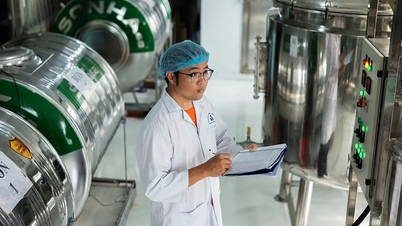
Besides the famous "specialties" associated with the land and people of Cua region for generations, in recent years, herbal extracts have become a new specialty of this red soil land. The Minh Nhi Herbal Extract Production and Business facility, established by Mr. and Mrs. Truong Cong Minh, currently residing in Dinh Son village, Cam Nghia commune, produces and sells over 10 different types of herbal extracts, including extracts of *Lá Vằng* (a type of leaf), *Cà Gai Leo* (a type of thorny vine), and *Đinh Lăng* (a type of herb)...


In a conversation with us, Mr. Minh explained that to produce a herbal extract, the cook needs to go through many steps, from initial processing to concentrating it into a paste. Compared to fresh leaves, the extract is more convenient because it doesn't take as much time and effort as the traditional method. Especially, by using a wider variety of ingredients to make the extract, herbal extracts can reach a broader range of customers.
With the development of herbal extracts, local people have more jobs and are guided in switching crops and developing the economy. In the past, there were pepper and tea, but now there are herbal extracts, and people traveling far away buy them as gifts. As a son of the Cua region, Minh feels happy that the local specialty is being popularized far and wide.”
These products, though simple, are the culmination of the unique soil, water, climate, and the sweat and hard work of the people of the red soil region, thus possessing very special values of the Cua land.
Truc Phuong
Source