

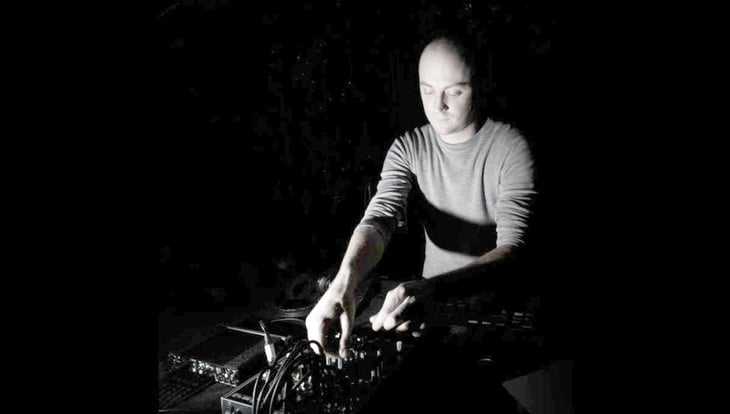
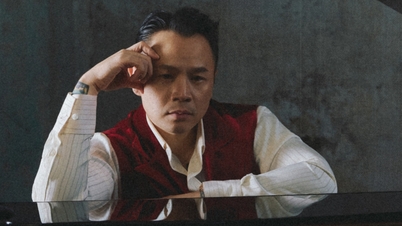
Composer Kangding Ray - Photo: Tom Durston
This could be the most bizarre movie scene of 2025: a gang of thugs and an elderly man go into the desert searching for their missing child, blasting apocalyptic techno music through two loudspeakers, swaying to the beat, and suddenly, one of them is blown up by a landmine.
The group had wandered into a minefield. Sirāt, directed by the Spanish filmmaker Óliver Laxe, has exceptionally distinctive music.
The deafening electronic music and the barren desert landscape cancel each other out, creating a sense of nihilism and emptiness. The sounds that should have been of a party suddenly become threatening and inhuman, each beat like a death knell, a cruel prophecy of death.
If the film's title, in Islamic tradition, means a fragile bridge where the wicked tumble into hell and the good are led to heaven, then the soundtrack is like a game of life and death, full of random chance and human destiny.
Sirāt's composer, Kangding Ray, started out as an electronic music DJ. This is only his second film to compose music, and he immediately won the soundtrack award at Cannes, receiving numerous nominations at major awards leading up to this year's Oscars.
In this year's Golden Globe nominations for film scores, the inclusion of Kangding Ray, along with others like Jonny Greenwood (One Battle After Another score) and Ludwig Göransson (Sinner score - the winner of this category), creates an interesting rivalry with composers who have more traditional tastes, such as the "king" of film scores, Hans Zimmer (F1 score), and masters like Alexandre Desplat (Frankenstein score).
How do their film music aesthetics and philosophies differ?
Let's compare two films that explore a common theme: Sinners and Frankenstein. Both tell the story of humanity's struggle against monsters.
In Sinners, blues musicians clash with vampires seeking to steal their souls and music. In Frankenstein, a scientist battles the immortal, untamed creature he created, driven by a desire to stop death. However, the role of the soundtrack in these two works is quite different.
With Frankenstein, a classic plot that everyone knows by heart, Desplat—the French composer who grew up with Debussy and Ravel—chose music that is very tragic, very classical, very romantic, very European.
From the very first dramatic opening scene, we are provided with a supporting string orchestra. Desplat's music focuses on melody. It represents the character, suggesting the soul of the scientist and the soul of the eccentric. The music is guided by thought; it is a moral narrative, elaborating on the character.
Göransson's music in Sinners, on the other hand, focuses on rhythm. We hear the beat, we hear the impulse, we hear the tapping, we are drawn into the music, we shudder before any conclusions about good/bad, right/wrong, what should be condemned/not condemned.
The body reacts to music before reason can judge. And because it draws inspiration from blues, the music of the working class, the music of the oppressed, the soundtrack of Sinners feels more like a collective ritual, a shared history, than a projection from the soul of a single character.
Therefore, the monster in Frankenstein has its own theme songs, its own musical style, and the music about the monster sometimes evokes disgust, sometimes fear, and sometimes empathy, compassion, and sympathy.
But the vampires in Sinners are far more complex. There isn't a single recurring theme song associated with them. They don't have a musical "face." They aren't a specific individual, but rather an entire system, a society.
The victories of experimental composers like Ludwig Göransson or Kangding Ray at pre-Oscar awards such as the Golden Globes and the Los Angeles Critics' Association Awards are not necessarily a sign of the decline of traditional film music.
They simply show that music can open up a different axis for cinema. Not necessarily an axis parallel to the image, but it could be a perpendicular axis, an oblique axis, disrupting what we see on screen. Cinema lies precisely where the image is "broken" by the music.
Source: https://tuoitre.vn/dai-chien-nhac-phim-20260118100058803.htm





































































































Comment (0)