|
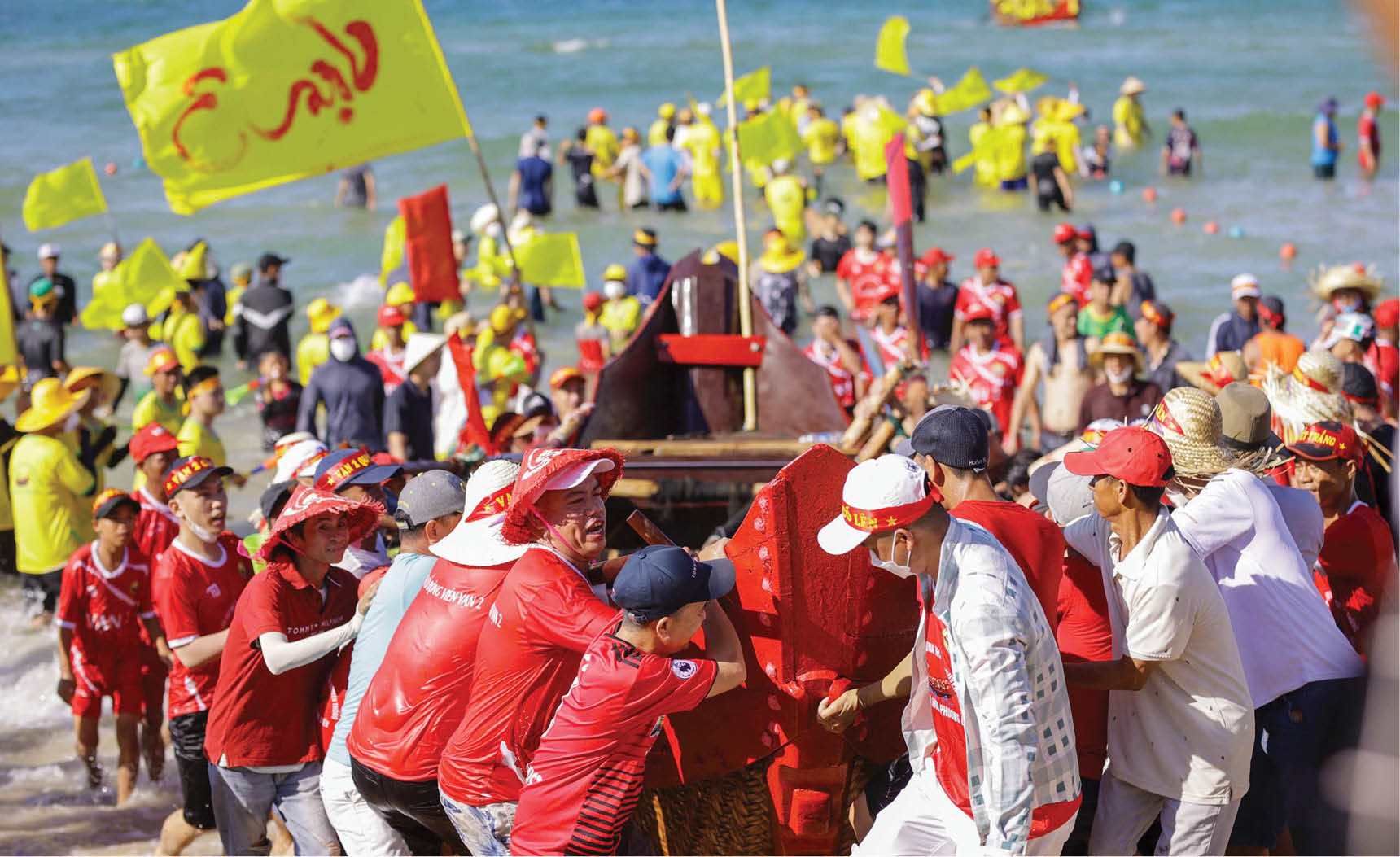
The festive part of the fishing prayer ceremony of the people of Phuong Dien village, Thuan An ward. Photo: Anh Le. |
The festival is associated with the worship of the tutelary deity Truong Quy Cong, who pioneered the land, taught fishing and trading skills to the lagoon residents. More importantly, in the community's consciousness, he is not just a historical figure but a symbol of indigenous knowledge – knowledge about the sea, the environment, and how people adapt to nature to survive. Therefore, the Fishing Festival is primarily a ritual of gratitude to the pioneer, to the sea, and to the community that together created this living space.
Placing the festival within the Thuận An area reveals the deeper layers of this heritage. Thuận An is not only the most geographically important seaport of Huế , but also a strategic gateway to the capital throughout the Nguyễn Dynasty. It houses Trấn Hải Thành, a fortress built by King Gia Long in 1813 to protect the sea; Thuận An Royal Palace, a relic of the emperors' royal tours; and the Thuận Hải Quy Phàm scenic spot, ranked by King Thiệu Trị as one of the twenty most beautiful sights of the imperial capital. And today, the massive and magnificent Thuận An sea bridge is opening up a new development axis for Huế towards the ocean.
Within that structure, the Thai Duong Fishing Festival is a layer of community cultural sediment, supplementing the system of royal heritage, creating a complete whole of Hue: a heritage city that not only has historical depth but also a broad cultural space.
Following the tradition of "Tam Nien Dao Le" (Every Three Years), a large-scale festival is held every three years, bringing together villagers from all over, including overseas Vietnamese. It's not just a religious activity, but a cultural mechanism for community restructuring. During those days, the village temple is illuminated all night, and solemn rituals of welcoming, praying for peace, and offering sacrifices are performed. Boat owners in traditional attire take turns offering gifts to the village guardian deity. In that moment, people stand before the sea with humility and faith, a philosophy of life for coastal inhabitants.
The highlight of the festival is the fishing ritual performance, where the entire economic and cultural life of the fishing village is recreated: casting nets, pulling in traps, catching squid, and the bustling scene of boats buying and selling. From a heritage perspective, this is a "living museum" of maritime culture. There is no boundary between performers and spectators, between the past and the present. The younger generation learns the trade from their ancestors not through books but through the actions passed down through generations. Those who have left their homeland rediscover their roots. Tourists realize that behind each catch lies a whole system of cultural values.
The most valuable aspect is that the community is always the main subject of the festival. People voluntarily contribute funds and effort, organize the event themselves, and pass on the rituals through generations. This is the essence of intangible cultural heritage, whose subject is the local community, who is both the creator, the practitioner, and the beneficiary.
In the current context, as Hue enters a new phase of development as a centrally-governed city, the story of the Thai Duong Fishing Festival offers an important insight for development strategy: Heritage should not only be an object of preservation but also become a resource.
The Thuan An area is being positioned as Hue's gateway to the sea, a place for developing coastal tourism , service economy, and eco-urban development. However, for this development to be distinctive and sustainable, the core element remains community culture. The Fishing Festival is the foundation for creating experiential tourism products linked to the lives of fishermen, the material for building Hue's maritime cultural brand, and, more importantly, the environment for nurturing human values.
Because at the heart of this festival lie qualities essential for a city in the new era: a spirit of community cohesion, an awareness of adapting to the natural environment, a sense of gratitude to one's roots, and faith in the future.
And at this year's January festival, attending the Fishing Festival in Thai Duong Ha village, I witnessed truly beautiful and symbolic images: As dawn broke, the fleet of boats departed for the southern fishing season, the five-colored flags fluttering brightly on the waters of Tam Giang lagoon, the sound of drums echoing across the vast expanse of the sea. In that moment, the past and the present met. Heritage ceased to be a concept and became a living energy.
And it is in festivals like these that one realizes: Hue is not only facing the Perfume River, Mount Ngu, and the Imperial Citadel, but this city is also facing the sea with its cultural depth.
The Thai Duong Fishing Festival is therefore more than just a spring festival. It is a cultural declaration of the coastal inhabitants, a symbol of community vitality, and an important piece in the vision of building Hue into a heritage city linked to the maritime economy – where the past is not merely preserved, but continues to exist and energize the present and future.
Phan Thanh Hai
Source: https://huengaynay.vn/van-hoa-nghe-thuat/tu-di-san-cong-dong-den-tam-nhin-huong-bien-163609.html




![[Image] Hanoi Police officially crowned champions of V-League 2025/2026](https://vphoto.vietnam.vn/thumb/1200x675/vietnam/resource/IMAGE/2026/05/31/1780244769054_ndo_br_039d561b692be875b13a-jpg.webp)
![[Photo] The General Secretary, President and his wife begin their state visit to the Philippines.](https://vphoto.vietnam.vn/thumb/1200x675/vietnam/resource/IMAGE/2026/05/31/1780230559452_anh-man-hinh-2026-05-31-luc-19-28-11.png)















![[Video] Sunset at Lap An Lagoon – Where the sun sets over the fishing nets](https://vphoto.vietnam.vn/thumb/340x192/vietnam/resource/IMAGE/2026/05/31/1780192137701_beach-landscape-sea-water-nature-grass-745871-pxhere-com.jpeg)
![[Photo] Solemn bathing ceremony and Buddha procession in Hue](https://vphoto.vietnam.vn/thumb/1200x675/vietnam/resource/IMAGE/2026/05/31/1780228263543_1-jpg.webp)
![[Photo] Admire the coral "masterpiece" amidst the million-year-old heritage of Dak Lak province.](https://vphoto.vietnam.vn/thumb/1200x675/vietnam/resource/IMAGE/2026/05/31/1780221235105_anh-man-hinh-2026-05-31-luc-16-53-27.png)













































Comment (0)