
Schools play a crucial role in shaping engaged citizens. (In the photo: Teachers and students at Ta Quang Buu High School, Binh Dong Ward, Ho Chi Minh City during a class - Photo: Nhu Hung)
Since the Doi Moi (Renovation) period, Vietnam has undergone significant changes, from rice shortages to rice exports. International relations have expanded, from being under embargo by major powers to becoming a strategic partner with them. The nation's standing has been affirmed through its peacekeeping forces, providing humanitarian assistance and facilitating peace talks.
People-to-people diplomacy has emerged, shifting from receiving international funding to contributing to the benefit of underprivileged communities abroad; programs like bringing books to rural India or building schools in remote Africa are prime examples.
We need committed citizens.
The major families in Europe, America, and India have consistently led in material and intellectual surplus for centuries, a fact not acquired naturally. Subsequent generations both inherit the legacy of their predecessors and continuously innovate to create new trends in society. They are the creators of games for countless players, profiting from them.
Countries that have experienced continuous growth and led the world for centuries, such as Japan, the US, and the UK, not only possess optimal social governance models but also have many citizens who are actively creating new products and standards that dominate and generate profits across borders. Microsoft, Honda, Facebook, YouTube, Starlink... shape and set development trends for the world.
New Vietnamese citizens need to understand and face the reality that the achievements our country has today are merely a step towards surpassing itself after a long period of stagnation. The pressing concern of our time is no longer about having enough to eat and wear, but about striving to become a nation of high moral character, on par with the elite of humanity. Therefore, citizens with integrity and aspirations need to put themselves in the position of those who dedicate themselves to the common good.
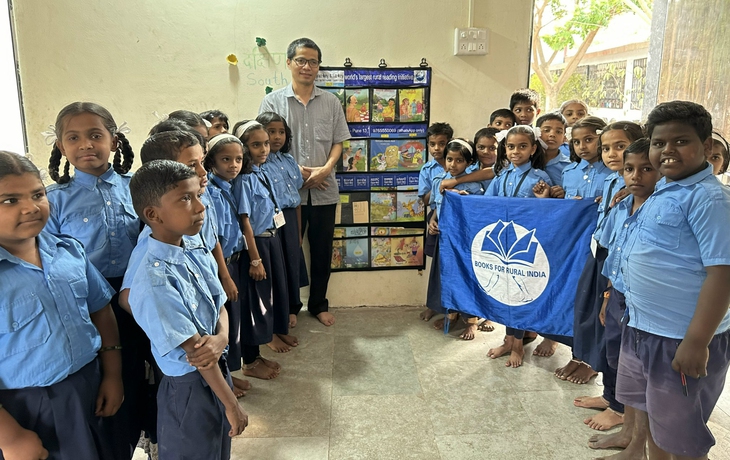
Author Nguyen Quang Thach presents books to Indian students - Photo courtesy of the author.
Start with the family.
For many years, the roles of family and school education have been scrutinized, and the cycle of blame seems to be never-ending.
Frankly speaking, personal character is nurtured through three channels of education: family, school, and society. However, for families with toxic parents, school and social education are supplementary. If school education is poor in philosophy and lacks humanity, the child will have nowhere to turn for support, as the two pillars of family and school constitute social education.
Therefore, for children to develop well, parents and grandparents need to actively acquire knowledge through books and newspapers, as well as seek guidance from good parents and grandparents in society to support their children's learning. Families committed to education should minimize their phone use and avoid bad habits such as alcohol and gambling.
When the family becomes an environment for discussing knowledge, debating what should and shouldn't be done, a culture of lifelong learning becomes the foundation for social development. From there, new, purely Vietnamese educational standards will easily absorb the best of humanity and form a system of civilized standards that spread and take root within society.
You may also like
Reforming the quality assurance of higher education: Meeting standards does not necessarily mean excellence.In Vietnam, higher education quality accreditation has played a crucial role in bringing educational institutions into orderly governance. However, the question to be asked in the coming period is: after achieving accreditation, will the institution continue to be encouraged to innovate its training model, improve research quality, develop governance data, form startup businesses, expand its social impact, and enhance its academic standing? The school must take the initiative.
Education should not only train people to do existing jobs but also nurture minds capable of creating new work trends. If teachers only teach to complete the curriculum and chase after achievements, students will learn merely to cope and will not be able to awaken their creative potential.
If universities focus solely on degrees without building a research ecosystem linked to national and global interests, national innovation will not be fostered.
A quality education must produce minds that identify social problems and create solutions. Furthermore, the quality of education is measured by indicators of humanity, humanism, creativity, social responsibility, and compassion in each citizen.
Therefore, educational designers must be capable of absorbing the best of global education and transforming it into a national curriculum on par with developed countries. By doing so, teachers will not only impart knowledge but also become intellectuals who constantly innovate in education and shape the future of society.
If schools don't get involved, the nation cannot change.
Embarking on a journey to bring civilization to the villages.
Rural Vietnam traditionally embraces empiricism, with many outdated customs persisting as cultural habits. Over 90% of rural parents and grandparents shape the thinking and lifestyles of their children and grandchildren during their early years. Even after the age of 18, and despite receiving an education in the city, many carry this mindset throughout their lives.
The problem isn't about rural origins, but about the lack of knowledge flow. A segment of the urban middle class, originating from rural areas, isn't returning to invest in their family, alma mater, or the community where they grew up.
When knowledge does not return, the civilization gap between urban and rural areas continues to widen, and tens of millions of rural children are forced to grow up lacking access to intellectual resources.
Over the past two decades, approximately 600,000 people have been involved in bringing books to children, but that number is still far too small compared to a population of over 80 million.
Therefore, civilization must be brought back to its roots: books about villages, and support networks for those living away from home who want to connect with their homeland need to be established.
Venturing into the upper echelons of the architecture.
A nation cannot escape stagnation if public funds are misused and power remains unchecked. Public service ethics are nurtured within a system of transparent controls and appropriate punishment for wrongdoing. When controls are weak, greed is always unleashed and corruption is encouraged. Commitment means designing a governance system based on intelligence, integrity, and the aspiration to lead the country to become a powerful nation.
In this new era, citizens have the right to stand outside the nation's aspirations for progress. Naturally, those who blame others remain outside of history, while those who actively participate create their own history, the history of their families, society, and ultimately, the history of humanity.
Human happiness is the harmonious blend of what one thinks, says, and does, in a spirit of responsibility and compassion. National prosperity stems from the concerted efforts of politicians, families, schools, and society as a whole, guided by values of integrity, transparency, appreciation of knowledge, shared social responsibility, and love for humanity.
Vietnamese people need to understand that no one else will take on the responsibility of building Vietnam's future for us.
Intellectuals committed to the cause
National development requires a team of intellectuals to lead academia and set new standards. Dedicated intellectuals should not only engage in criticism but also participate in system design, train the next generation, and persistently raise research standards. Together with businesses, they must create domestic products that are competitive with neighboring countries and meet export standards.
In the age of technology, if we do not master fundamental knowledge and core technologies, we will become dependent. As artificial intelligence (AI) expert Nguyen The Trung – a member of the National Advisory Council on Science, Technology, Innovation and Digital Transformation (Resolution 57) – stated: "To avoid the risk of being enslaved by AI, Vietnamese people need to learn genuinely, work diligently, and understand AI to transform technology into a tool serving economic development, nurturing a culture that cherishes knowledge, and creating new values based on the wisdom revealed and hidden over thousands of years."
According to Mr. Trung, commitment is a continuation of tradition but with a broader scope, because only through commitment can there be innovation and creativity.
Venturing beyond national borders.
A nation matures when it shifts from a receiving mindset to a sharing mindset of responsibility with humanity. When Vietnam contributes to peacekeeping forces, provides humanitarian assistance, or shares educational initiatives with other countries, it is not merely diplomacy but an affirmation of national character.
It's time for Vietnamese people to stop asking what we've gained and instead act to answer the question of what we've contributed to the development of humanity.
NGUYEN QUANG THACH
Source: https://tuoitre.vn/dan-than-trong-thoi-dai-moi-2026022309210217.htm



















































![[Video] Sunset at Lap An Lagoon – Where the sun sets over the fishing nets](https://vphoto.vietnam.vn/thumb/1200x675/vietnam/resource/IMAGE/2026/05/31/1780192137701_beach-landscape-sea-water-nature-grass-745871-pxhere-com.jpeg)

























Comment (0)