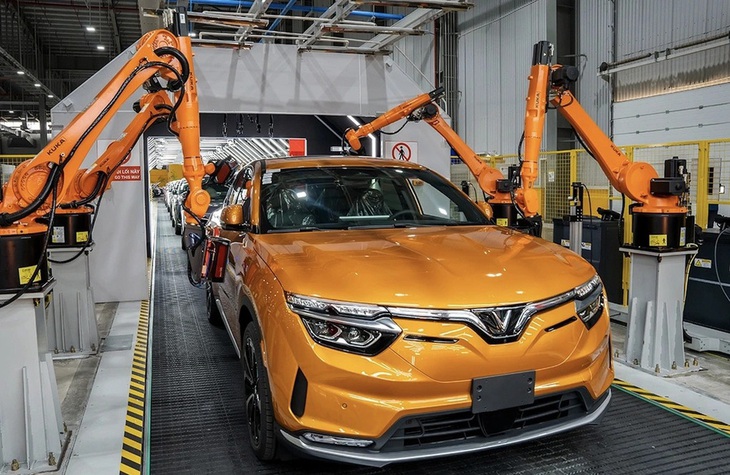
Vietnam is now able to produce many automotive components and spare parts domestically - Photo: VinFast
The goal of becoming a high-income country is not just an economic indicator. It is an aspiration for Vietnam's position, competitiveness, and stature in the global economic order.
The history of global economic development over the past 70 years clearly shows one thing: no nation has become a superpower through luck or simply due to a low labor cost advantage.
Japan was nearly exhausted after World War II. South Korea in the 1960s was poorer than many African nations. Germany was heavily devastated and divided. Singapore had no resources and a small domestic market.
But these countries have something in common: they have implemented sufficiently robust institutional reforms to foster confidence and long-term investment incentives; they know how to choose focused, not scattered, industrial strategies; and they have built domestic enterprises capable of accumulating technology and leading the value chain.
Their common denominator is not population size or resources, but endogenous capacity accumulated in a disciplined manner.
For Vietnam, after nearly four decades of Doi Moi (Renovation), remarkable progress has been made. From a closed economy, we have become one of the most open economies in the world in terms of trade.
Tens of millions of people have escaped poverty. The middle class is growing rapidly. The private sector – once a shrinking entity – now accounts for over 96% of businesses and contributes approximately 40% of GDP. A new generation of entrepreneurs has emerged in an environment of global integration and competition.
However, when setting a high-income target for 2045, we are forced to look deeper into the structure of the economy (small business scale, low investment in research and development (R&D), domestic businesses mainly participating in processing stages in the global supply chain, large export turnover but not commensurate quality...).
Many argue that Vietnamese businesses lack capital, technology, and high-quality human resources. That's true, but it's not the whole story. The deeper issue lies in the structure of the development ecosystem.
When the policy environment lacks long-term predictability, businesses tend to prioritize short-term strategies.
When the long-term capital market is underdeveloped, investment in technology and innovation is difficult. When the links between research institutes, universities, and businesses are weak, the process of mastering indigenous technologies is slow.
Without sufficiently leading enterprises, the spillover effect of technology in the economy is limited. The consequence is a familiar cycle: short-term investment - low R&D - no breakthrough in productivity - limited endogenous accumulation - no improvement in position within the value chain.
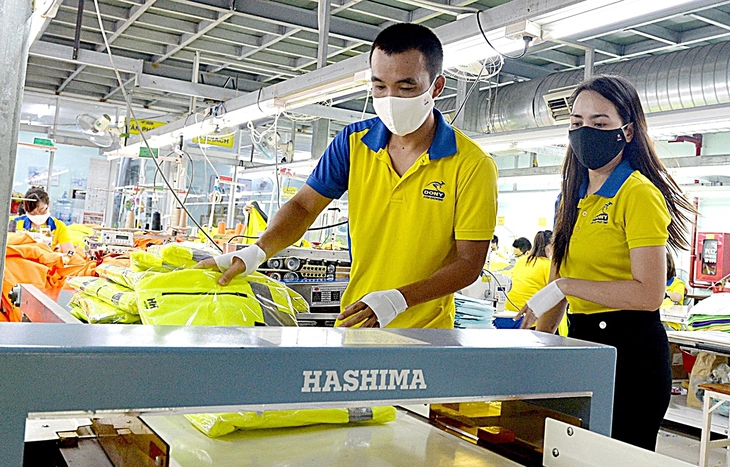
Garment products from a private enterprise (Dony Company, Tan Binh District, Ho Chi Minh City) are exported to Asian and European markets... - Photo: TU TRUNG
To believe in 2045, we must break this cycle. Belief only becomes an advantage, a strength, when it is transformed into capability.
The 2045 vision is well-founded because total factor productivity (TFP) becomes the primary driver of growth.
The rate of investment in R&D has increased to a level commensurate with the goals of modern industrialization. A class of leading technology enterprises has been formed, capable of leading the industry and participating deeply in regional value chains.
The "three-way" linkage – the State, schools, and businesses – is implemented through specific projects with clear outcomes. Institutions have created a transparent, stable, and predictable environment for long-term investment.
The year 2045 cannot be achieved through slogans alone, but through a capacity-building framework. This means striving for higher income through internal strength, not by outpacing others in the short term, but by building sustainable capabilities for the long term.
If Vietnamese businesses only focus on outsourcing, we will remain in the low-value segment. If Vietnamese businesses master technology, build brands, and control high-value-added processes, the nation's position will change. If institutions are not only stable but also create incentives, long-term investment confidence will be strengthened.
Vietnam has proven throughout history that with a firm commitment to reform, a country can transform rapidly.
The reforms of 1986 were a turning point. The reforms currently underway can also be considered a turning point if we shift from extensive growth to intensive capacity building.
When sufficient internal strength is accumulated, the aspiration for 2045 will no longer be just a beautiful dream.
It will become a well-founded belief – a belief in intellect, in elite resources, and in a nation ready to enter a new era with its own capabilities.
Ho Chi Minh City, February 2026
Back to the topic
PHAM PHU NGOC TRAI
Source: https://tuoitre.vn/vuon-minh-bang-noi-luc-20260223225605306.htm


![[Photo] Admire the coral "masterpiece" amidst the million-year-old heritage of Dak Lak province.](https://vphoto.vietnam.vn/thumb/1200x675/vietnam/resource/IMAGE/2026/05/31/1780221235105_anh-man-hinh-2026-05-31-luc-16-53-27.png)
![[Photo] The General Secretary, President and his wife begin their state visit to the Philippines.](https://vphoto.vietnam.vn/thumb/1200x675/vietnam/resource/IMAGE/2026/05/31/1780230559452_anh-man-hinh-2026-05-31-luc-19-28-11.png)
![[Photo] Solemn bathing ceremony and Buddha procession in Hue](https://vphoto.vietnam.vn/thumb/1200x675/vietnam/resource/IMAGE/2026/05/31/1780228263543_1-jpg.webp)













![[Photo] Admire the coral "masterpiece" amidst the million-year-old heritage of Dak Lak province.](https://vphoto.vietnam.vn/thumb/402x226/vietnam/resource/IMAGE/2026/05/31/1780221235105_anh-man-hinh-2026-05-31-luc-16-53-27.png)






![[Video] Sunset at Lap An Lagoon – Where the sun sets over the fishing nets](https://vphoto.vietnam.vn/thumb/340x192/vietnam/resource/IMAGE/2026/05/31/1780192137701_beach-landscape-sea-water-nature-grass-745871-pxhere-com.jpeg)




































































Comment (0)