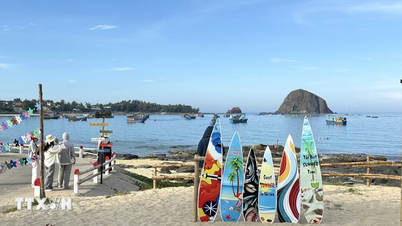
However, apart from the name "infinite sea" that netizens have been searching for recently, tourism in Thai Binh in general, and Con Den in particular, remains a "low-lying area" compared to other localities, and therefore needs to be "awakened" soon for development.

Tourists stroll through the pine forest and bungalows located within the Con Den Eco-tourism Area.
The hidden beauty of a "rough gem"
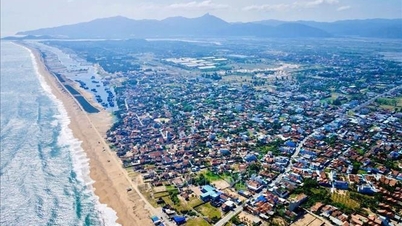
Con Den islet was formed by the alluvial deposits from two major rivers, the Tra Ly and Diem Ho, in Thai Binh province. Over time, nature has created a flat terrain with a strip of sand covered in green by rows of pine and casuarina trees that function as a barrier against coastal erosion. Along with this is a diverse coastal mangrove ecosystem, including Rhizophora, Avicennia, and Sonneratia species. This sturdy "green wall" not only protects coastal villages from major storms but also serves as a "common home" for 200 species of birds, many of which are rare, along with 500 species of aquatic animals and a valuable source of seafood .


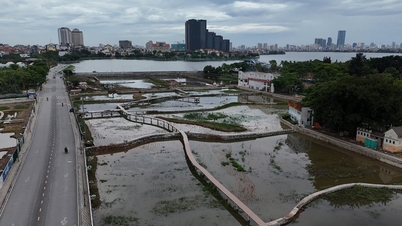
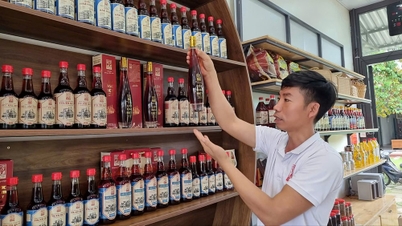
Con Den Ecotourism Area is located 35km from Thai Binh city and about 15km from the center of Diem Dien town. It boasts a 4km long beach bordering the East Sea and mangrove forests. At Con Den, visitors can immerse themselves in the fascinating coastal natural world by taking boat trips through the mangrove forests, strolling across Vietnam's longest bamboo bridge, or experiencing clam harvesting and learning about the process of making the local specialty clam fish sauce.
In particular, the experience that has made Con Den the hottest destination recently is taking check-in photos on the "infinity sea." It's called the "infinity sea" because when the tide rises, the waves are calmer than in other areas, creating a scene where the sea and sky merge as if there were no dividing line. Con Den is also very hospitable, offering visitors fresh seafood. Under the skillful hands of the chefs, visitors can enjoy rustic dishes such as steamed clams, squid, and shrimp; clam salad, jellyfish salad, and sea spinach soup...
During their trip, tourists should not forget to combine their visit with exploring interesting historical and cultural sites around Con Den Island, such as the Nguyen Duc Canh Memorial Area; the Ba Chua Muoi Temple and Shrine Complex; or famous traditional craft villages like the incense-making village of Lai Trieu (Duong Phuc commune), the blacksmithing village of An Tiem (Thuy Dan commune), and the salt-making village of Thuy Hai commune...
Fill in the "low points"...
Given the immense potential of Con Den Island, in 2010, the People's Committee of Thai Binh province approved the General Planning for the Con Den Ecotourism Area, covering 1,150 hectares, focusing on developing ecotourism, resort tourism, sightseeing, research, and entertainment. However, according to Mr. Vu Trung Kien, Chairman of the Board of Directors and General Director of Minh Phu Trading and Service Company Limited - the investor of the Con Den Ecotourism Area - the area has not developed to its full potential due to limitations in socio-economic conditions and the province's tourism infrastructure and technical systems. Furthermore, the lack of close cooperation with local authorities and travel agencies in promotion and product development, coupled with a lack of long-term vision for sustainable tourism development planning, has left Con Den Island and Thai Binh province underdeveloped for many years.
To address this situation, according to many tourism experts and travel agencies, Con Den tourism needs to define its target market, thereby formulating a development strategy and prioritizing appropriate investment capital. According to Associate Professor Dr. Duong Van Sau, former Head of the Tourism Department (Hanoi University of Culture), Con Den should initially focus on developing the local tourism market. Furthermore, the essence of tourism is linkage; therefore, it is necessary to find cultural connections to build compelling narratives at various locations, creating curiosity that will draw tourists to Con Den.


Having been involved with the tourism industry in Thai Binh province for many years, Dr. Ngo Kieu Oanh, a consultant specializing in agricultural and rural tourism, believes that Con Den should develop cultural tourism products, emphasizing the unique features associated with the legend of the Salt Goddess and the distinctive salt-making craft of Thai Binh. According to her, although many provinces across the country produce salt from North to South, only Thai Binh has the belief in worshipping the Salt Goddess, reflecting the characteristic folk culture of the Red River Delta region in general and Thai Binh in particular. Therefore, linking and developing resort tourism, ecotourism, agricultural tourism, and cultural-spiritual tourism products at Con Den will create unique selling points and elevate the value of tourism products there.
Expressing surprise at the rich, untapped potential of Con Den Island, Ms. Stella Ciorra, Vice President of the Friends of Vietnamese Heritage (FVH) Association, stated: “Catching clams, preparing dishes, making clam fish sauce… will be experiences that any international tourist would want to participate in. In particular, the pristine natural landscape, unique folk culture, and rich culinary traditions are strong points that will attract foreign visitors living, studying, and working in Hanoi to Con Den Island.” In the future, the Association will cooperate with the Con Den Eco-tourism Area in developing products and bringing international tourists to the island. Many travel businesses from the North, Central, and South of Vietnam have also committed to strengthening cooperation with Con Den Island to accelerate tourism development in Thai Binh in the coming time.
Source


![[Photo] General Secretary and President To Lam working with the Technical and Professional Center, Ministry of Public Security](https://vphoto.vietnam.vn/thumb/1200x675/vietnam/resource/IMAGE/2026/07/06/1783318005842_a1-bnd-1129-2263-jpg.webp)






![[Video] Weather forecast for tonight and tomorrow, July 7, 2026: Thunderstorms continue during the night and early morning in Northern and Central Vietnam.](https://vphoto.vietnam.vn/thumb/402x226/vietnam/resource/IMAGE/2026/07/06/1783342904145_dem-6-png.webp)