

Once considered priceless yet mysterious treasures, almost on the fringes of life, national archives have in recent years been actively engaging with contemporary society, as their vast archives – a heritage of documents – are being progressively exploited and supplemented daily.
Gathering memories for generations to come.
Over the past three years, through document acquisitions and exhibitions, exchanges, and seminars organized by national archives, lovers of Vietnamese literature and art have had the opportunity to access a considerable amount of valuable and rare materials by many famous artists and writers. These occasions also provide rare opportunities for the public to gain a more thorough understanding of many renowned works that have stood the test of time.
Music lovers of many generations may have memorized the lyrics and the circumstances surrounding the creation of "The Marching Song," but it wasn't until the Center announced the collection of documents donated by the family of composer Van Cao that the majority of the public saw the manuscript and handwritten score of this work for the first time. Throughout the end of 2023 and the beginning of 2024, those interested in musical heritage continued to rejoice as thousands of pages of manuscripts, documents, and artifacts about the lives and careers of two famous figures of revolutionary music: composer Doan Nho and composer Hoang Ha, were donated by the composers and their relatives to the National Archives Center III. The Center's staff then organized, arranged, and preserved these materials scientifically.
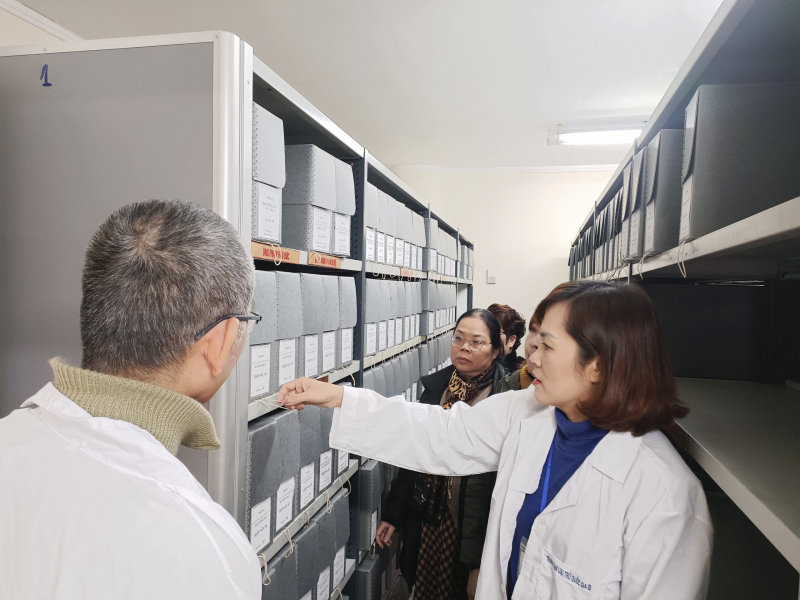
Director of the National Archives Center III, Tran Viet Hoa, and the family of musician Hoang Ha visit the personal document preservation area at the Center.
In fact, this is only a very small part of the collection of documents that the National Archives Center III has recently collected and preserved. According to Dr. Tran Viet Hoa, Director of the Center, for many years, the Center has been collecting rare documents of outstanding individuals who have made great contributions in various fields of social life, including political and social activists, diplomats, scientists, and artists in the field of literature and art who have received the Ho Chi Minh Prize, the State Prize, and international prizes, as well as individuals who possess rare documents related to important historical and cultural events of the country. By 2023, it is estimated that the Center has initially collected and preserved the memories of the labor and creative activities of nearly 200 outstanding individuals, families, and clans of Vietnam.
Valuable artifacts, documents, and manuscripts donated to the archives contain many stories about authors, their works, social life, and even important evidence of historical moments of the nation. Now, through these activities, we have the opportunity to look back, see, listen, and learn more thoroughly. As musician Doãn Nho shared, just by looking at the manuscripts he donated to the Center, many people can "read" many things about social life during the resistance war and the days immediately after the country's liberation. For example, the brownish-black paper used by the musicians was only available during that period. The musicians only had pencils to write. Some manuscripts require magnifying glasses to read.
Ms. Hoang Yen - daughter of musician Hoang Ha - and many officials of the National Archives Center III also believe that by simply looking at the notebooks that the musician bound himself for his own use, which are only slightly longer than a finger, or reviewing the letters that the musician and his wife wrote to each other during their lifetime, today's generation can get a glimpse of what their ancestors' lives were like in the past.
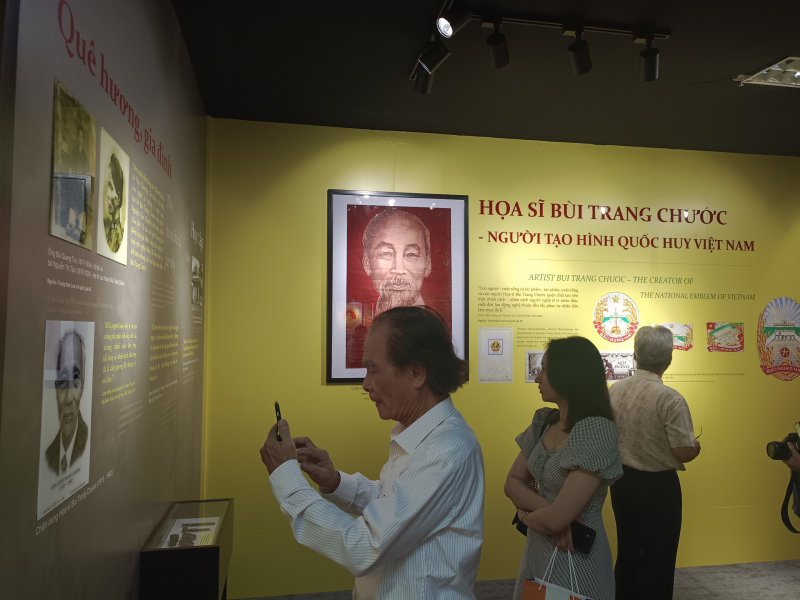
The exhibition hall displays documents about the painter Bui Trang Chuoc.
Confirming that all the works from the artistic career of painter Bui Trang Chuoc have been donated by his family for long-term preservation by the archives, Ms. Nguyen Thi Minh Thuy, the artist's daughter, also stated that thousands of pages of manuscripts and original photographic documents have been collected by the family. The sketches of the Vietnamese national emblem, designs for medals, badges, certificates of merit, the design for the exterior decoration of President Ho Chi Minh's mausoleum, designs for banknotes and postage stamps, along with many graphic publications directly serving culture and social life… have been carefully preserved and protected by the family over a long period, in the cramped and difficult conditions of the war, during evacuations, after peace and liberation, numerous moves, and even after 1992, when the artist passed away.
Before entrusting their archives to the Center, artists, scientists, and their families were very cautious and spent a considerable amount of time selecting documents, exploring preservation methods, and assessing the value of the materials. Bringing the archives of musician Hoang Ha to the Center as they are today required nearly seven years of collaboration between the family and archival staff. The archives of musician Doan Nho at the Center began to be compiled more than 10 years ago. The archives of painter Bui Trang Chuoc have been there for almost 20 years.
A vivid testament to the history, the country, and its people.
According to the State Archives and Records Administration, the aforementioned documents and materials collected by the National Archives Center III are only a part of the massive collection of documents that the National Archives Centers have collected and preserved over the years. Previously, implementing the project "Collecting valuable and rare documents of Vietnam and about Vietnam," from 2012 to 2020, the centers alone collected 3,709 ancient documents of the Cham ethnic group; 20 original documents, 24,133 pages of copied documents in Han-Nom script on personal biographies, family genealogies, clan genealogies, certificates, imperial decrees, etc.; and photographed 8,959 woodblock prints recording Buddhist scriptures and medical books. These documents reflect on the origins, development, material and spiritual life, customs, and traditions of the Vietnamese people throughout different historical periods, as well as documents about families and clans that have left a significant mark on Vietnamese history in the provinces and centrally-governed cities.
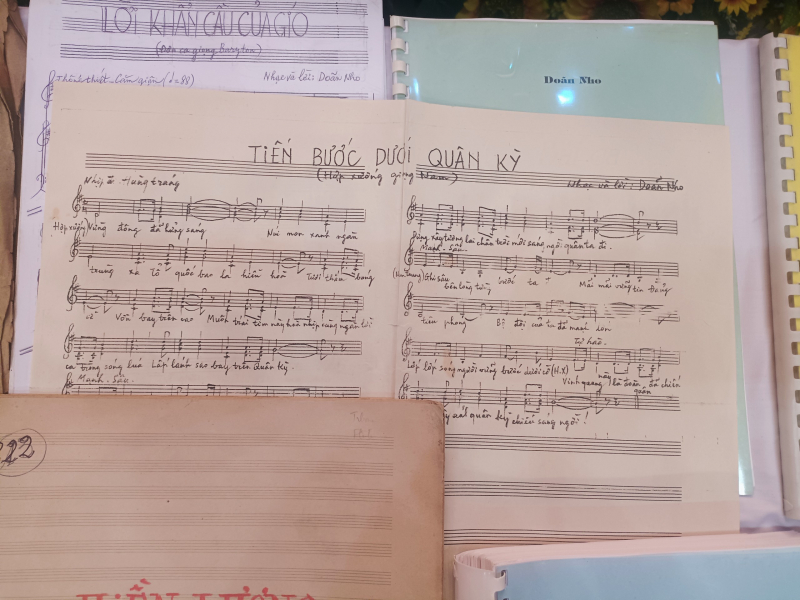
Original documents containing many famous musical works by composer Doãn Nho were published in early 2024.
The Centers have also collected documents reflecting the lives and careers of 20 generals of the Vietnam People's Army, and 25 outstanding individuals in various fields. In addition, there are tens of thousands of documents related to Vietnam's maritime and island sovereignty, the period of socialist construction in the North, the Geneva Conference, the Paris Conference, and campaigns during the resistance war against the US (1954-1975); interviews, audio and video recordings of 14 witnesses (480 minutes) about many historical events. These valuable and rare documents, collected and well-managed, have contributed to enriching the source of materials and documents serving the study of national history and culture, or the study of the lives and careers of the country's cultural figures. However, the number of documents collected during this period is still very modest compared to the actual number of valuable and rare archival documents currently held by individuals, families, and clans in the country, as well as archival agencies and organizations abroad.
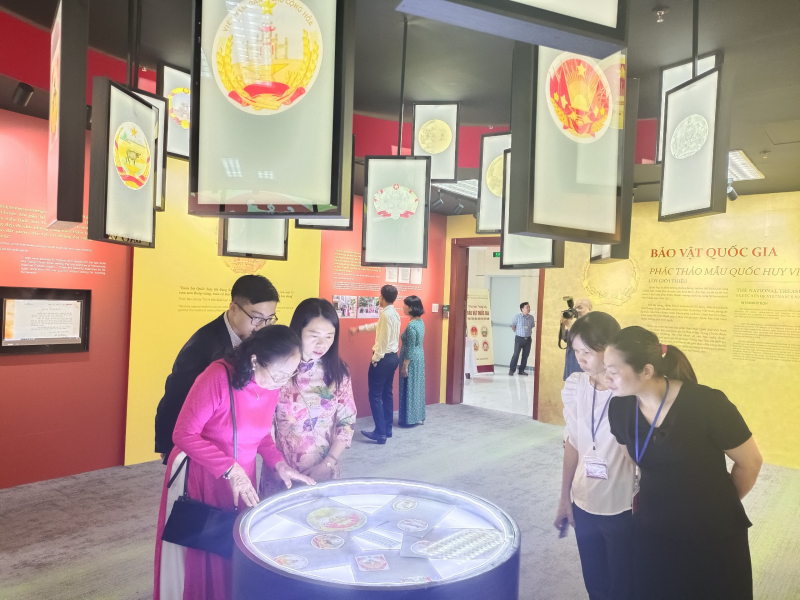
Many visitors were curious about the sketch of the Vietnamese national emblem by artist Bui Trang Chuoc.
Overall, to date, the National Archives Centers under the State Archives Department are preserving more than 35 km of document shelving, including many valuable and rare documents on various materials such as paper, photographs, magnetic tapes, and wood. These documents were created during the operation of central agencies and organizations under different regimes, as well as by prominent individuals, families, and clans, reflecting the economic, political, cultural, and social life of Vietnam from the 15th century to the present. According to Dr. Tran Viet Hoa, within this heritage, there are some documents of exceptional value. These include the Nguyen Dynasty woodblocks (preserved at the National Archives Center IV), which were recognized by UNESCO as a World Documentary Heritage in 2009. These comprise numerous woodblock prints in Han-Nom script reflecting all aspects of Vietnamese social life, history, and geography under the Nguyen Dynasty.
The Nguyen Dynasty's imperial archives (preserved at the National Archives Center I), recognized by UNESCO as a regional documentary heritage of the Asia-Pacific in 2014, possess dual historical and legal value, representing the only remaining administrative documents of Vietnam's last feudal dynasty. At the National Archives Center III, there is the collection of decrees of the President of the Provisional Government of the Democratic Republic of Vietnam (from August 30, 1945 to February 28, 1946), demonstrating the resilience of the fledgling revolutionary government under President Ho Chi Minh in the early days of the successful August Revolution, and the collection of Vietnamese national emblem designs by artist Bui Trang Chuoc, recognized as a national treasure. Thus, it can be seen that the archival documents at the National Archives Centers are extremely rich and diverse in form and content, encompassing a large volume and comprehensively reflecting the development of the nation's history through various periods.
Along with the implementation of the program "Publishing national archival documents to serve socio-economic development and protect national sovereignty," instead of being preserved only in national archives, the aforementioned vast heritage is being actively utilized.
According to Dang Thanh Tung, Director of the State Archives and Records Department, the National Archives Centers serve over 5,000 domestic and international readers annually; provide copies and certifications for over 100,000 pages of documents; and welcome over 30,000 visitors to exhibitions. Over 100 exhibitions and displays of archival documents have been held, including many large-scale international exhibitions attracting a large number of visitors. Published publications and archival documentaries are produced with diverse and rich content, promptly serving important events of the country and localities, and contributing to the dissemination of information about the country's sovereignty over its maritime territories and islands.
Source
![[Photo] The heat at the fireworks display site on the opening night of the Da Nang International Fireworks Festival 2026](https://vphoto.vietnam.vn/thumb/1200x675/vietnam/resource/IMAGE/2026/05/27/1779889741485_ndo_br_z7872039145157-fecaba5112f39e8352544099d7ef4738-5140-jpg.webp)






























































Comment (0)