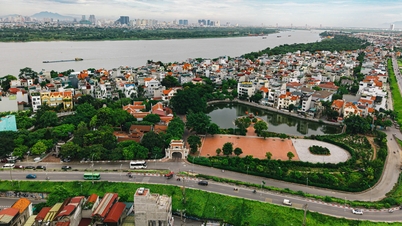
The Red River Stone Beach is a popular recreational and tourist spot in Hanoi.
Across the Han River, the Chao Phraya River
In 2023, we had a business trip to Seoul (South Korea) and were very impressed by the modern beauty of the city. But perhaps the most impressive thing was the Han River with its modern roads, the "forest of skyscrapers" on both sides, and the dozens of magnificent bridges connecting the two banks.
From the airport to the city, travelers journey along the highway on the south bank of the river, crossing a beautiful arched bridge to the north bank to enter the urban core. The highway runs parallel to the river, separated from it by a long stretch of green parkland. In many sections, the highway "offshore," running over the river; in the evening twilight, the scenery becomes even more breathtaking.
From the top of the 123-story Lotte World Tower – currently the tallest building in South Korea – visitors can enjoy panoramic views of the Han River as if it were right below them. Glancing along the river, one can admire over 30 bridges spanning it, each with a unique architectural design, like a fashion show. The Banpo Bridge is bathed in mesmerizing light thanks to its multicolored LED fountain system. The Dongjak Bridge is striking with its tram crossing. The Grand Bridge, the longest cable-stayed bridge in South Korea, sparkles at night. The Hangang Bridge, crossing the artificial island of Nodeulseom, is also a magnificent viewpoint...
I once toured Bangkok (Thailand) on a cruise along the Chao Phraya River at night. The riverbank was lined with modern high-rise buildings, stretching all the way to the water's edge. From the boat on the Chao Phraya, visitors felt as if they were floating between two dazzling strips of light created by the buildings – a work of art woven from light.
The Red River is still "sleepy".



Returning to the Red River in Hanoi , we find ourselves in a different, more pristine landscape, with reed-covered banks and herds of cattle grazing peacefully in the afternoon sun. The section of the Red River passing through the capital is associated with the glorious victories of our ancestors: the battles against the Mongol-Yuan invaders (the pinnacle being the victory at Chuong Duong - Ham Tu); Le Loi's Battle of Bo De against the Ming invaders; the victory in the spring of Ky Dau (1789), when King Quang Trung defeated 290,000 invading Qing troops... Thang Long Imperial City, on the banks of the Red River, is over 1,000 years old, having experienced many golden periods and at one time flourishing as the most prosperous city in Southeast Asia. However, today, compared to the Han River in Seoul and the Chao Phraya River in Bangkok, the Red River seems to still be "sleeping."
For me, the Red River evokes images of river traders. The deserted riverbanks suddenly become bustling, thin planks connecting boats to the sand, swaying with the waves. Women, carrying baskets on their shoulders and woven containers on their heads, nimbly disembark. They bring baskets of agricultural products: fruits, grains, livestock, bamboo shoots, wood ear mushrooms, shiitake mushrooms... from villages upstream on the Red River, arriving by boat to be gathered on the sandbank at the foot of the Chương Dương Bridge, then sold to merchants at Long Biên Market and other markets throughout Hanoi.
They sail down the river in the morning to Hanoi and then travel up the Red River at night to return home. Despite the hardship, river traders are mostly women. Ms. Hanh, a trader I met here, said she travels by boat carrying bananas from An Lac district (Vinh Phuc province), and all more than 30 traders are from the same village. The men in the families handle the banana collection, while the women are responsible for transporting the goods to the capital for sale.
They make one trip a day, departing from home at 10 am and arriving at their destination at 2 pm, selling their goods until 6 pm. The merchant boats return in the evening, with planks laid out on the deck to serve as beds. They have long been accustomed to this life on the river. Ms. Huong, another female trader, confided: "The 'river trading' profession is ingrained in my blood and flesh; even if I didn't like it, I wouldn't want to switch to another job."
My impression of the Red River also includes the picturesque flower gardens along its banks. There's the Nhật Tân flower village with its vibrant peach blossoms every spring. In particular, the flower gardens on the rocky banks of the Red River at the foot of the Nhật Tân bridge, or the Long Biên flower garden on the north bank, have become attractive tourist destinations for many years. From daisies and sunflowers to lotuses, asters, cosmos, peach blossoms, and purple chrysanthemums... these flower gardens have created a unique charm for the Red River and Hanoi.
"Awakening" a river
Crossing the Han River, the Chao Phraya River, and many other rivers in various cities, when we think of the Red River, we always hope to see change in this place. We want to see the Red River awaken, dressing our capital in a magnificent, modern, and harmonious garment, enriching the enduring historical flow of the nation.
Today, the section of the Red River passing through Hanoi's inner city already has the Nhat Tan Bridge, Vinh Tuy Bridge, Chuong Duong Bridge, Thang Long Bridge, Thanh Tri Bridge... But it seems Hanoi still needs many more bridges. It also needs urban areas, beautiful high-rise buildings, and modern transportation infrastructure that blend seamlessly with the beauty of the historical river, with walking paths extending along the riverbanks so that tourists can admire the unique scenery.


The General Planning for the Construction of Hanoi until 2030 and with a vision to 2050, approved by the Prime Minister, identifies the Red River as the main landscape axis of the capital. The Red River urban zoning plan has also been approved by the Hanoi People's Committee, creating favorable conditions for developing the Red River into an important landscape axis. Currently, the Hanoi Department of Culture and Sports is coordinating with the Hanoi Department of Planning and Architecture to gather feedback on the draft "Project for the Construction of a Cultural and Landscape Park on the Red River's Mid-River Embankment".
Architect Tran Ngoc Chinh - Chairman of the Vietnam Urban Planning and Development Association, commented: "The research and renovation of the sandbars and alluvial plains of the Red River into a cultural and tourism park is a groundbreaking solution to effectively exploit the land resources and potential advantages, as well as the natural beauty of the Red River sandbars, meeting the needs for recreation and tourism, and increasing the proportion of green space in the historical inner city area."
I believe that building a cultural and landscape park on the Red River's sandbank shouldn't just create green spaces like any other park. Developing the Red River landscape needs to create something unique and different from other cities around the world. That is, it needs to promote the distinctive features of existing flower villages and gardens along the river. The city should focus on developing flower parks based on the models of existing flower gardens and villages. These could be private flower parks or public flower parks invested in by the State, creating a colorful floral ecosystem. Later, when cruising along the Red River, tourists will be able to admire a modern city overflowing with flowers.
Source
![[Photo] General Secretary and President To Lam attends the 13th National Congress of the Ho Chi Minh Communist Youth Union](https://vphoto.vietnam.vn/thumb/1200x675/vietnam/resource/IMAGE/2026/06/25/1782356968989_ndo_br_1-jpg.webp)

![[Image] Schools organize meetings and introduce teaching models to students admitted to grade 10.](https://vphoto.vietnam.vn/thumb/1200x675/vietnam/resource/IMAGE/2026/06/25/1782368077271_ndo_br_z7970052192242-1ec8daeb77a6eed1a4e9f58c564ddd3e-jpg.webp)

![[Photo] General Secretary and President To Lam receives Palestinian Ambassador Saadi Salama](https://vphoto.vietnam.vn/thumb/1200x675/vietnam/resource/IMAGE/2026/06/25/1782365384740_a1-bnd-9423-8322-jpg.webp)