

The High-Tech Innovation Center (HIC), built on the basis of the Capital City Law (amended in 2024) and strategic documents from the Central Government, will be a pioneering center for testing many new and groundbreaking mechanisms for digital transformation and the digital economy of Hanoi City.
Coordination Center
The entrepreneurial journey of Mr. Dang Quang Huy (Hong Ha Ward, Hanoi ) reflects the transformation of the young workforce in the capital city. Leaving a stable marketing job at an electronics distribution company, he chose to start his own business selling technology accessories entirely on a digital platform.
With no fixed office, no fixed working hours, and no cumbersome organizational structure, this 27-year-old's startup operates through a network of nearly 20 remote freelancers. Each person takes on a different role in the value chain, from handling advertising, content, and videos to managing e-commerce platforms and livestreaming.
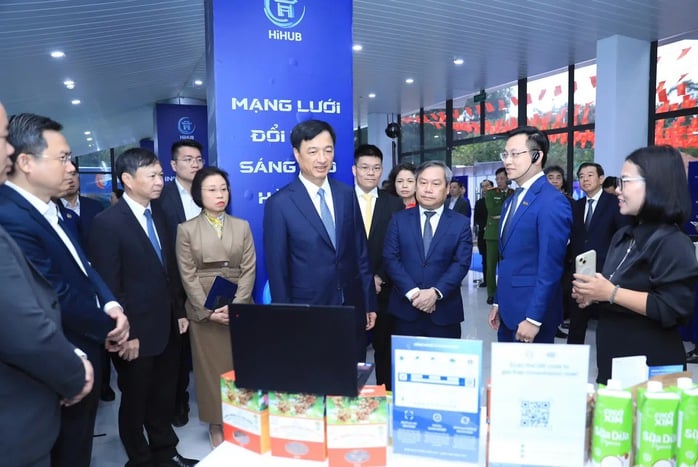
Hanoi Party Secretary Nguyen Duy Ngoc visits the Hanoi Innovation Network Exhibition in December 2025.
Huy's startup model belongs to the "Gig economy" wave, where flexibility, creativity, and efficiency replace traditional structures. For young people like Huy, stability no longer means being fixed in place. They are willing to work multiple jobs simultaneously, leveraging digital platforms to increase their income and experience.
However, not everyone is as successful as Dang Quang Huy. Many tech startups have failed prematurely due to lack of capital, strategic advisors, and a policy testing environment. This raises the question of how innovative ideas can not only shine brightly for a moment but also grow and become real businesses. The answer lies in building a strong institutional foundation and infrastructure – a role that HIC is striving to fulfill.
In the digital age, artificial intelligence (AI), virtual reality (VR), and augmented reality (AR) are opening up entirely new approaches to culture and tourism. Hanoi possesses abundant high-quality human resources and a rich heritage. When these two factors combine, heritage is no longer "static" but becomes a creative economic product.
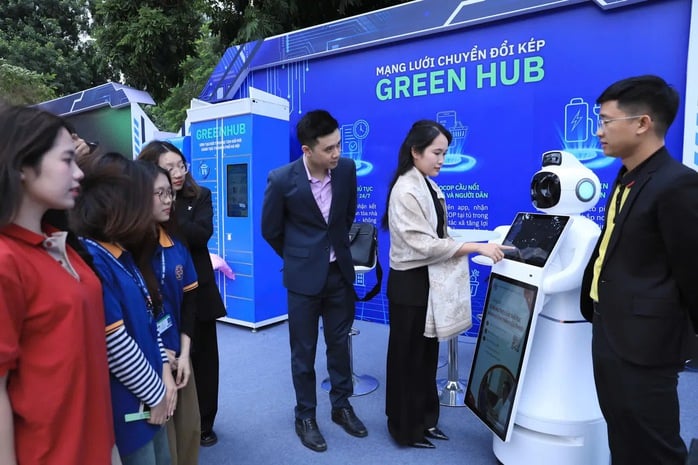
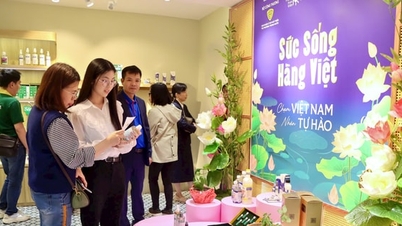
Many products were displayed at the Hanoi Innovation Network Exhibition. Photo: PHAM LINH
In 2025, Hanoi is expected to welcome over 33.7 million tourists, generating tourism revenue exceeding 134,000 billion VND – a 21.5% increase compared to the previous year. Digital transformation plays a crucial role in this. The VR360 project – a digital heritage map – allows tourists to "stroll" through 360-degree images of Hanoi's streets and neighborhoods. At the Temple of Literature, 3D mapping technology recreates the atmosphere of the old school grounds, helping visitors "step into" the past…
Trends such as gamifying heritage sites, digital animations about the legend of Hoan Kiem Lake, and virtual tours exploring culinary delights demonstrate that technology is expanding its creative horizons. Young people – who make up about 60% of Hanoi's population – are the target customers who favor these personalized experiences.
For these digital products to develop sustainably and on a larger scale, a supporting ecosystem is needed, encompassing policies, finance, and R&D (research and development) infrastructure. This is precisely the space where HIC can play a central coordinating role.
Breakthrough model
HIC was built on the "state-oriented - enterprise-operated" model. This is the first time Hanoi has designed an innovation organization with a joint-stock company structure that is state-owned but operates according to modern corporate governance standards – considered a breakthrough.
HIC's centralized management mechanism is another breakthrough. Instead of providing decentralized support through multiple channels, the center will act as an ecosystem coordinator, connecting research capabilities with urban problem-solving, startups with investment funds, and talent with specific projects.
Notably, HIC was empowered to implement a "sandbox" mechanism – a controlled testing environment. This is likened to a "policy laboratory," where businesses can test new technologies in a safe legal environment, exempt from certain objective risks. In the fields of fintech, blockchain, AI, or smart cities, a sandbox is a key condition for ideas to enter the market without encountering legal obstacles.
In addition, there are incentives related to taxes, land, and credit; access to state-owned laboratories, R&D infrastructure, and digital platforms; along with venture capital funds and technology incubation programs. These tools create a financial and technical "launchpad" for startups.
According to the plan, in the period 2026-2030, HIC aims to incubate over 200 startups, attract more than 500 billion VND in investment capital, and organize over 20 international science and technology events annually. By 2045, the center aims to establish at least 10 "unicorn" companies, build 20 key laboratories, and achieve technology commercialization revenue of over 500 billion VND per year.
Those expectations of Hanoi will become a reality if HIC truly becomes the nucleus linking the "three stakeholders": the State - scientists - businesses. When the State creates flexible institutions, scientists provide knowledge, and businesses undertake commercialization, the innovation value chain will be closed.
International experience shows that many cities such as Seoul - South Korea, Tel Aviv - Israel, and Singapore have achieved breakthroughs thanks to innovation centers with specific mechanisms. Hanoi is following that trend, but based on its existing scientific and technological potential and unique cultural identity.
Innovation cannot rely solely on individual initiative; it requires a solid institutional foundation. HIC can be seen as the first step for Hanoi in building that foundation – the foundation for a creative city where ideas are nurtured, technology is commercialized, and aspirations for development are realized in the era of the knowledge economy.
The establishment of HIC can be seen as a crucial decision in the development thinking of the capital city. HIC is not only essential for the start-up community but also lays the institutional foundation for a sustainable innovation ecosystem.
In the future, when HIC truly plays the role of "conductor" in innovation, startups like Mr. Dang Quang Huy's company can access venture capital funds, test products in a sandbox, receive mentorship from international experts, and expand into global markets right here in Hanoi. At that point, technology will continue to revive heritage and improve the quality of life for the capital's residents.
Source: https://nld.com.vn/dat-nen-mong-doi-moi-sang-tao-196260305191937872.htm
![[Image] A night of light, many layers of message](https://vphoto.vietnam.vn/thumb/1200x675/vietnam/resource/IMAGE/2026/03/10/1773158812907_hoa-nhac9-jpg.webp)






















































































Comment (0)