

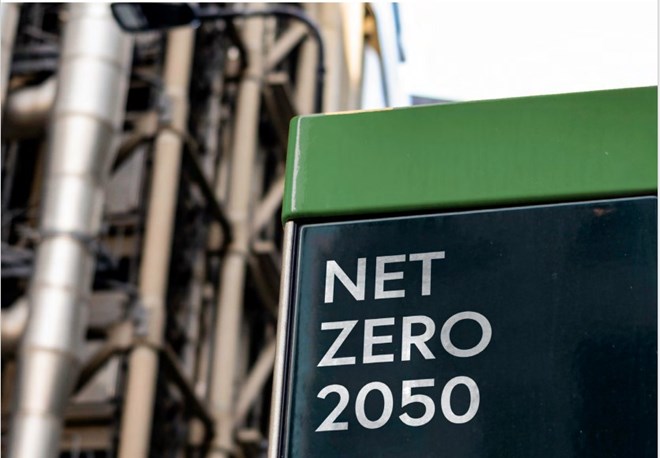
The manufacturing sector is one of the largest sources of greenhouse gas emissions globally. According to the International Energy Agency (IEA), industry and manufacturing contribute approximately 24% of total global CO2 emissions.
Digital transformation will accelerate the green transition process because the widespread application of digital technology solutions can reduce total emissions by 20% and move towards a net-zero emissions target by 2050. In this process, digital technology not only helps cut CO2 but also increases production efficiency, saves operating costs, and brings significant economic benefits, estimated at up to $4.9 trillion. Digital technology can save $1.2 trillion in electricity costs, $1.1 trillion in fuel costs, and $2.6 trillion from other areas such as real estate and water.
Like other countries, Vietnam is striving to transition to cleaner energy and improve energy efficiency in manufacturing to reduce its environmental impact. In this effort, the national digital transformation program will play a central role in guiding the manufacturing sector towards a Net Zero goal by 2050, through process optimization, waste reduction, and support for renewable energy.
In 2023, Vietnam achieved several major successes in digital transformation, such as the national digital transformation index increasing from 0.48 in 2022 to 0.71; the Innovation Index rising two places to 46th globally; Vietnam being in the top 10 countries with the highest mobile app downloads in the world for one consecutive year; the number of users on digital platforms increasing by 46% compared to 2022; and Vietnam's digital economy growth rate being the fastest in Southeast Asia for two consecutive years.
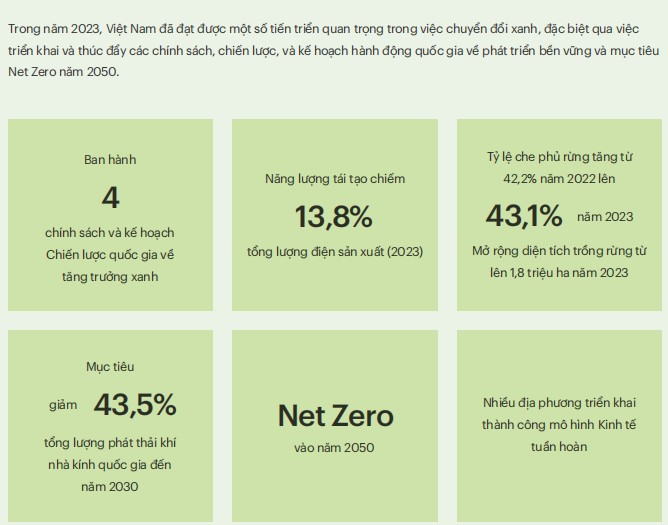
Advances in digital transformation are directly proportional to green transformation in Vietnam. According to DxReports by FPT Digital, published on May 4th, in 2023, Vietnam achieved significant progress in green transformation, particularly through the implementation and promotion of national policies, strategies, and action plans on sustainable development and the Net Zero 2050 goals.
For example, renewable energy accounts for 13.8% of total electricity production; forest cover increased from 42.2% in 2022 to 43.1% in 2023, and many localities have successfully implemented circular economy models...
Overall, digital transformation supports green transformation by providing technologies and solutions to optimize processes, reduce waste, and improve energy efficiency. At the same time, the goal of a greener future also fuels the demand for digital innovations in sectors such as energy, transportation, and waste management, thereby creating a positive cycle between technology and the environment.
However, according to experts, green transformation in Vietnam also faces major challenges such as skill shortages and high investment costs. Therefore, businesses need to find ways to access "green" capital, invest in training and skill development, and upgrade information technology infrastructure. This will be key to maximizing the benefits of digital transformation.
Source: https://laodong.vn/cong-nghe/dau-an-chuyen-doi-so-trong-qua-trinh-chuyen-doi-xanh-tai-viet-nam-1335810.ldo


































































![[Photo] Closing Ceremony of the 15th Conference of the Central Committee of the 13th Party Congress](https://vphoto.vietnam.vn/thumb/402x226/vietnam/resource/IMAGE/2025/12/23/1766462841764_a1-bnd-3731-1647-jpg.webp)





























Comment (0)