

Silence is not golden.
The Ho Dynasty Citadel became a World Heritage site in 2011, possessing outstanding global value: it is both a royal citadel symbolizing royal power and a formidable military fortress. Here, we see a unique and unparalleled Vietnamese technique of large-scale stone construction combined with construction art from East Asia and Southeast Asia. A continuous system of manual techniques, from quarrying and processing the stone to transporting massive blocks weighing 10-26 tons, preparing the stone foundations, and lifting the large blocks to heights exceeding 10 meters, ensured both the functionality and aesthetic appeal of the citadel.
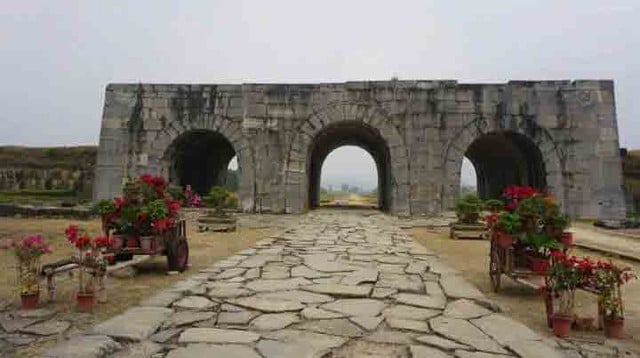
The southern gate of Ho Dynasty citadel. PHOTO: MINH HAI
"However, many people, looking only at images of the stone walls, will find it difficult to imagine the grandeur of the citadel and the unparalleled engineering skills of the ancients," said Associate Professor Tong Trung Tin, President of the Vietnam Archaeological Association. In 2021, Professor Pham Mai Hung, former Director of the Museum of the Revolution, assessed the Ho Dynasty citadel as the UNESCO cultural heritage site with the lowest ticket sales revenue among all inscribed domestic heritage sites.
Therefore, the Ho Dynasty citadel is a heritage site that needs more stories to become more accessible to the public. Continuous archaeological excavations are being carried out to further decipher the layout, the short-lived Ho Dynasty, and the connections between this dynasty and related dynasties within a single architectural framework.
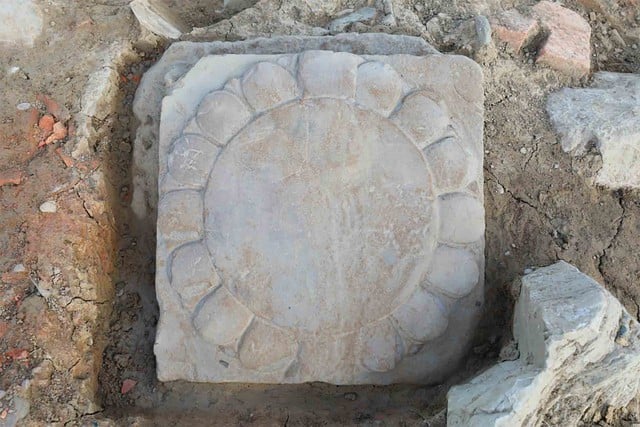
Foundation stones were discovered at the Ho Dynasty citadel. PHOTO: INSTITUTE OF ARCHAEOLOGY
The largest excavation, covering an area of 25,000 m² in 2021, yielded valuable insights into this stone citadel. Accordingly, many Trần-Hồ dynasty architectural structures were found in excavation pits in the central area (the King's Foundation). The traces of numerous gates and corridors surrounding the large structures in the north, connected to each other, suggest that the excavated area may have been the central space, the main hall of the Hồ citadel. Many researchers, such as Associate Professor Tống Trung Tín, Professor Phạm Mai Hùng, and Associate Professor Đặng Văn Bài (Vice Chairman of the National Heritage Council), have considered reconstructing the main hall of the Hồ citadel, along with displaying related artifacts. However, this will be a matter for many years to come, after the research is complete.
Telling stories from life and technology.
While the stone walls are largely unassuming, the Ho Dynasty citadel can tell stories through simulated depictions of the heritage site or narratives of life within the citadel. This requires the support of technology to create vivid images. "Short films and clips could be made to show the construction process of the Ho Dynasty citadel's stone walls. These might just be theoretical concepts, and many such videos would be needed, but it would help make history more easily visualized," shared a cultural tourism expert.
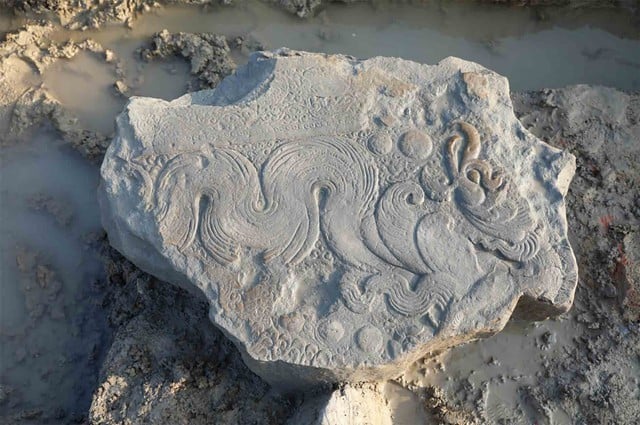
Royal imprints on architectural materials at Ho Dynasty Citadel. PHOTO: INSTITUTE OF ARCHAEOLOGY
Another approach could be to create videos depicting the process of making the artifacts found at Ho Citadel. Many terracotta and stone artifacts with dragon and phoenix motifs have been discovered at Ho Citadel, revealing aspects of royal life there. Although not entirely intact, recreating the remaining parts through animation is entirely feasible. This is also the approach taken by Thang Long Imperial Citadel with many archaeological artifacts.
The Ho Dynasty Citadel is also connected to other impressive attractions. For example, the ancient house of Mr. Pham Ngoc Tung's family, built with precious woods such as ironwood, rosewood, and teak, is intricately carved with the four mythical creatures and four auspicious symbols. Located only about 200 meters from the western gate of the citadel, it attracts many visitors and is considered one of the most representative traditional houses in Vietnam.
Currently, tours of the Ho Dynasty citadel offer products such as: a cultural space showcasing the agricultural practices of the Western Capital region, an exhibition space displaying models of cannons and reforms of the Ho Dynasty, and an exhibition space showcasing the stones used to build the citadel… The common feature of these products is the combination of the Ho Dynasty citadel heritage with surrounding areas to tell the story of a region. (to be continued)
Mr. Nguyen Ba Linh, Director of the Ho Dynasty Citadel Conservation Center (Thanh Hoa), acknowledged that compared to other World Heritage sites nationwide, the Ho Dynasty Citadel is "less attractive" to tourists. Mr. Linh cited that in 2023, the site only received 200,000 visitors, in 2024 250,000, and in the first six months of 2025 140,000. Mr. Linh added that recently, the Thanh Hoa Department of Culture, Sports and Tourism submitted a proposal to the Ministry of Culture, Sports and Tourism requesting permission to implement the largest project ever undertaken at the Ho Dynasty Citadel, with a total investment of over 745 billion VND, aimed at preserving the heritage and further enhancing its value for the tourism industry.
Specifically, the Thanh Hoa Department of Culture, Sports and Tourism has developed a project for the preservation, restoration, and enhancement of several structures within the inner citadel of Ho Dynasty Citadel, including: restoration and preservation of the Hoang Nguyen Palace foundation and the east-west foundations of Thai Mieu Temple; restoration and rehabilitation of the southern moat and Hoang Gia Road; waterproofing of the South Gate; landscape enhancement and construction of technical infrastructure within the heritage area. If approved by the relevant authorities, the project will be implemented in the period 2025-2028, aiming to both preserve the heritage and develop tourism and socio-economic development of Thanh Hoa province; and to soon make Ho Dynasty Citadel a key national and regional tourist destination.
Minh Hai
Source: https://thanhnien.vn/su-im-lang-cua-toa-thanh-nha-ho-185250905222737541.htm
![[Photo] Prime Minister Pham Minh Chinh holds a phone call with the CEO of Russia's Rosatom Corporation.](/_next/image?url=https%3A%2F%2Fvphoto.vietnam.vn%2Fthumb%2F1200x675%2Fvietnam%2Fresource%2FIMAGE%2F2025%2F12%2F11%2F1765464552365_dsc-5295-jpg.webp&w=3840&q=75)


![[Photo] Closing Ceremony of the 10th Session of the 15th National Assembly](/_next/image?url=https%3A%2F%2Fvphoto.vietnam.vn%2Fthumb%2F1200x675%2Fvietnam%2Fresource%2FIMAGE%2F2025%2F12%2F11%2F1765448959967_image-1437-jpg.webp&w=3840&q=75)







































![[OFFICIAL] MISA GROUP ANNOUNCES ITS PIONEERING BRAND POSITIONING IN BUILDING AGENTIC AI FOR BUSINESSES, HOUSEHOLDS, AND THE GOVERNMENT](https://vphoto.vietnam.vn/thumb/402x226/vietnam/resource/IMAGE/2025/12/11/1765444754256_agentic-ai_postfb-scaled.png)




































Comment (0)