

- Are you embroidering old patterns again? Nowadays, they all print patterns by machine; they're so much nicer and save time! If you embroider like the Chinese ones, it'll sell better. Who buys old patterns anymore, ma'am?
Mrs. May didn't answer, only tilted her head, threading the needle through the green thread—a color she had to boil from indigo leaves for three days and three nights, then dry in the sun for two days to get the exact mountain-green color her mother had taught her. But the scarves she embroidered didn't sell well because the traditional patterns were too complex, and the indigo color seemed no longer suitable for the market.
The wind picked up again. The embroidery thread trembled gently. Each thread stood out like a leaf vein, each fold resembling the shape of nameless border hills that everyone in the village remembered. She spoke softly, as if speaking to the thread:
- The new template can print flowers, but not scents.
Lành shook her head and walked away. The old woman, however, put the needle back into the fabric and continued embroidering the places that were no longer on the map but still lived on in her hands and in the hearts of the villagers.

That evening, after dinner, Mrs. May was still sitting by the stove embroidering. After washing the dishes, Lanh sat opposite her, the crackling fire between them. Lanh opened her phone to look at the picture of the scarf that Thuc had sent. She flipped through it, and the more she looked, the more she saw that it was exactly as Thuc had said: even, clear, beautiful, modern—who wouldn't like it? Lanh looked at Mrs. May's hands; each stitch trembled slightly, the indigo color was dark. She thought, how could this sell?
"Grandma, I'm telling you the truth, okay?" Lành hesitated.
- YES.
- How about we embroider it like the sample they ordered? They won't know who we are anyway. We'll just do it, and figure things out when we get paid.
Mrs. May looked up. For the first time that day, her eyes met her granddaughter's directly:
- It doesn't matter who you embroider it to. But if there's no difference anymore, then who are you embroidering for?
She fell silent. She thought back to the time her mother sent home some rolls of fabric, asking her to sell them at the market, but her mother refused. Her mother had said:
- Those scarves were embroidered by people for their wedding season. If I wear them, my ancestors will be lost.
Lành said:
- But nowadays people only buy what's beautiful. Nobody asks about what's right anymore, ma'am.
She didn't argue, only said softly:
- When she was little, every house had a loom. Each clan had its own way of winding the thread. You could tell who was embroidering by looking at the patterns. You could tell who was getting married by looking at the colors. Now, if she doesn't keep it, when you get married in the future, who will know which village your daughter-in-law is from?
That night, Lanh lay awake, unable to sleep. A nagging question ran through her mind: If she embroidered the scarf exactly like the sample ordered, she would sell it. But if someone asked whose design it was, how would she answer?
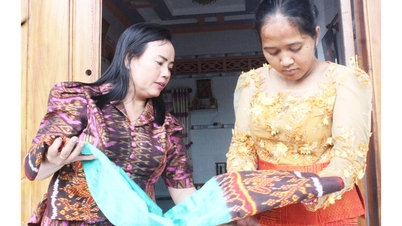
It had been raining for a whole week, the village soil had softened like soaked yeast. Lành took the opportunity to tidy up the attic, where Mrs. Mẩy still kept her unsold belongings. In the corner, between a pile of old fabrics and a broken embroidery frame, Lành saw a rolled-up piece of cloth, tied with string, without a label or name. She picked it up; dust flew off, and the smell of indigo mixed with kitchen smoke and something very strange, almost like the smell of slowly decaying plants. Lành unfolded it. On each side of the cloth were not embroidered flowers, but symbols, each pattern accompanied by a handwritten note in faded black ink: Three diagonal wings - the Lâm family; Horizontal bird's eye - people of Khe Vàng; Crooked corner - the Cò family. She flipped through the remaining pieces and realized that each piece represented a family lineage, a symbol. The last pattern had the inscription: no one remembers how to embroider it anymore. It left Lành speechless.
That evening, she brought the scroll of fabric downstairs. Mrs. May looked at it, her embroidery stopped, her eyes weren't wide open, but her gaze shone with an unusual brightness:
- The fact that Lanh still remembers how to untie this cloth means this family has preserved its roots.
Lành asked:
Why did you never tell me?
She smiled:
- Because my grandmother used to say, "You said those patterns were outdated." Each embroidery pattern in that book wasn't for sale, but for embroidering onto wedding dresses, so that when she left the village, looking at the hem of her dress, everyone would know which village she was from and what her surname was.
Lành picked up the roll of fabric again, and for the first time, she felt her hands tremble not because it was difficult, but because she was afraid of making a mistake. Outside, the rain had stopped, but the cold wind had returned. The young woman sat by the stove, holding an embroidery frame, taking a colored thread, gently poking it at the edge of the cloth, and whispering:
Grandma, please teach me how to embroider starting from the last pattern. I want to keep something that no printing machine can replicate.
At the end of the month, the wind was dry and harsh, and the village of Nặm Cát was as quiet as an old fold nestled in the mountains. That day, a delegation from the Department of Culture came to survey ancient embroidery patterns in the border region. A seven-seater car stopped in the village courtyard. People stepped out wearing white shirts, carrying large cameras and shiny black briefcases. Everyone spoke with the unfamiliar accent of people from the lowlands. The village didn't have a lavish reception. Only Mrs. Mẩy sat in the kitchen, still holding a handkerchief, her eyes looking down. Lành led them inside. A young female official approached and presented a collection of photographs:
- Do you recognize this pattern, ma'am? We're looking for the phoenix eye pattern that used to appear on wedding dresses in our ethnic minority community.
Mrs. May looked up, not at the photo, but pulled out an old pillowcase from the basket. The fabric was faded to a grayish color, with a bird's eye embroidered in the corner with thread dyed with forest leaves. The whole group gathered around. The oldest man exclaimed:
That's right! This design was once recorded in a sketchbook, but the original copy has been lost. How did you manage to keep it?
She spoke softly:
- My mother left this to me. She instructed that this pattern should only be embroidered for a daughter who marries and moves far away.
Lành stood nearby, noticing for the first time how people looked at her with such admiration. It wasn't because of her business dealings or because she'd fulfilled orders correctly, but because she possessed something no one else had. A young officer asked to take a picture. Lành told her to let her embroider it as a sample for a reconstruction. She nodded and added:
- The design can be photographed, but the embroiderer needs to be able to hear the thread passing through their skin. If they can't hear it, the stitches are incorrect. If they're incorrect, the plants, flowers, and birds won't survive.
That's what she said, but Lành didn't fully understand, and perhaps even those in relationships don't understand it either.
That afternoon, the whole group left the village with a photo of the scarf. Meanwhile, Mrs. May still sat in the fading twilight, her loom tilted, a strand of indigo thread draped over her knees. Lanh took out her phone and deleted the "hot trend patterns" folder. Then, quietly, she opened an old fabric roll, took out the bird's eye pattern, and began embroidering again.
After the survey team arrived, there was no ceremony of commendation, no one was featured in the newspaper, only a request sent to the commune, proposing the preservation of some patterns along with a photograph of Mrs. May's scarf. Lanh didn't mention it again. She borrowed Mrs. May's old wooden frame and set it up on the drying rack. Every afternoon, she called the children in the village, all girls, some of whom didn't even know how to hold a needle, to sit and learn. Initially, there were only three, but after a month, there were eight. She didn't teach embroidery patterns, only how to thread the needle through the fabric without missing a beat. Each child was given a strand of indigo thread and asked: "Does anyone in your family embroider? Do you remember where your grandmother kept the scarf pattern?" Some couldn't remember, some ran home to ask their grandmother, and the next day brought back a torn-edged pillow pattern. Some sat and listened all afternoon, not embroidering anything, only silently repeating a family name embroidered on old clothes. Mrs. May sat inside the house, watching, without interfering.
At the end of the year, the fog was so thick that you couldn't see the footprints of people passing by in the yard. Mrs. May sat in the kitchen, threading the needle one last time through the cloth. The thread was old, the needle worn. She stopped the last stitch at the edge of the fabric, without fastening or cutting. She said to herself:
- So that future generations can continue the legacy!
Source: https://baolangson.vn/soi-chi-theu-cu-truyen-ngan-5065829.html
















































































Comment (0)