

The craft of making Dong Ho folk paintings ( Bac Ninh ) has just been recognized by UNESCO as an Intangible Cultural Heritage in need of urgent protection.
UNESCO's inscription of Dong Ho folk painting on the List of Intangible Cultural Heritage in Need of Urgent Safeguarding affirms the unique historical and artistic value of the craft, while also creating motivation for artisans to continue preserving the skills and secrets of this traditional craft, which is facing the risk of disappearing.
According to Meritorious Artisan Nguyen Dang Che, the craft of making Dong Ho folk paintings has existed for a long time. The genealogy of the Nguyen Dang family in Dong Ho village records that since the 16th century, there was a craft of making paintings and it flourished in the 40s of the 20th century.
After 1945, the craft of making Dong Ho folk paintings was in danger of disappearing, with no one coming to buy the paintings. Therefore, families switched to making votive offerings. Currently, Dong Ho village has only two families making paintings: Nguyen Huu and Nguyen Dang, with three dedicated families still sticking with the craft.
Dong Ho paintings are a unique style, deeply rooted in traditional culture, featuring cheerful, innocent images and embodying dreams of a prosperous and happy life. These paintings depict the age-old aspirations of working people for a harmonious, prosperous, and happy family life, and a just and good society.
With its own unique features and imbued with great cultural values, Dong Ho paintings, with their rustic and familiar symbolic images, contain hidden messages full of humanity.
Rich in design, style, and themes, Dong Ho folk paintings reflect almost everything that happens in the simple life of working people, such as herding buffalo and playing the flute, collecting coconuts, wrestling, and jealousy, as well as dreams and aspirations for a better life, such as etiquette, righteousness, glory, wealth, herds of pigs, and flocks of chickens.
The appeal of Dong Ho folk paintings is not only about life: full granaries of rice, full yards of chickens, wishes for wealth and honor... but also about the life of couples and spouses with a humorous yet profound perspective.
About materials and colors
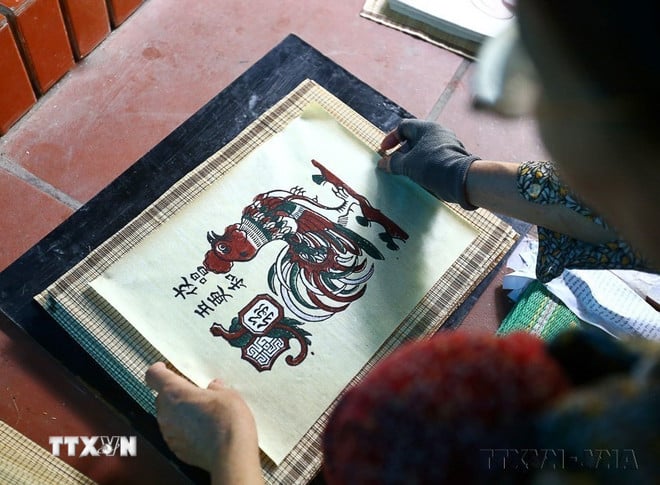
After printing, Dong Ho paintings are removed from the printing plates, glued onto bamboo trays, and then dried in well-ventilated areas. Only when the paintings are dry are the other colors printed. The black outlines are always printed last. (Photo: Minh Quyet/TTXVN)
The first unique feature that attracts the viewer's senses of the painting is the color and the material of the printing paper. The paper used to print the painting is Do paper, made from the bark of the Do tree, with the characteristics of being porous, soft, thin, tough, easy to absorb color without smudging when printed.
A layer of pearlescent paper is applied to the paper, which has a very unique shiny shine. People crush scallop shells (a type of thin-shelled seashell) and mix them with glue (rice flour, or sticky rice flour, sometimes tapioca flour), then use a pine needle broom to apply it to the surface of the Do paper.
Using pine needle brushes creates lines that follow the sweeping motion, and natural seashells provide a shimmering white color from the small seashell fragments under the light. Other colors can be added to the paste during the process of making seashell paper. The colors used in the paintings are natural colors from plants and herbs, such as black from the charcoal of the neem tree or bamboo leaves, green from copper rust or indigo leaves, yellow from pagoda tree flowers, red from cinnabar, and redwood, etc. These are basic, unmixed colors.
Regarding genre
Based on subject matter, Dong Ho paintings can be divided into seven main categories: devotional paintings, celebratory paintings, historical paintings, narrative paintings, proverbial paintings, landscape paintings, and paintings reflecting daily life.
About the production process
Painting has many stages, of which there are 2 main stages: creating the model (engraving the wood) and printing (painting). Here we can see that each artisan is required to have more or less innate talent as well as high labor skills.
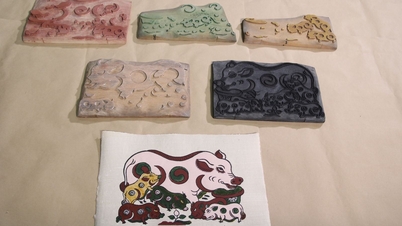
There are two types of woodblocks for printing: line-printing boards and color-printing boards. Line-printing boards are made from wood or ink-rope wood. The tools used to carve the boards are chisels or sets of steel (about 30-40 pieces/set).
Ho village artisans create the painting designs by hand and use printing blocks for other steps.
About artistic value
Dong Ho folk paintings are symbolic and decorative but still retain a rustic, easy-to-understand character, very close to the lives of people in the Northern Delta.
About the content
Dong Ho folk paintings deeply reflect the spiritual and material life of people and society according to the folk aesthetic perspective of the people of this region. These paintings express the age-old dreams of working people for a harmonious, prosperous, and happy family life and a just and good society.
Meaning of some Dong Ho folk paintings:
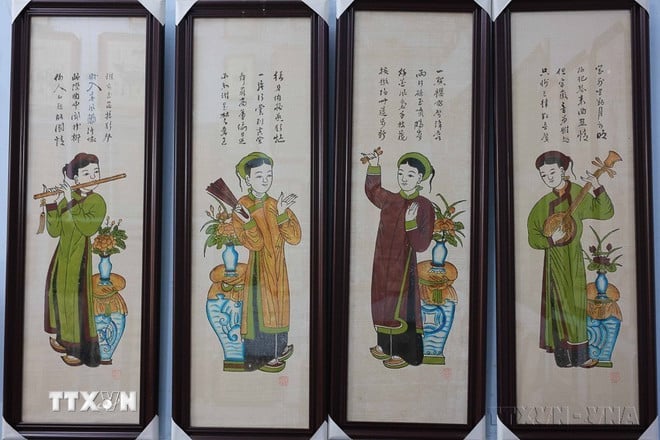
Dong Ho folk paintings are divided into many categories: devotional paintings, celebratory paintings, historical paintings, narrative paintings, proverbial paintings, landscape paintings, and paintings reflecting daily life (2025). (Photo: Hoang Hieu/TTXVN)
Mother hen and her chicks painting : talks about maternal love, love, and care between family members, and the responsibility of parents to their children.
The painting of Yin and Yang Pigs : closely associated with everyday life, expressing the desire for a prosperous and peaceful life. This reflects the depth of the feeling of love and protection of a mother's love for her child.
Rooster and Rose Painting : Rooster is an animal representing 5 good qualities: literature, martial arts, bravery, humanity, and trust. The painting implies bringing good luck and longevity to the new year.
The painting "Carp watching the moon" implies the spirit of overcoming difficulties, the will to rise up, striving in studying and success.
Vinh Hoa painting: brings to the new year the wish of success with all the gentlemanly virtues: humanity, justice, trust, bravery and both literature and martial arts for the men in the family.
Phu Quy painting: with the image of a little girl holding a duck brings wishes for graceful, gentle, and pure qualities.
Painting of a cowherd playing the flute: shows the peace and happiness in the poor, miserable life of a cowherd.
Toad Teacher Painting: Praising the studiousness and respect for teachers of the Vietnamese people.
Tranh Tre sue each other: a tragicomedy about the ignorance and stupidity of the common people and reflects the corrupt habits of mandarins in the old regime.
The painting depicting "Vinh Quy Bai To" (Returning Home in Glory to Pay Respect to Ancestors): "Vinh Quy Bai To" is not only an honor for the newly graduated scholar, his parents, relatives, and villagers, but also an opportunity for the scholar to express gratitude to his ancestors, parents, and teachers, in accordance with the Vietnamese moral principle of "The merits of the father, the kindness of the mother, and the gratitude to the teacher." This is a very valuable and cherished cultural tradition.
Wrestling painting: extols the spirit of chivalry. Wrestling is a traditional Vietnamese martial art that originated with the nation's founding and has been closely associated with national defense and spring festivals. This is a famous painting from Dong Ho village.
The "Jealousy Confrontation" painting is a witty yet highly educational piece depicting everyday life. It portrays a wife with her skirt rolled up, wielding scissors to cut the mistress's hair. The husband, caught red-handed, keeps one hand on his mistress's chest to protect her while using the other to try and appease his wife. A child is shown with clasped hands, pleading for forgiveness for their parents' behavior.
The painting serves as a warning that parents' actions deeply affect children's minds, significantly impacting their character development later in life. The painting carries profound humanistic meaning.
The painting "The Mouse Wedding" (Mouse's Triumphal Return): vividly portrays the pure, simple, and honest spirit and character of ordinary people, while also being rich in folk philosophy and possessing profound, subtle humanistic values. The mouse wedding, outwardly a joyous occasion, must include offerings to the cat. The painting portrays the charming beauty of feudal society through the witty and insightful imagery of animals.
Besides the Dong Ho folk paintings depicting everyday life with simple yet meaningful themes, there are also more esteemed paintings of the four seasons, representing luxury and nobility, which were only used by kings, emperors, and officials in the past.
For example, "Four seasons, Four vases, Four seasons cranes, Four seasons beautiful women" ... have a strong royal quality because of the images symbolizing luxury, nobility, and wishes for everything to go as planned in the new year./.
(Vietnam+)
Source: https://www.vietnamplus.vn/tim-hieu-net-doc-dao-cua-tranh-dong-ho-di-san-van-hoa-can-bao-ve-khan-cap-post1082132.vnp


![[Photo] Prime Minister Pham Minh Chinh holds a phone call with the CEO of Russia's Rosatom Corporation.](/_next/image?url=https%3A%2F%2Fvphoto.vietnam.vn%2Fthumb%2F1200x675%2Fvietnam%2Fresource%2FIMAGE%2F2025%2F12%2F11%2F1765464552365_dsc-5295-jpg.webp&w=3840&q=75)

![[Photo] Closing Ceremony of the 10th Session of the 15th National Assembly](/_next/image?url=https%3A%2F%2Fvphoto.vietnam.vn%2Fthumb%2F1200x675%2Fvietnam%2Fresource%2FIMAGE%2F2025%2F12%2F11%2F1765448959967_image-1437-jpg.webp&w=3840&q=75)




































![[OFFICIAL] MISA GROUP ANNOUNCES ITS PIONEERING BRAND POSITIONING IN BUILDING AGENTIC AI FOR BUSINESSES, HOUSEHOLDS, AND THE GOVERNMENT](https://vphoto.vietnam.vn/thumb/402x226/vietnam/resource/IMAGE/2025/12/11/1765444754256_agentic-ai_postfb-scaled.png)






































Comment (0)