

Immediately after UNESCO announced the voting results, a reporter from Bac Ninh Newspaper conducted a quick interview with Mr. Mai Son, Member of the Standing Committee of the Provincial Party Committee, Permanent Vice Chairman of the Provincial People's Committee, and Head of the Bac Ninh Provincial Delegation attending the UNESCO session in New Delhi (India). The general feeling was one of emotion and pride that the Dong Ho folk painting craft – a unique heritage of the homeland – has been recognized internationally.
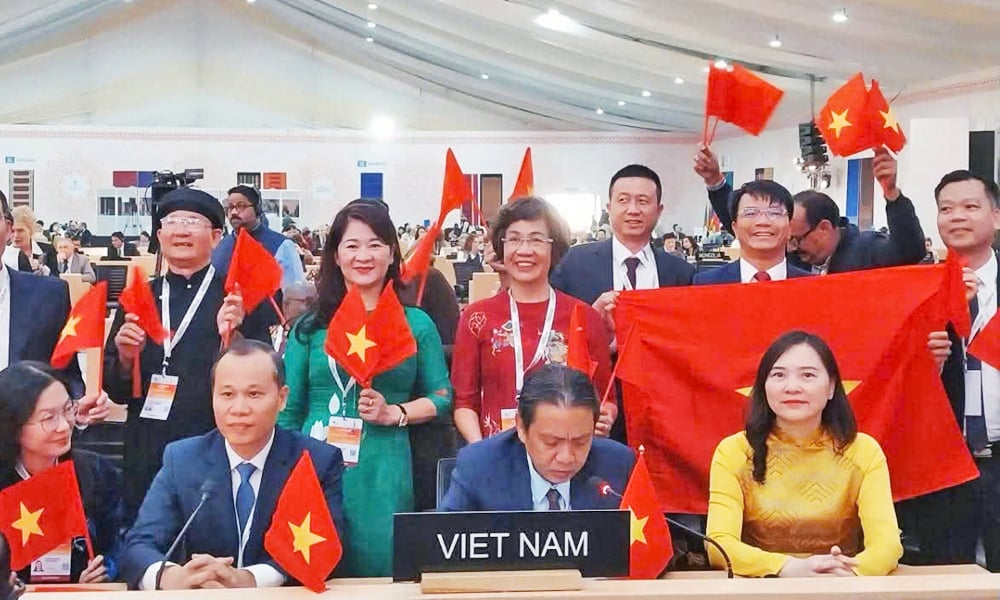 |
Comrade Mai Son (front row, second from left) attended the 20th session of the Intergovernmental Committee of the 2003 Convention in India. |
- Comrade, what are your feelings and thoughts right now that the Dong Ho folk painting craft has just been inscribed by UNESCO as an Intangible Cultural Heritage in need of urgent safeguarding?
- Right now, my greatest emotion is pride that the unique heritage of my hometown, Bac Ninh, has been recognized by the international community; at the same time, I also recognize the responsibility that UNESCO has placed its trust in us to protect a heritage that is in need of urgent assistance.
For me personally, as well as for the members of the delegation and cultural workers of the province, the event of Dong Ho folk painting being inscribed by UNESCO on the list of Intangible Cultural Heritage in need of urgent safeguarding is a source of great emotion and pride. This is the result of many years of persistent efforts by the provincial Party committee, government, specialized agencies, experts, researchers, and especially the community of artisans in the painting village - those who have kept the flame of this heritage alive during the most difficult times.
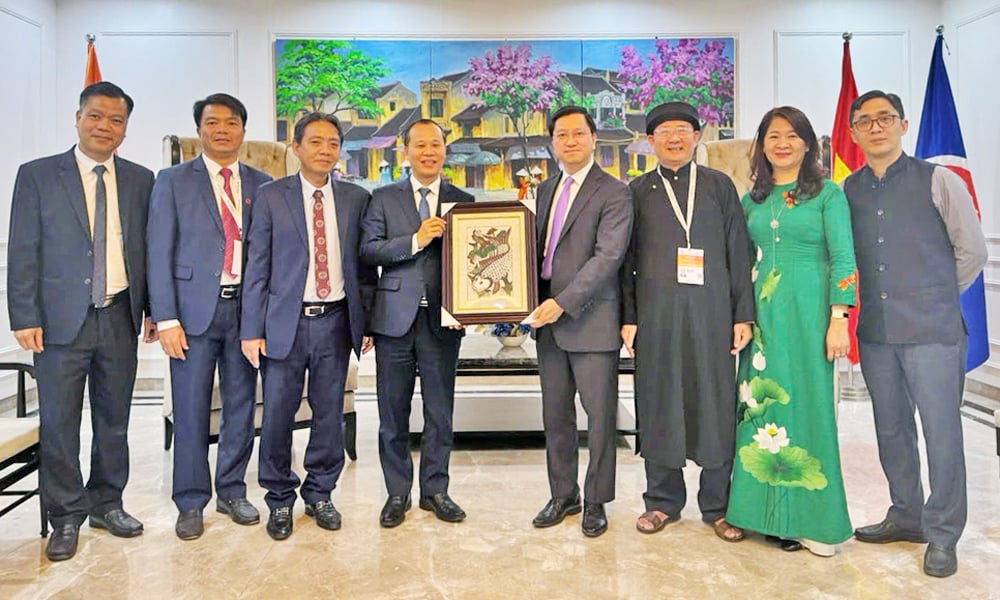 |
Comrade Mai Son and the delegation respectfully presented Dong Ho paintings to the Vietnamese Ambassador to India. |
- What significance does the UNESCO recognition bring to the heritage, especially to the artisan community, craft villages and the current cultural and economic development of Bac Ninh province?
- First and foremost, the recognition affirms the outstanding global value of Dong Ho painting, not only in terms of art, but also in terms of folk knowledge, cultural identity, and the humanistic message that this heritage conveys.
Secondly, UNESCO's recognition came at a time when the art of painting was facing many challenges: a shortage of successor artisans, a shrinking market, and the village's space being heavily impacted by urbanization. Therefore, this recognition serves as both a catalyst and a warning, helping to mobilize strong attention from the State, the community, and the international community to preserve the heritage in a more urgent, systematic, and sustainable way.
More importantly, this is an opportunity for us to preserve and develop the painting profession in association with tourism development, creative economy, creating livelihoods for people and spreading more widely the quintessence of Vietnamese culture.
- During the appraisal process, how did UNESCO members evaluate the Dossier of Vietnam's Dong Ho Folk Painting Craft and what outstanding values were recognized, sir?
- Members of the UNESCO Intergovernmental Committee for the Protection of Intangible Cultural Heritage highly appreciated the information in the dossier, the thorough preparation, and the fulfillment of the criteria for inscription on the List of Intangible Cultural Heritage in Need of Urgent Safeguarding.
International delegates also noted that the Dong Ho folk painting heritage has been closely associated with the lives of Vietnamese people for hundreds of years, especially during the Lunar New Year, Mid-Autumn Festival as well as ancestor worship and god worship ceremonies. The themes of the paintings are related to traditional customs, history, daily life, landscapes... The international community also highly appreciates the value and uniqueness of Dong Ho paintings when knowing that the entire process of making paintings is done by hand, from sketching on paper to wood carving, printing each color. In particular, the raw materials, materials, and colors are completely taken from nature such as grass, trees, flowers, scallops, red pebbles...
The dossier also shows that the number of artisans committed to the craft is decreasing, thus requiring urgent protection. The proposed plan and goals for heritage conservation are also feasible, in line with international recommendations to put the community at the center.
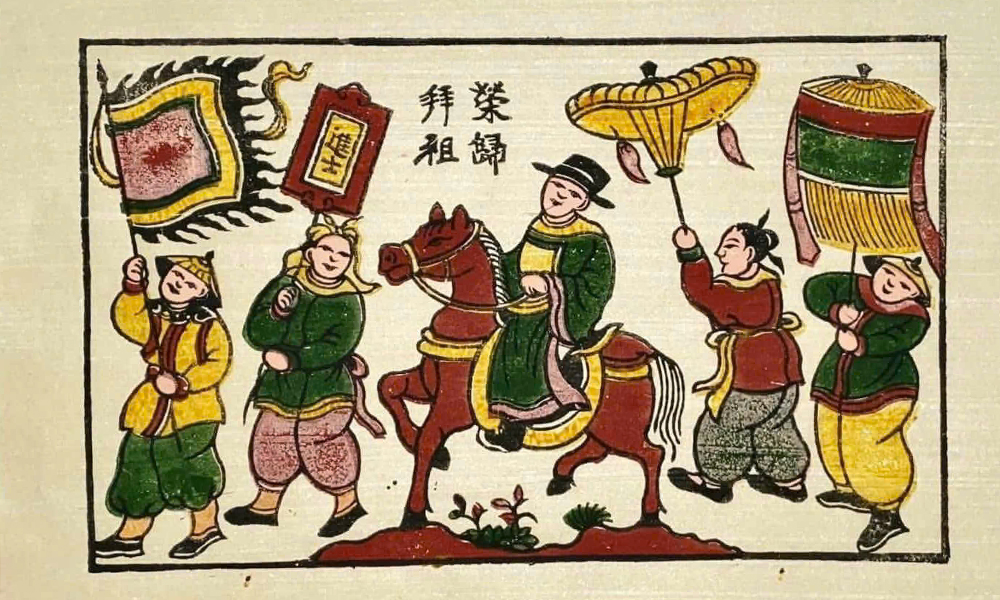 |
The work "Vinh Quy Bai To" (Returning Home in Glory to Pay Respect to Ancestors). |
- Could you please tell us about the process of Bac Ninh province coordinating to build and complete the nomination dossier in the past time, especially the difficulties and efforts to overcome to fully meet the strict criteria of UNESCO?
- The process of building the dossier on Dong Ho folk painting to submit to UNESCO was a long one, spanning many years, with the responsible involvement of Bac Ninh province, the Ministry of Culture, Sports and Tourism, experts, and especially the community of artisans in the painting village.
In terms of advantages, Dong Ho painting is a heritage of outstanding value, continuously preserved by the community through many generations, so the documents, engravings, painting samples and craft stories are still quite rich. Moreover, Bac Ninh province always pays attention and closely directs the Department of Culture, Sports and Tourism in proactively coordinating with research institutes, universities and leading experts to build the dossier, strictly following UNESCO standards. In particular, the artisan community actively participates, provides documents and accompanies in every step of the dossier building.
However, the nomination process also faced considerable difficulties. Because the heritage is in a state of decline, compiling a list of artisans, inventorying woodblocks, and restoring traditional techniques requires a great deal of time and effort. Furthermore, the context of rapid urbanization makes proving the continuity of the craft's practice space a challenge.
Furthermore, UNESCO has stringent requirements for documentation, ranging from scientific evidence and video evidence to short-term and long-term action plans, necessitating meticulous preparation and close coordination among numerous agencies and organizations. Despite the challenges, this journey has helped us gain a deeper understanding of the heritage's value and strengthened our resolve to sustainably protect Dong Ho folk painting.
 |
Meritorious Artisan Nguyen Dang Che guides tourists in printing Dong Ho paintings. |
- After the heritage is registered, how will the province direct the implementation of the action program to protect and promote the value of Dong Ho folk painting in the new situation?
- Immediately after the heritage site was inscribed by UNESCO, Bac Ninh province implemented the Action Program for the Emergency Protection of Dong Ho Folk Painting Craft in accordance with international commitments.
First, the province will direct specialized agencies and local authorities to coordinate with relevant units to strengthen the workforce of artisans, open classes to pass on knowledge and train the next generation, ensuring that the craft has people to continue it for a long time.
Secondly, the directive focuses on preserving the spaces for traditional crafts, such as reviving some households practicing traditional crafts, building exhibition areas for creative works, improving the environment of craft villages, and linking preservation with cultural tourism activities.
Third, direct the Department of Culture, Sports and Tourism to coordinate with consulting units to inventory and digitize to preserve the system of engravings and related documents, forming a data bank to serve research, education and creativity.
Fourth, strengthen international cooperation to research and learn good and effective models from countries around the world in preserving, promoting the value and promoting Dong Ho folk painting heritage internationally.
Furthermore, it is essential to strengthen communication, develop diverse experiential products, and connect with markets to ensure sustainable livelihoods for those involved in the craft. Most importantly, all activities will be implemented based on the principle that the community is the main stakeholder, and the management agency is the supporting unit, aiming to ensure that the heritage is preserved in its true value and to promote sustainable development.
- How do you evaluate the role of the community, especially the young generation, in preserving and spreading heritage? What is the province's orientation to encourage people's participation?
- As I just stated, the community is the main creator, custodian, and disseminator of heritage values; therefore, all conservation policies must place the people at the center. During the UNESCO nomination process, the local community, from the elders and artisan families to the residents of Dong Khe neighborhood, actively participated in providing documentation, sharing techniques, discussing difficulties, and proposing solutions for preserving the Dong Ho folk painting craft. This is clear evidence of the community's collective effort and unity in preserving the heritage.
The province will direct the implementation of many synchronous solutions to facilitate the community's participation in heritage conservation such as: Restoring the Tet painting market, recreating the traditional cultural space; promoting on the media, spreading the value and applicability of Dong Ho paintings in contemporary life; creating conditions for artisans to participate in exhibitions and cultural and tourism events at home and abroad; ensuring natural raw materials, supporting artisans to buy scallop shells, expanding the market, promoting display, promotion and consumption of products; encouraging innovation, diversifying designs associated with new tastes...
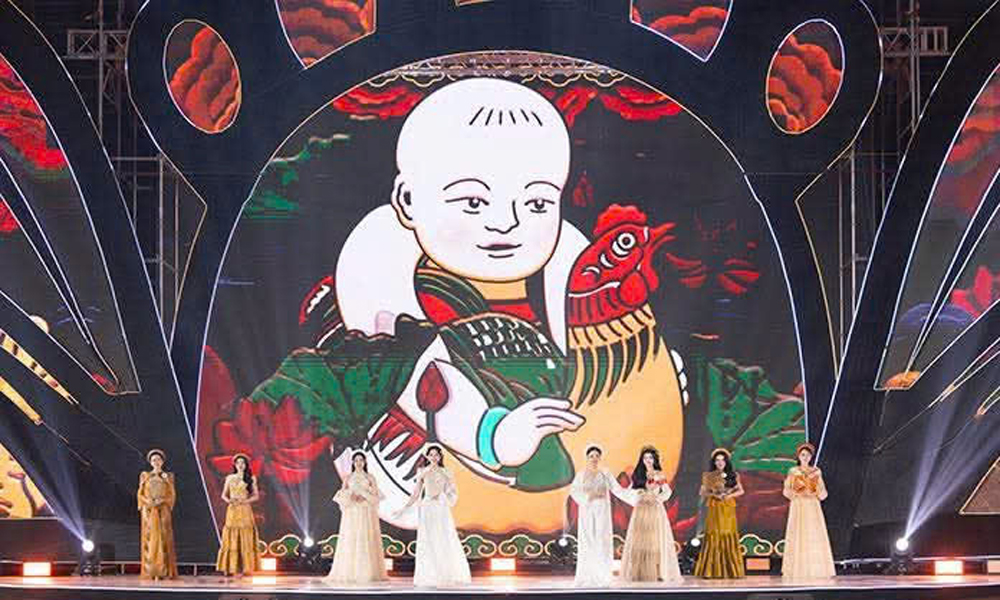 |
Dong Ho paintings are used in stage design. |
Identifying the important role of the young generation because they are the next generation to work in the profession, we will strengthen heritage education in schools and organize experiential activities and extracurricular learning for students in Dong Ho painting village; research and promulgate mechanisms and policies to encourage young people to participate in creating, designing new product models, applying paintings to cultural and tourism products...
When people truly become the subject, when the young generation is aware of their responsibility towards the heritage, Dong Ho folk paintings will be protected for a long time and have sustainable vitality in contemporary life.
Thank you very much for your insightful and up-to-date sharing!
Source: https://baobacninhtv.vn/vice-chancellor-president-of-the-board-tinh-mai-son-expressed-proud-ness-when-he-died-on-his-own-homeland-recognized-by-international-recognition-postid432848.bbg


![[Photo] Prime Minister Pham Minh Chinh holds a phone call with the CEO of Russia's Rosatom Corporation.](/_next/image?url=https%3A%2F%2Fvphoto.vietnam.vn%2Fthumb%2F1200x675%2Fvietnam%2Fresource%2FIMAGE%2F2025%2F12%2F11%2F1765464552365_dsc-5295-jpg.webp&w=3840&q=75)























































Comment (0)